

9.2.3 Solar Thermal Power Generation
Solar thermal power generation is a technology for harnessing solar thermal energy
to generate electricity. Its energy conversion efficiency is given in the following
equation:
η ¼ η sc Á η pgc
ð9:7Þ
where η sc [À] is the efficiency of the solar collector, which is given in the following
equation:
η sc ¼ η 0 À a 1 Á
t sc À t 0
ð
Þ
G
À a 2 Á
t sc À t 0
G
2
ð9:8Þ
where η 0 [À] is zero-loss efficiency, a 1 [W/(m
2
ÁK)] is the linear heat loss coefficient,
a 2 [W/(m
2
ÁK
2 )] is the quadratic heat loss coefficient, G [W/m
2 ] is solar irradiance, t sc
[
C] is mean solar collector temperature, and t 0 [
C] is ambient temperature.
The efficiency of the power generation cycle in KCS-11 (Sun et al. 2012a,
2013a, b) is given by η pgc , which is a more efficient technology for converting low
to mid temperature heat sources into electricity:
η pgc ¼ 0:64ΔP
3
À 4:90ΔP
2
þ 14:67ΔP þ 0:22
ð9:9Þ
where ΔP [MPa] is the pressure difference of the evaporator and condenser and has
an effective range of 2.5 MPa.
Then, electricity generation is given in the following equation:
P out ¼ P in  η
ð9:10Þ
where P in is the solar thermal energy input for electricity generation and the potential
supply of solar thermal power generation is defined by the following equation:
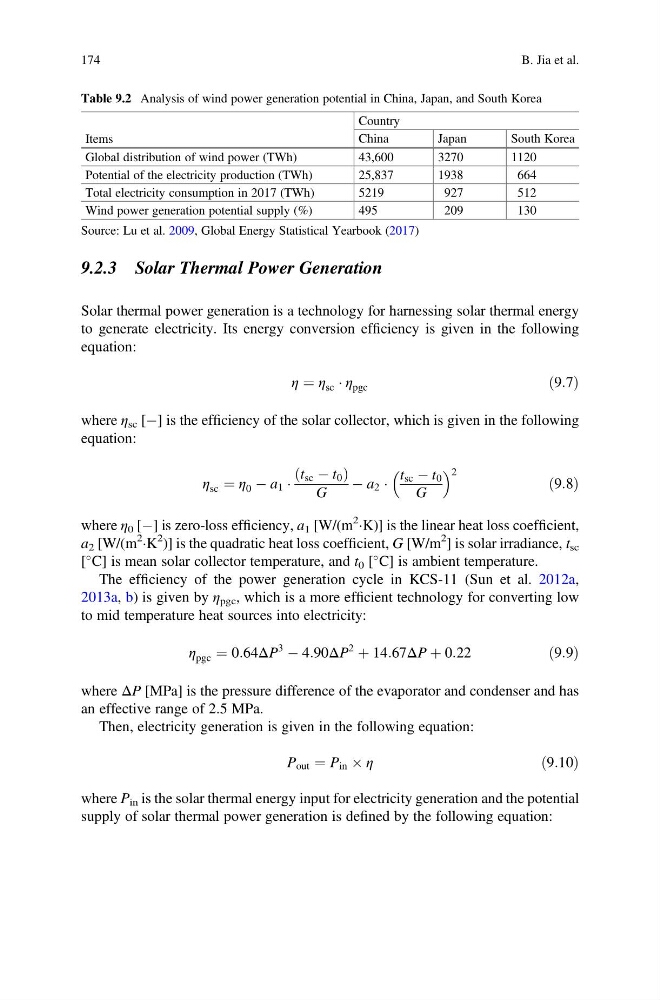
Table 9.2 Analysis of wind power generation potential in China, Japan, and South Korea
Items
Country
China
Japan
South Korea
Global distribution of wind power (TWh)
43,600
3270
1120
Potential of the electricity production (TWh)
25,837
1938
664
Total electricity consumption in 2017 (TWh)
5219
927
512
Wind power generation potential supply (%)
495
209
130
Source: Lu et al. 2009, Global Energy Statistical Yearbook (2017)
174
B. Jia et al.
Solar thermal power generation is a technology for harnessing solar thermal energy
to generate electricity. Its energy conversion efficiency is given in the following
equation:
η ¼ η sc Á η pgc
ð9:7Þ
where η sc [À] is the efficiency of the solar collector, which is given in the following
equation:
η sc ¼ η 0 À a 1 Á
t sc À t 0
ð
Þ
G
À a 2 Á
t sc À t 0
G
2
ð9:8Þ
where η 0 [À] is zero-loss efficiency, a 1 [W/(m
2
ÁK)] is the linear heat loss coefficient,
a 2 [W/(m
2
ÁK
2 )] is the quadratic heat loss coefficient, G [W/m
2 ] is solar irradiance, t sc
[
C] is mean solar collector temperature, and t 0 [
C] is ambient temperature.
The efficiency of the power generation cycle in KCS-11 (Sun et al. 2012a,
2013a, b) is given by η pgc , which is a more efficient technology for converting low
to mid temperature heat sources into electricity:
η pgc ¼ 0:64ΔP
3
À 4:90ΔP
2
þ 14:67ΔP þ 0:22
ð9:9Þ
where ΔP [MPa] is the pressure difference of the evaporator and condenser and has
an effective range of 2.5 MPa.
Then, electricity generation is given in the following equation:
P out ¼ P in  η
ð9:10Þ
where P in is the solar thermal energy input for electricity generation and the potential
supply of solar thermal power generation is defined by the following equation:
Table 9.2 Analysis of wind power generation potential in China, Japan, and South Korea
Items
Country
China
Japan
South Korea
Global distribution of wind power (TWh)
43,600
3270
1120
Potential of the electricity production (TWh)
25,837
1938
664
Total electricity consumption in 2017 (TWh)
5219
927
512
Wind power generation potential supply (%)
495
209
130
Source: Lu et al. 2009, Global Energy Statistical Yearbook (2017)
174
B. Jia et al.