

In this chapter, some potential low-carbon technologies for power generation are
introduced in detail, which are considered as potential ones for East Asian
Low-Carbon Community to realize a sustainable decarbonized society.
9.2 Low-Carbon Technologies for Power Generation
The current status, basic principles, analysis of potential, and technology integration
of some potential low-carbon technologies are described below.
9.2.1 Solar Cells
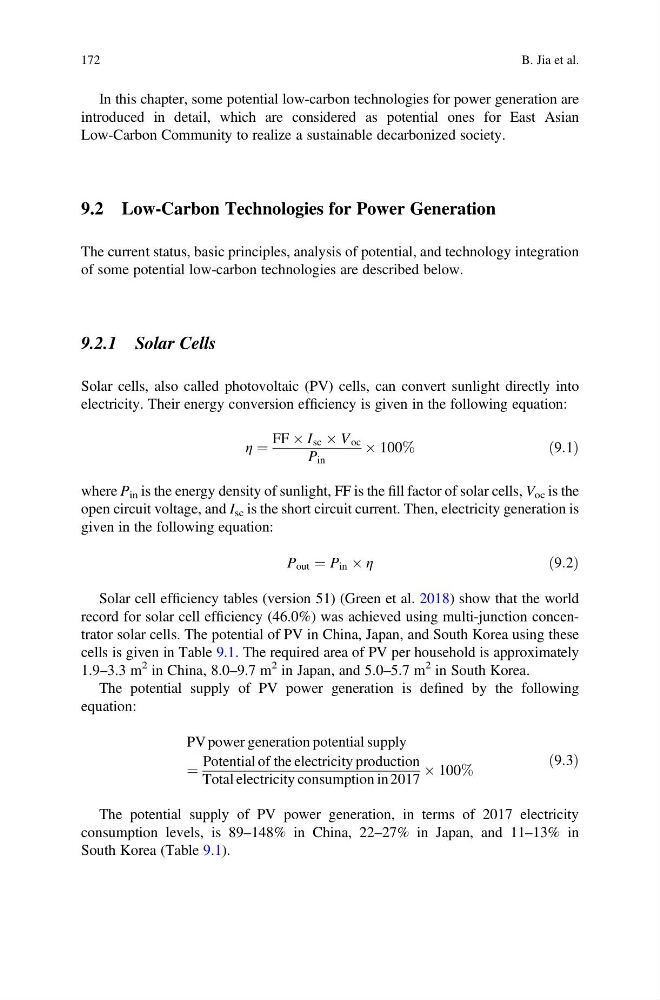
Solar cells, also called photovoltaic (PV) cells, can convert sunlight directly into
electricity. Their energy conversion efficiency is given in the following equation:
η ¼
FF  I sc  V oc
P in
 100%
ð9:1Þ
where P in is the energy density of sunlight, FF is the fill factor of solar cells, V oc is the
open circuit voltage, and I sc is the short circuit current. Then, electricity generation is
given in the following equation:
P out ¼ P in  η
ð9:2Þ
Solar cell efficiency tables (version 51) (Green et al. 2018) show that the world
record for solar cell efficiency (46.0%) was achieved using multi-junction concentrator solar cells. The potential of PV in China, Japan, and South Korea using these
cells is given in Table 9.1. The required area of PV per household is approximately
1.9–3.3 m
2 in China, 8.0–9.7 m
2 in Japan, and 5.0–5.7 m
2 in South Korea.
The potential supply of PV power generation is defined by the following
equation:
PV power generation potential supply
¼
Potential of the electricity production
Total electricity consumption in 2017
 100%
ð9:3Þ
The potential supply of PV power generation, in terms of 2017 electricity
consumption levels, is 89–148% in China, 22–27% in Japan, and 11–13% in
South Korea (Table 9.1).
172
B. Jia et al.
introduced in detail, which are considered as potential ones for East Asian
Low-Carbon Community to realize a sustainable decarbonized society.
9.2 Low-Carbon Technologies for Power Generation
The current status, basic principles, analysis of potential, and technology integration
of some potential low-carbon technologies are described below.
9.2.1 Solar Cells
Solar cells, also called photovoltaic (PV) cells, can convert sunlight directly into
electricity. Their energy conversion efficiency is given in the following equation:
η ¼
FF  I sc  V oc
P in
 100%
ð9:1Þ
where P in is the energy density of sunlight, FF is the fill factor of solar cells, V oc is the
open circuit voltage, and I sc is the short circuit current. Then, electricity generation is
given in the following equation:
P out ¼ P in  η
ð9:2Þ
Solar cell efficiency tables (version 51) (Green et al. 2018) show that the world
record for solar cell efficiency (46.0%) was achieved using multi-junction concentrator solar cells. The potential of PV in China, Japan, and South Korea using these
cells is given in Table 9.1. The required area of PV per household is approximately
1.9–3.3 m
2 in China, 8.0–9.7 m
2 in Japan, and 5.0–5.7 m
2 in South Korea.
The potential supply of PV power generation is defined by the following
equation:
PV power generation potential supply
¼
Potential of the electricity production
Total electricity consumption in 2017
 100%
ð9:3Þ
The potential supply of PV power generation, in terms of 2017 electricity
consumption levels, is 89–148% in China, 22–27% in Japan, and 11–13% in
South Korea (Table 9.1).
172
B. Jia et al.