

Easy model expression
LINGO can reduce user development time by allowing the user to formulate
linear, nonlinear, and integer problems quickly in a highly readable form. The
modeling language of LINGO allows the user to express models in a straightforward, intuitive manner using summations and subscripted variables, much like
approaching the problem with pencil and paper. Models are easier to build, easier
to understand, and, therefore, easier to maintain.
Convenient data options
LINGO makes data management easier by allowing the user to build models
that pull information directly from databases and spreadsheets. Similarly, LINGO
can output solution information directly into a database or spreadsheet, making it
easier for the user to generate reports in their application of choice.
Powerful solvers
LINGO has a comprehensive set of fast, built-in solvers for linear, nonlinear
(convex and non-convex), quadratic, quadratically constrained, and integer optimization. The user is not required to specify or load a separate solver; LINGO
reads the formulation and automatically selects an appropriate solver.
Model interactively or through creation of turn-key applications
The user can build and solve models within LINGO, or LINGO can be called
directly from an application written by the user. For developing models interactively, LINGO provides a complete modeling environment to build, solve, and
analyze models. For turn-key solutions, LINGO comes with callable DLL and
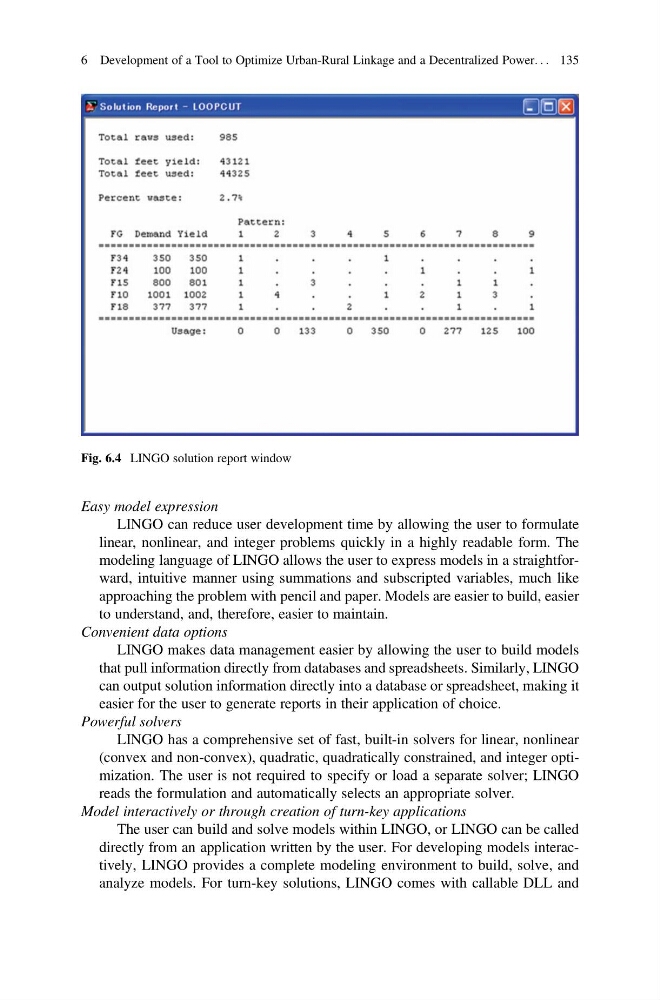
Fig. 6.4 LINGO solution report window
6 Development of a Tool to Optimize Urban-Rural Linkage and a Decentralized Power. . . 135
LINGO can reduce user development time by allowing the user to formulate
linear, nonlinear, and integer problems quickly in a highly readable form. The
modeling language of LINGO allows the user to express models in a straightforward, intuitive manner using summations and subscripted variables, much like
approaching the problem with pencil and paper. Models are easier to build, easier
to understand, and, therefore, easier to maintain.
Convenient data options
LINGO makes data management easier by allowing the user to build models
that pull information directly from databases and spreadsheets. Similarly, LINGO
can output solution information directly into a database or spreadsheet, making it
easier for the user to generate reports in their application of choice.
Powerful solvers
LINGO has a comprehensive set of fast, built-in solvers for linear, nonlinear
(convex and non-convex), quadratic, quadratically constrained, and integer optimization. The user is not required to specify or load a separate solver; LINGO
reads the formulation and automatically selects an appropriate solver.
Model interactively or through creation of turn-key applications
The user can build and solve models within LINGO, or LINGO can be called
directly from an application written by the user. For developing models interactively, LINGO provides a complete modeling environment to build, solve, and
analyze models. For turn-key solutions, LINGO comes with callable DLL and
Fig. 6.4 LINGO solution report window
6 Development of a Tool to Optimize Urban-Rural Linkage and a Decentralized Power. . . 135