

4.3.2.2 Marginal Abatement Cost
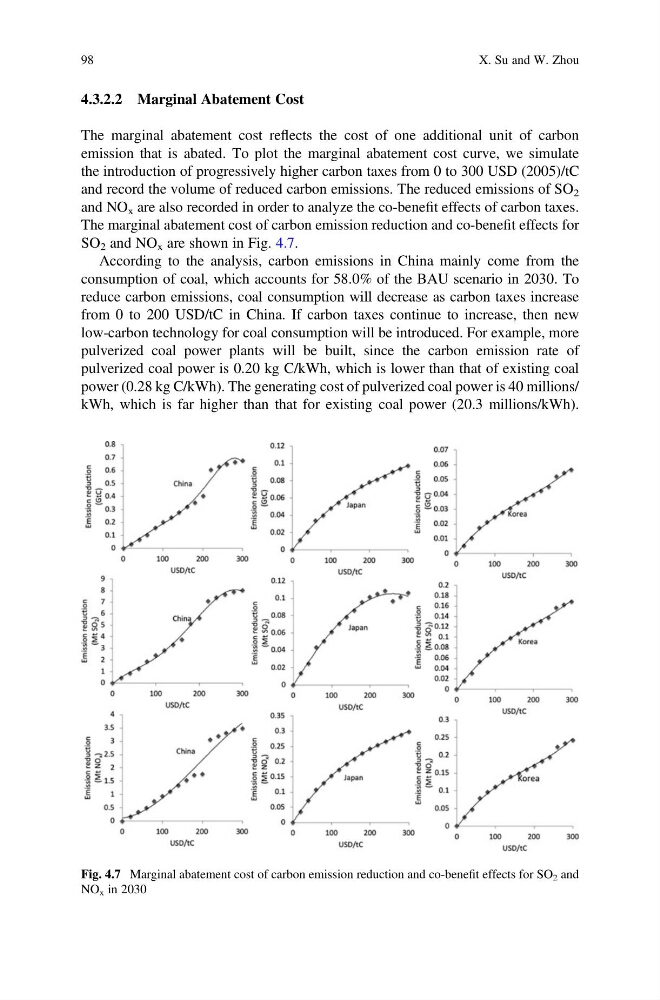
The marginal abatement cost reflects the cost of one additional unit of carbon
emission that is abated. To plot the marginal abatement cost curve, we simulate
the introduction of progressively higher carbon taxes from 0 to 300 USD (2005)/tC
and record the volume of reduced carbon emissions. The reduced emissions of SO 2
and NO x are also recorded in order to analyze the co-benefit effects of carbon taxes.
The marginal abatement cost of carbon emission reduction and co-benefit effects for
SO 2 and NO x are shown in Fig. 4.7.
According to the analysis, carbon emissions in China mainly come from the
consumption of coal, which accounts for 58.0% of the BAU scenario in 2030. To
reduce carbon emissions, coal consumption will decrease as carbon taxes increase
from 0 to 200 USD/tC in China. If carbon taxes continue to increase, then new
low-carbon technology for coal consumption will be introduced. For example, more
pulverized coal power plants will be built, since the carbon emission rate of
pulverized coal power is 0.20 kg C/kWh, which is lower than that of existing coal
power (0.28 kg C/kWh). The generating cost of pulverized coal power is 40 millions/
kWh, which is far higher than that for existing coal power (20.3 millions/kWh).
Fig. 4.7 Marginal abatement cost of carbon emission reduction and co-benefit effects for SO 2 and
NO x in 2030
98
X. Su and W. Zhou
The marginal abatement cost reflects the cost of one additional unit of carbon
emission that is abated. To plot the marginal abatement cost curve, we simulate
the introduction of progressively higher carbon taxes from 0 to 300 USD (2005)/tC
and record the volume of reduced carbon emissions. The reduced emissions of SO 2
and NO x are also recorded in order to analyze the co-benefit effects of carbon taxes.
The marginal abatement cost of carbon emission reduction and co-benefit effects for
SO 2 and NO x are shown in Fig. 4.7.
According to the analysis, carbon emissions in China mainly come from the
consumption of coal, which accounts for 58.0% of the BAU scenario in 2030. To
reduce carbon emissions, coal consumption will decrease as carbon taxes increase
from 0 to 200 USD/tC in China. If carbon taxes continue to increase, then new
low-carbon technology for coal consumption will be introduced. For example, more
pulverized coal power plants will be built, since the carbon emission rate of
pulverized coal power is 0.20 kg C/kWh, which is lower than that of existing coal
power (0.28 kg C/kWh). The generating cost of pulverized coal power is 40 millions/
kWh, which is far higher than that for existing coal power (20.3 millions/kWh).
Fig. 4.7 Marginal abatement cost of carbon emission reduction and co-benefit effects for SO 2 and
NO x in 2030
98
X. Su and W. Zhou