

58
3 Molecular Liquids
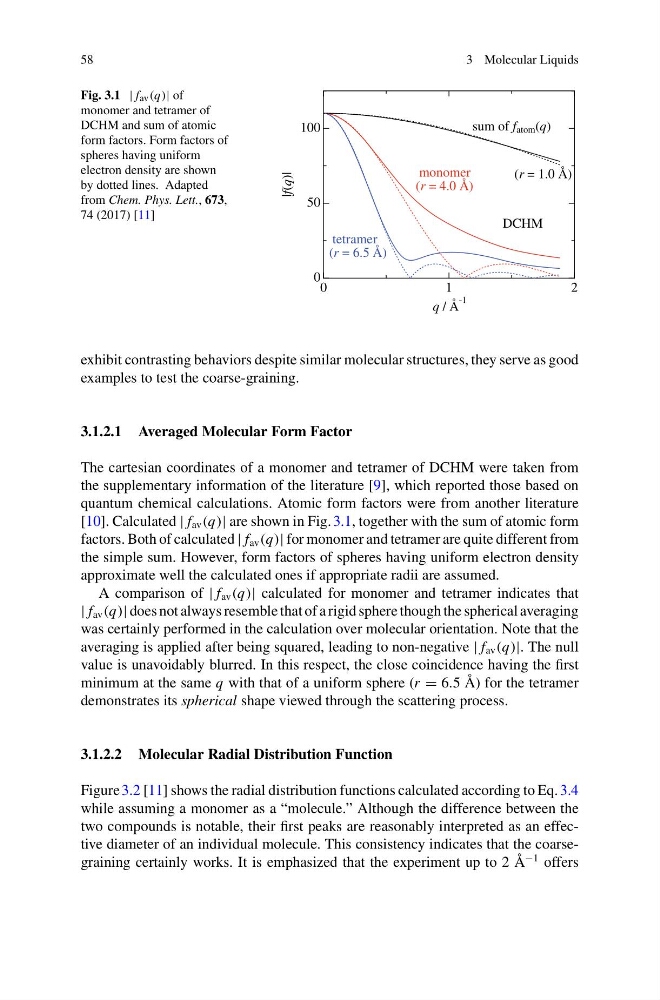
Fig. 3.1 | f av (q)| of
monomer and tetramer of
DCHM and sum of atomic
form factors. Form factors of
spheres having uniform
electron density are shown
by dotted lines. Adapted
from Chem. Phys. Lett., 673,
74 (2017) [11]
100
50
0
|f(q)|
2
1
0
q / Å
-1
sum of f atom (q)
monomer
(r = 4.0 Å)
tetramer
(r = 6.5 Å)
(r = 1.0 Å)
DCHM
exhibit contrasting behaviors despite similar molecular structures, they serve as good
examples to test the coarse-graining.
3.1.2.1 Averaged Molecular Form Factor
The cartesian coordinates of a monomer and tetramer of DCHM were taken from
the supplementary information of the literature [9], which reported those based on
quantum chemical calculations. Atomic form factors were from another literature
[10]. Calculated | f av (q)| are shown in Fig. 3.1, together with the sum of atomic form
factors. Both of calculated | f av (q)| for monomer and tetramer are quite different from
the simple sum. However, form factors of spheres having uniform electron density
approximate well the calculated ones if appropriate radii are assumed.
A comparison of | f av (q)| calculated for monomer and tetramer indicates that
| f av (q)| does not always resemble that of a rigid sphere though the spherical averaging
was certainly performed in the calculation over molecular orientation. Note that the
averaging is applied after being squared, leading to non-negative | f av (q)|. The null
value is unavoidably blurred. In this respect, the close coincidence having the first
minimum at the same q with that of a uniform sphere (r = 6.5 Å) for the tetramer
demonstrates its spherical shape viewed through the scattering process.
3.1.2.2 Molecular Radial Distribution Function
Figure 3.2 [11] shows the radial distribution functions calculated according to Eq. 3.4
while assuming a monomer as a “molecule.” Although the difference between the
two compounds is notable, their first peaks are reasonably interpreted as an effective diameter of an individual molecule. This consistency indicates that the coarsegraining certainly works. It is emphasized that the experiment up to 2 Å
−1 offers
3 Molecular Liquids
Fig. 3.1 | f av (q)| of
monomer and tetramer of
DCHM and sum of atomic
form factors. Form factors of
spheres having uniform
electron density are shown
by dotted lines. Adapted
from Chem. Phys. Lett., 673,
74 (2017) [11]
100
50
0
|f(q)|
2
1
0
q / Å
-1
sum of f atom (q)
monomer
(r = 4.0 Å)
tetramer
(r = 6.5 Å)
(r = 1.0 Å)
DCHM
exhibit contrasting behaviors despite similar molecular structures, they serve as good
examples to test the coarse-graining.
3.1.2.1 Averaged Molecular Form Factor
The cartesian coordinates of a monomer and tetramer of DCHM were taken from
the supplementary information of the literature [9], which reported those based on
quantum chemical calculations. Atomic form factors were from another literature
[10]. Calculated | f av (q)| are shown in Fig. 3.1, together with the sum of atomic form
factors. Both of calculated | f av (q)| for monomer and tetramer are quite different from
the simple sum. However, form factors of spheres having uniform electron density
approximate well the calculated ones if appropriate radii are assumed.
A comparison of | f av (q)| calculated for monomer and tetramer indicates that
| f av (q)| does not always resemble that of a rigid sphere though the spherical averaging
was certainly performed in the calculation over molecular orientation. Note that the
averaging is applied after being squared, leading to non-negative | f av (q)|. The null
value is unavoidably blurred. In this respect, the close coincidence having the first
minimum at the same q with that of a uniform sphere (r = 6.5 Å) for the tetramer
demonstrates its spherical shape viewed through the scattering process.
3.1.2.2 Molecular Radial Distribution Function
Figure 3.2 [11] shows the radial distribution functions calculated according to Eq. 3.4
while assuming a monomer as a “molecule.” Although the difference between the
two compounds is notable, their first peaks are reasonably interpreted as an effective diameter of an individual molecule. This consistency indicates that the coarsegraining certainly works. It is emphasized that the experiment up to 2 Å
−1 offers