

3.1 Liquid Structure
57
R 0 =
V rρ(r)dV
V ρ(r)dV
≈
i c i r i
l c i
,
(3.20)
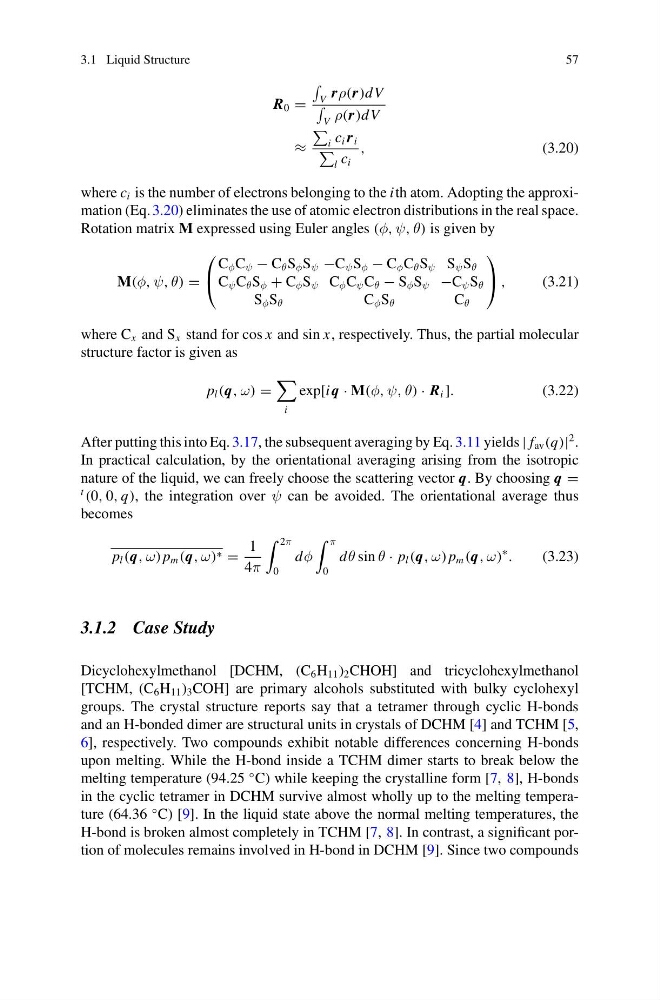
where c i is the number of electrons belonging to the ith atom. Adopting the approximation (Eq. 3.20) eliminates the use of atomic electron distributions in the real space.
Rotation matrix M expressed using Euler angles (φ, ψ, θ) is given by
M(φ, ψ, θ) =
⎛
⎝
C φ C ψ − C θ S φ S ψ −C ψ S φ − C φ C θ S ψ S ψ S θ
C ψ C θ S φ + C φ S ψ C φ C ψ C θ − S φ S ψ −C ψ S θ
S φ S θ
C φ S θ
C θ
⎞
⎠ ,
(3.21)
where C x and S x stand for cos x and sin x, respectively. Thus, the partial molecular
structure factor is given as
p l (q, ω) =
i
exp[i q · M(φ, ψ, θ) · R i ].
(3.22)
After putting this into Eq. 3.17, the subsequent averaging by Eq. 3.11 yields | f av (q)|
2 .
In practical calculation, by the orientational averaging arising from the isotropic
nature of the liquid, we can freely choose the scattering vector q. By choosing q =
t
(0, 0, q), the integration over ψ can be avoided. The orientational average thus
becomes
p l (q, ω) p m (q, ω) ∗ =
1
4π
2π
0
dφ
π
0
dθ sin θ · p l (q, ω) p m (q, ω)
∗
.
(3.23)
3.1.2 Case Study
Dicyclohexylmethanol [DCHM, (C 6 H 11 ) 2 CHOH] and tricyclohexylmethanol
[TCHM, (C 6 H 11 ) 3 COH] are primary alcohols substituted with bulky cyclohexyl
groups. The crystal structure reports say that a tetramer through cyclic H-bonds
and an H-bonded dimer are structural units in crystals of DCHM [4] and TCHM [5,
6], respectively. Two compounds exhibit notable differences concerning H-bonds
upon melting. While the H-bond inside a TCHM dimer starts to break below the
melting temperature (94.25
◦ C) while keeping the crystalline form [7, 8], H-bonds
in the cyclic tetramer in DCHM survive almost wholly up to the melting temperature (64.36
◦ C) [9]. In the liquid state above the normal melting temperatures, the
H-bond is broken almost completely in TCHM [7, 8]. In contrast, a significant portion of molecules remains involved in H-bond in DCHM [9]. Since two compounds
57
R 0 =
V rρ(r)dV
V ρ(r)dV
≈
i c i r i
l c i
,
(3.20)
where c i is the number of electrons belonging to the ith atom. Adopting the approximation (Eq. 3.20) eliminates the use of atomic electron distributions in the real space.
Rotation matrix M expressed using Euler angles (φ, ψ, θ) is given by
M(φ, ψ, θ) =
⎛
⎝
C φ C ψ − C θ S φ S ψ −C ψ S φ − C φ C θ S ψ S ψ S θ
C ψ C θ S φ + C φ S ψ C φ C ψ C θ − S φ S ψ −C ψ S θ
S φ S θ
C φ S θ
C θ
⎞
⎠ ,
(3.21)
where C x and S x stand for cos x and sin x, respectively. Thus, the partial molecular
structure factor is given as
p l (q, ω) =
i
exp[i q · M(φ, ψ, θ) · R i ].
(3.22)
After putting this into Eq. 3.17, the subsequent averaging by Eq. 3.11 yields | f av (q)|
2 .
In practical calculation, by the orientational averaging arising from the isotropic
nature of the liquid, we can freely choose the scattering vector q. By choosing q =
t
(0, 0, q), the integration over ψ can be avoided. The orientational average thus
becomes
p l (q, ω) p m (q, ω) ∗ =
1
4π
2π
0
dφ
π
0
dθ sin θ · p l (q, ω) p m (q, ω)
∗
.
(3.23)
3.1.2 Case Study
Dicyclohexylmethanol [DCHM, (C 6 H 11 ) 2 CHOH] and tricyclohexylmethanol
[TCHM, (C 6 H 11 ) 3 COH] are primary alcohols substituted with bulky cyclohexyl
groups. The crystal structure reports say that a tetramer through cyclic H-bonds
and an H-bonded dimer are structural units in crystals of DCHM [4] and TCHM [5,
6], respectively. Two compounds exhibit notable differences concerning H-bonds
upon melting. While the H-bond inside a TCHM dimer starts to break below the
melting temperature (94.25
◦ C) while keeping the crystalline form [7, 8], H-bonds
in the cyclic tetramer in DCHM survive almost wholly up to the melting temperature (64.36
◦ C) [9]. In the liquid state above the normal melting temperatures, the
H-bond is broken almost completely in TCHM [7, 8]. In contrast, a significant portion of molecules remains involved in H-bond in DCHM [9]. Since two compounds