

10
1 Molecules and Intermolecular Interactions
a)
b)
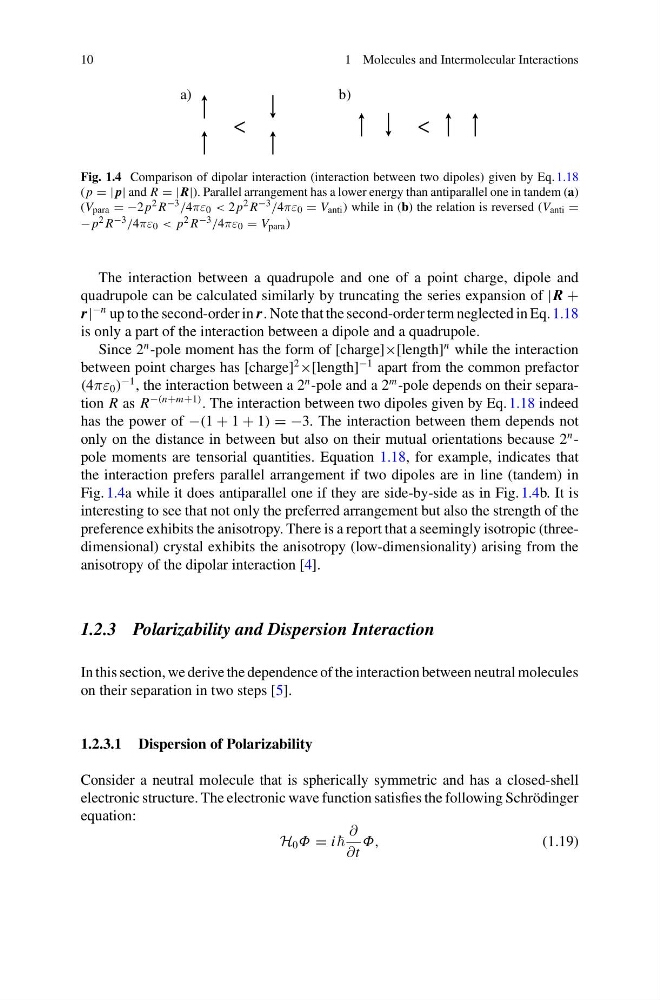
Fig. 1.4 Comparison of dipolar interaction (interaction between two dipoles) given by Eq. 1.18
( p = | p| and R = |R|). Parallel arrangement has a lower energy than antiparallel one in tandem (a)
(V para = −2 p 2 R −3 /4πε 0 < 2 p 2 R −3 /4πε 0 = V anti ) while in (b) the relation is reversed (V anti =
− p 2 R −3 /4πε 0 < p 2 R −3 /4πε 0 = V para )
The interaction between a quadrupole and one of a point charge, dipole and
quadrupole can be calculated similarly by truncating the series expansion of |R +
r|
−n up to the second-order in r. Note that the second-order term neglected in Eq. 1.18
is only a part of the interaction between a dipole and a quadrupole.
Since 2
n -pole moment has the form of [charge]×[length]
n while the interaction
between point charges has [charge]
2
×[length]
−1 apart from the common prefactor
(4πε 0 )
−1 , the interaction between a 2
n -pole and a 2
m -pole depends on their separation R as R
−(n+m+1) . The interaction between two dipoles given by Eq. 1.18 indeed
has the power of −(1 + 1 + 1) = −3. The interaction between them depends not
only on the distance in between but also on their mutual orientations because 2
n -
pole moments are tensorial quantities. Equation 1.18, for example, indicates that
the interaction prefers parallel arrangement if two dipoles are in line (tandem) in
Fig. 1.4a while it does antiparallel one if they are side-by-side as in Fig. 1.4b. It is
interesting to see that not only the preferred arrangement but also the strength of the
preference exhibits the anisotropy. There is a report that a seemingly isotropic (threedimensional) crystal exhibits the anisotropy (low-dimensionality) arising from the
anisotropy of the dipolar interaction [4].
1.2.3 Polarizability and Dispersion Interaction
In this section, we derive the dependence of the interaction between neutral molecules
on their separation in two steps [5].
1.2.3.1 Dispersion of Polarizability
Consider a neutral molecule that is spherically symmetric and has a closed-shell
electronic structure. The electronic wave function satisfies the following Schrödinger
equation:
H 0 Φ = i
∂
∂t
Φ,
(1.19)
1 Molecules and Intermolecular Interactions
a)
b)
Fig. 1.4 Comparison of dipolar interaction (interaction between two dipoles) given by Eq. 1.18
( p = | p| and R = |R|). Parallel arrangement has a lower energy than antiparallel one in tandem (a)
(V para = −2 p 2 R −3 /4πε 0 < 2 p 2 R −3 /4πε 0 = V anti ) while in (b) the relation is reversed (V anti =
− p 2 R −3 /4πε 0 < p 2 R −3 /4πε 0 = V para )
The interaction between a quadrupole and one of a point charge, dipole and
quadrupole can be calculated similarly by truncating the series expansion of |R +
r|
−n up to the second-order in r. Note that the second-order term neglected in Eq. 1.18
is only a part of the interaction between a dipole and a quadrupole.
Since 2
n -pole moment has the form of [charge]×[length]
n while the interaction
between point charges has [charge]
2
×[length]
−1 apart from the common prefactor
(4πε 0 )
−1 , the interaction between a 2
n -pole and a 2
m -pole depends on their separation R as R
−(n+m+1) . The interaction between two dipoles given by Eq. 1.18 indeed
has the power of −(1 + 1 + 1) = −3. The interaction between them depends not
only on the distance in between but also on their mutual orientations because 2
n -
pole moments are tensorial quantities. Equation 1.18, for example, indicates that
the interaction prefers parallel arrangement if two dipoles are in line (tandem) in
Fig. 1.4a while it does antiparallel one if they are side-by-side as in Fig. 1.4b. It is
interesting to see that not only the preferred arrangement but also the strength of the
preference exhibits the anisotropy. There is a report that a seemingly isotropic (threedimensional) crystal exhibits the anisotropy (low-dimensionality) arising from the
anisotropy of the dipolar interaction [4].
1.2.3 Polarizability and Dispersion Interaction
In this section, we derive the dependence of the interaction between neutral molecules
on their separation in two steps [5].
1.2.3.1 Dispersion of Polarizability
Consider a neutral molecule that is spherically symmetric and has a closed-shell
electronic structure. The electronic wave function satisfies the following Schrödinger
equation:
H 0 Φ = i
∂
∂t
Φ,
(1.19)