

1.2 Intermolecular Interaction
9
The molecular characteristic that is tensor of the order n emerges in these terms.
They are called a 2
n -pole moment for arbitrary n. The first few are dipole (n = 1),
quadrupole (n = 2), octopole (n = 3), hexadecapole (n = 4), etc.
1.2.2 Electrostatic Interaction
In this section, we calculate electrostatic interactions while placing the charge distribution of another molecule in the electrostatic potential produced by a molecule (such
as Eq. 1.3). It is noteworthy that only interactions involving up to dipole moments
are necessary to consider in most real cases in comparison with the shape effects of
molecules discussed later.
When molecules are spherical, the interaction is simply of that between point
charges
E mm (R) =
1
4πε 0
q 0 q R
|R|
,
(1.16)
where q 0 and q R are their charges. For non-spherical molecules, the calculation can
be performed as in the following example of the dipolar interaction. Suppose one
molecule is at the origin and the other at R with the electron density ρ
(R + r
)
around R. We expand |R + r
|
−3 in r
assuming |R| | |r
| as
1
|R + r | 3 ≈
1
|R| 3 − 3
(r
·R)
|R| 5 .
(1.17)
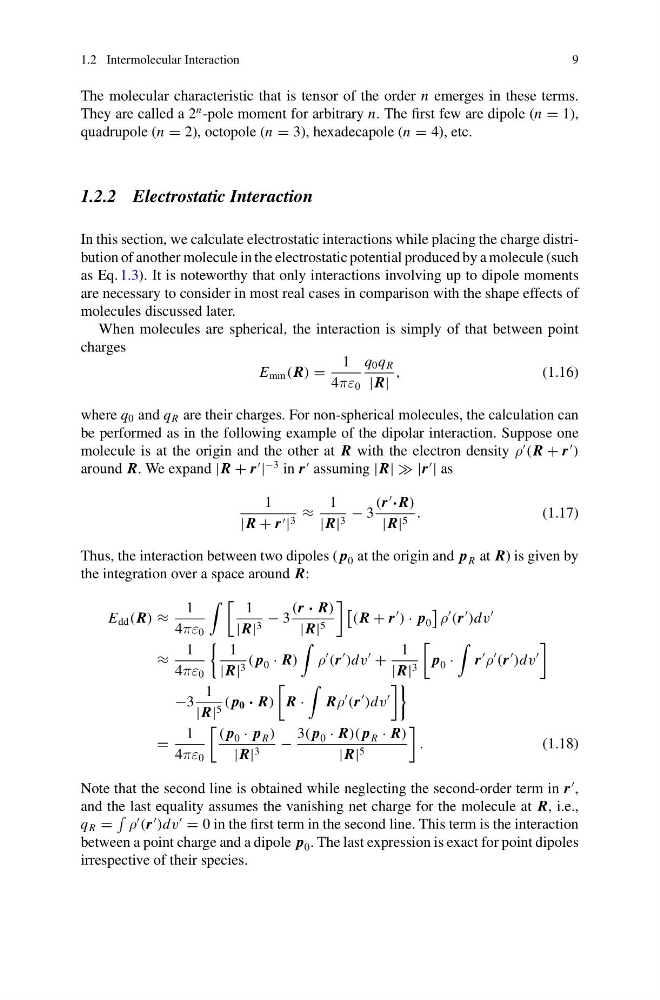
Thus, the interaction between two dipoles ( p 0 at the origin and p R at R) is given by
the integration over a space around R:
E dd (R) ≈
1
4πε 0
1
|R| 3 − 3
(r · R)
|R| 5
(R + r
) · p 0
ρ
(r
)dv
≈
1
4πε 0
1
|R| 3 ( p 0 · R)
ρ
(r
)dv
+
1
|R| 3
p 0 ·
r
ρ
(r
)dv
−3
1
|R| 5 ( p 0 · R)
R ·
Rρ
(r
)dv
=
1
4πε 0
( p 0 · p R )
|R| 3 −
3( p 0 · R)( p R · R)
|R| 5
.
(1.18)
Note that the second line is obtained while neglecting the second-order term in r
,
and the last equality assumes the vanishing net charge for the molecule at R, i.e.,
q R =
ρ
(r
)dv
= 0 in the first term in the second line. This term is the interaction
between a point charge and a dipole p 0 . The last expression is exact for point dipoles
irrespective of their species.
9
The molecular characteristic that is tensor of the order n emerges in these terms.
They are called a 2
n -pole moment for arbitrary n. The first few are dipole (n = 1),
quadrupole (n = 2), octopole (n = 3), hexadecapole (n = 4), etc.
1.2.2 Electrostatic Interaction
In this section, we calculate electrostatic interactions while placing the charge distribution of another molecule in the electrostatic potential produced by a molecule (such
as Eq. 1.3). It is noteworthy that only interactions involving up to dipole moments
are necessary to consider in most real cases in comparison with the shape effects of
molecules discussed later.
When molecules are spherical, the interaction is simply of that between point
charges
E mm (R) =
1
4πε 0
q 0 q R
|R|
,
(1.16)
where q 0 and q R are their charges. For non-spherical molecules, the calculation can
be performed as in the following example of the dipolar interaction. Suppose one
molecule is at the origin and the other at R with the electron density ρ
(R + r
)
around R. We expand |R + r
|
−3 in r
assuming |R| | |r
| as
1
|R + r | 3 ≈
1
|R| 3 − 3
(r
·R)
|R| 5 .
(1.17)
Thus, the interaction between two dipoles ( p 0 at the origin and p R at R) is given by
the integration over a space around R:
E dd (R) ≈
1
4πε 0
1
|R| 3 − 3
(r · R)
|R| 5
(R + r
) · p 0
ρ
(r
)dv
≈
1
4πε 0
1
|R| 3 ( p 0 · R)
ρ
(r
)dv
+
1
|R| 3
p 0 ·
r
ρ
(r
)dv
−3
1
|R| 5 ( p 0 · R)
R ·
Rρ
(r
)dv
=
1
4πε 0
( p 0 · p R )
|R| 3 −
3( p 0 · R)( p R · R)
|R| 5
.
(1.18)
Note that the second line is obtained while neglecting the second-order term in r
,
and the last equality assumes the vanishing net charge for the molecule at R, i.e.,
q R =
ρ
(r
)dv
= 0 in the first term in the second line. This term is the interaction
between a point charge and a dipole p 0 . The last expression is exact for point dipoles
irrespective of their species.