

1.2 Intermolecular Interaction
11
where H 0 is a Hamiltonian operator of the molecule. Normalized stationary states
are denoted by φ n exp(−iω n t) (n = 0, 1, 2, . . .). Then,
H 0 φ n = ω n φ n .
(1.20)
This indicates that φ n are eigen functions of the time-independent Schrödinger equation.
Suppose the weak electric field is exerted on the molecules in the ground state
(n = 0) along the x-axis. The time dependence of the field is assumed to be E x cos ωt.
Then, the total Hamiltonian H is given by
H = H 0 − P x E x cos(ωt)
= H 0 + H
,
(1.21)
where P x is the operator corresponding to the x component of the molecular dipole
moment. The wave function should fulfill the following time-dependent Schrödinger
equation:
H 0 + H
Φ = i
∂
∂t
Φ.
(1.22)
Considering the weak filed, we assume the proportionality between the electric field
and the dipole moment. Thus,
Φ
∗
P x Φdv = α(ω)E x cos ωt,
(1.23)
where α(ω) is the frequency-dependent polarizability of the molecule.
Assuming |H
| | |H 0 |, we proceed with the time-dependent perturbation theory.
We write the wave function as
Φ = φ 0 exp(−iω 0 t) +
n
φ n exp(−iω n t)a n (t).
(1.24)
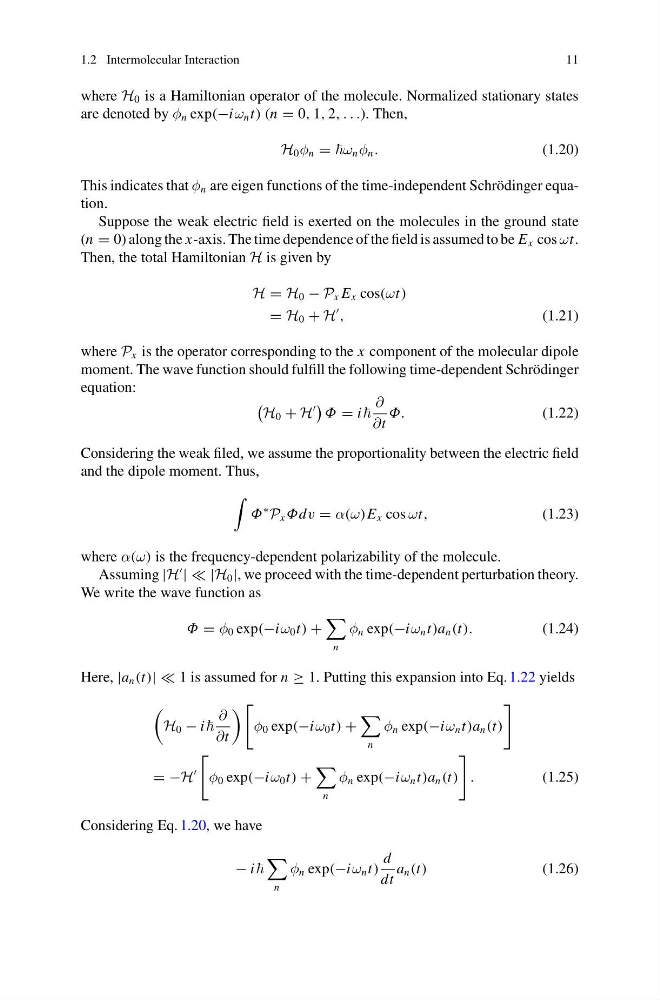
Here, |a n (t)| | 1 is assumed for n ≥ 1. Putting this expansion into Eq. 1.22 yields
H 0 − i
∂
∂t
φ 0 exp(−iω 0 t) +
n
φ n exp(−iω n t)a n (t)
= −H
φ 0 exp(−iω 0 t) +
n
φ n exp(−iω n t)a n (t)
.
(1.25)
Considering Eq. 1.20, we have
− i
n
φ n exp(−iω n t)
d
dt
a n (t)
(1.26)
11
where H 0 is a Hamiltonian operator of the molecule. Normalized stationary states
are denoted by φ n exp(−iω n t) (n = 0, 1, 2, . . .). Then,
H 0 φ n = ω n φ n .
(1.20)
This indicates that φ n are eigen functions of the time-independent Schrödinger equation.
Suppose the weak electric field is exerted on the molecules in the ground state
(n = 0) along the x-axis. The time dependence of the field is assumed to be E x cos ωt.
Then, the total Hamiltonian H is given by
H = H 0 − P x E x cos(ωt)
= H 0 + H
,
(1.21)
where P x is the operator corresponding to the x component of the molecular dipole
moment. The wave function should fulfill the following time-dependent Schrödinger
equation:
H 0 + H
Φ = i
∂
∂t
Φ.
(1.22)
Considering the weak filed, we assume the proportionality between the electric field
and the dipole moment. Thus,
Φ
∗
P x Φdv = α(ω)E x cos ωt,
(1.23)
where α(ω) is the frequency-dependent polarizability of the molecule.
Assuming |H
| | |H 0 |, we proceed with the time-dependent perturbation theory.
We write the wave function as
Φ = φ 0 exp(−iω 0 t) +
n
φ n exp(−iω n t)a n (t).
(1.24)
Here, |a n (t)| | 1 is assumed for n ≥ 1. Putting this expansion into Eq. 1.22 yields
H 0 − i
∂
∂t
φ 0 exp(−iω 0 t) +
n
φ n exp(−iω n t)a n (t)
= −H
φ 0 exp(−iω 0 t) +
n
φ n exp(−iω n t)a n (t)
.
(1.25)
Considering Eq. 1.20, we have
− i
n
φ n exp(−iω n t)
d
dt
a n (t)
(1.26)