

184
9 Molecular Flexibility and Material Properties
0
1 0
2 0
3 0
0
2
4
6
n C
Δ
trs
S
/ J K
-1
mol -1
ANBC
BABH
SmC cub*
Ia3d SmC
SmC Ia3d
–
–
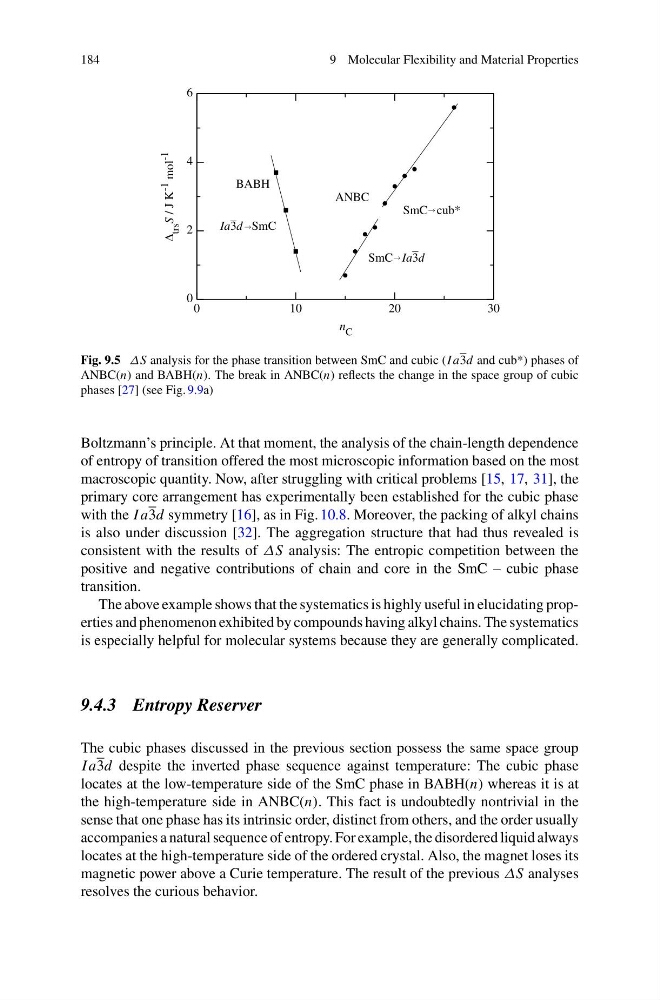
Fig. 9.5 ΔS analysis for the phase transition between SmC and cubic (I a3d and cub*) phases of
ANBC(n) and BABH(n). The break in ANBC(n) reflects the change in the space group of cubic
phases [27] (see Fig. 9.9a)
Boltzmann’s principle. At that moment, the analysis of the chain-length dependence
of entropy of transition offered the most microscopic information based on the most
macroscopic quantity. Now, after struggling with critical problems [15, 17, 31], the
primary core arrangement has experimentally been established for the cubic phase
with the I a3d symmetry [16], as in Fig. 10.8. Moreover, the packing of alkyl chains
is also under discussion [32]. The aggregation structure that had thus revealed is
consistent with the results of ΔS analysis: The entropic competition between the
positive and negative contributions of chain and core in the SmC – cubic phase
transition.
The above example shows that the systematics is highly useful in elucidating properties and phenomenon exhibited by compounds having alkyl chains. The systematics
is especially helpful for molecular systems because they are generally complicated.
9.4.3 Entropy Reserver
The cubic phases discussed in the previous section possess the same space group
I a3d despite the inverted phase sequence against temperature: The cubic phase
locates at the low-temperature side of the SmC phase in BABH(n) whereas it is at
the high-temperature side in ANBC(n). This fact is undoubtedly nontrivial in the
sense that one phase has its intrinsic order, distinct from others, and the order usually
accompanies a natural sequence of entropy. For example, the disordered liquid always
locates at the high-temperature side of the ordered crystal. Also, the magnet loses its
magnetic power above a Curie temperature. The result of the previous ΔS analyses
resolves the curious behavior.
9 Molecular Flexibility and Material Properties
0
1 0
2 0
3 0
0
2
4
6
n C
Δ
trs
S
/ J K
-1
mol -1
ANBC
BABH
SmC cub*
Ia3d SmC
SmC Ia3d
–
–
Fig. 9.5 ΔS analysis for the phase transition between SmC and cubic (I a3d and cub*) phases of
ANBC(n) and BABH(n). The break in ANBC(n) reflects the change in the space group of cubic
phases [27] (see Fig. 9.9a)
Boltzmann’s principle. At that moment, the analysis of the chain-length dependence
of entropy of transition offered the most microscopic information based on the most
macroscopic quantity. Now, after struggling with critical problems [15, 17, 31], the
primary core arrangement has experimentally been established for the cubic phase
with the I a3d symmetry [16], as in Fig. 10.8. Moreover, the packing of alkyl chains
is also under discussion [32]. The aggregation structure that had thus revealed is
consistent with the results of ΔS analysis: The entropic competition between the
positive and negative contributions of chain and core in the SmC – cubic phase
transition.
The above example shows that the systematics is highly useful in elucidating properties and phenomenon exhibited by compounds having alkyl chains. The systematics
is especially helpful for molecular systems because they are generally complicated.
9.4.3 Entropy Reserver
The cubic phases discussed in the previous section possess the same space group
I a3d despite the inverted phase sequence against temperature: The cubic phase
locates at the low-temperature side of the SmC phase in BABH(n) whereas it is at
the high-temperature side in ANBC(n). This fact is undoubtedly nontrivial in the
sense that one phase has its intrinsic order, distinct from others, and the order usually
accompanies a natural sequence of entropy. For example, the disordered liquid always
locates at the high-temperature side of the ordered crystal. Also, the magnet loses its
magnetic power above a Curie temperature. The result of the previous ΔS analyses
resolves the curious behavior.