

9.4 Conformational Disordering of Alkyl Groups
183
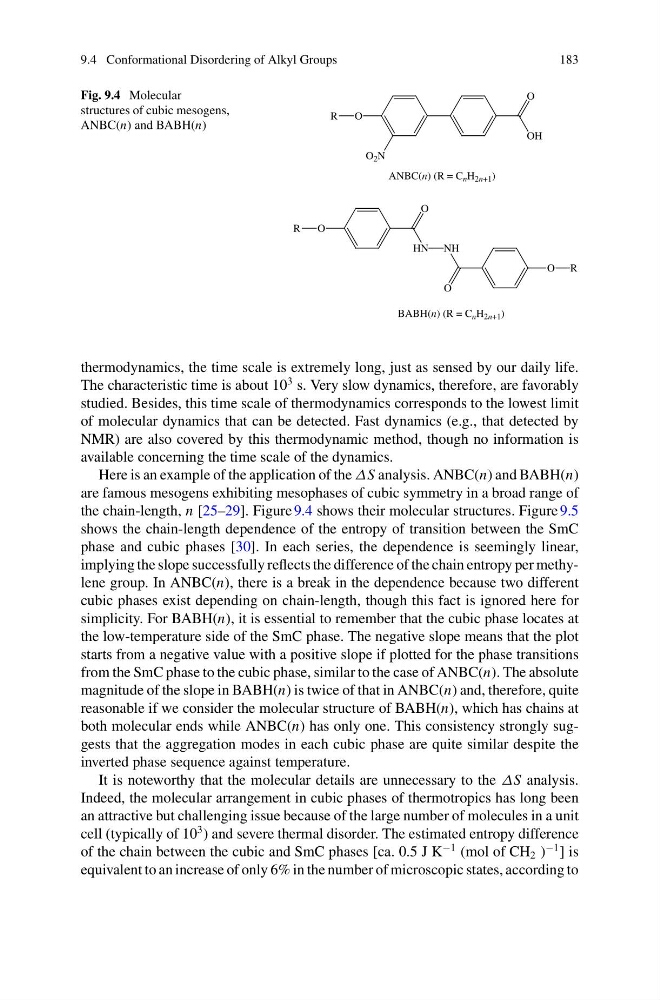
Fig. 9.4 Molecular
structures of cubic mesogens,
ANBC(n) and BABH(n)
O
OH
O 2 N
O
R
HN
O
NH
O
O R
O
R
ANBC(n) (R = C n H 2n+1 )
BABH(n) (R = C n H 2n+1 )
thermodynamics, the time scale is extremely long, just as sensed by our daily life.
The characteristic time is about 10
3 s. Very slow dynamics, therefore, are favorably
studied. Besides, this time scale of thermodynamics corresponds to the lowest limit
of molecular dynamics that can be detected. Fast dynamics (e.g., that detected by
NMR) are also covered by this thermodynamic method, though no information is
available concerning the time scale of the dynamics.
Here is an example of the application of the ΔS analysis. ANBC(n) and BABH(n)
are famous mesogens exhibiting mesophases of cubic symmetry in a broad range of
the chain-length, n [25–29]. Figure 9.4 shows their molecular structures. Figure 9.5
shows the chain-length dependence of the entropy of transition between the SmC
phase and cubic phases [30]. In each series, the dependence is seemingly linear,
implying the slope successfully reflects the difference of the chain entropy per methylene group. In ANBC(n), there is a break in the dependence because two different
cubic phases exist depending on chain-length, though this fact is ignored here for
simplicity. For BABH(n), it is essential to remember that the cubic phase locates at
the low-temperature side of the SmC phase. The negative slope means that the plot
starts from a negative value with a positive slope if plotted for the phase transitions
from the SmC phase to the cubic phase, similar to the case of ANBC(n). The absolute
magnitude of the slope in BABH(n) is twice of that in ANBC(n) and, therefore, quite
reasonable if we consider the molecular structure of BABH(n), which has chains at
both molecular ends while ANBC(n) has only one. This consistency strongly suggests that the aggregation modes in each cubic phase are quite similar despite the
inverted phase sequence against temperature.
It is noteworthy that the molecular details are unnecessary to the ΔS analysis.
Indeed, the molecular arrangement in cubic phases of thermotropics has long been
an attractive but challenging issue because of the large number of molecules in a unit
cell (typically of 10
3 ) and severe thermal disorder. The estimated entropy difference
of the chain between the cubic and SmC phases [ca. 0.5 J K
−1 (mol of CH 2 )
−1 ] is
equivalent to an increase of only 6% in the number of microscopic states, according to
183
Fig. 9.4 Molecular
structures of cubic mesogens,
ANBC(n) and BABH(n)
O
OH
O 2 N
O
R
HN
O
NH
O
O R
O
R
ANBC(n) (R = C n H 2n+1 )
BABH(n) (R = C n H 2n+1 )
thermodynamics, the time scale is extremely long, just as sensed by our daily life.
The characteristic time is about 10
3 s. Very slow dynamics, therefore, are favorably
studied. Besides, this time scale of thermodynamics corresponds to the lowest limit
of molecular dynamics that can be detected. Fast dynamics (e.g., that detected by
NMR) are also covered by this thermodynamic method, though no information is
available concerning the time scale of the dynamics.
Here is an example of the application of the ΔS analysis. ANBC(n) and BABH(n)
are famous mesogens exhibiting mesophases of cubic symmetry in a broad range of
the chain-length, n [25–29]. Figure 9.4 shows their molecular structures. Figure 9.5
shows the chain-length dependence of the entropy of transition between the SmC
phase and cubic phases [30]. In each series, the dependence is seemingly linear,
implying the slope successfully reflects the difference of the chain entropy per methylene group. In ANBC(n), there is a break in the dependence because two different
cubic phases exist depending on chain-length, though this fact is ignored here for
simplicity. For BABH(n), it is essential to remember that the cubic phase locates at
the low-temperature side of the SmC phase. The negative slope means that the plot
starts from a negative value with a positive slope if plotted for the phase transitions
from the SmC phase to the cubic phase, similar to the case of ANBC(n). The absolute
magnitude of the slope in BABH(n) is twice of that in ANBC(n) and, therefore, quite
reasonable if we consider the molecular structure of BABH(n), which has chains at
both molecular ends while ANBC(n) has only one. This consistency strongly suggests that the aggregation modes in each cubic phase are quite similar despite the
inverted phase sequence against temperature.
It is noteworthy that the molecular details are unnecessary to the ΔS analysis.
Indeed, the molecular arrangement in cubic phases of thermotropics has long been
an attractive but challenging issue because of the large number of molecules in a unit
cell (typically of 10
3 ) and severe thermal disorder. The estimated entropy difference
of the chain between the cubic and SmC phases [ca. 0.5 J K
−1 (mol of CH 2 )
−1 ] is
equivalent to an increase of only 6% in the number of microscopic states, according to