

9.4 Conformational Disordering of Alkyl Groups
185
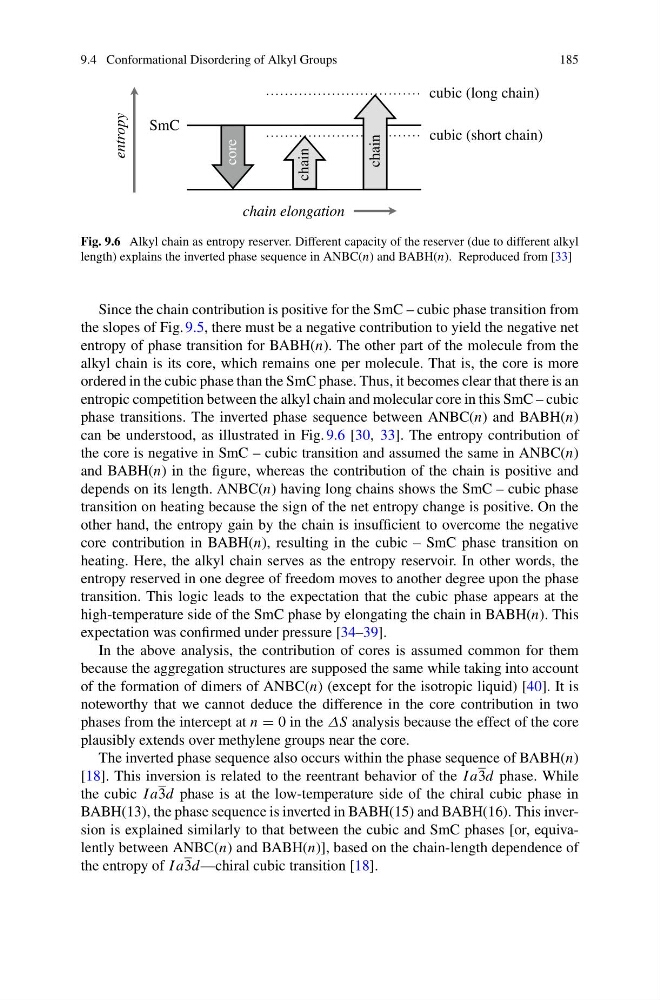
Fig. 9.6 Alkyl chain as entropy reserver. Different capacity of the reserver (due to different alkyl
length) explains the inverted phase sequence in ANBC(n) and BABH(n). Reproduced from [33]
Since the chain contribution is positive for the SmC – cubic phase transition from
the slopes of Fig. 9.5, there must be a negative contribution to yield the negative net
entropy of phase transition for BABH(n). The other part of the molecule from the
alkyl chain is its core, which remains one per molecule. That is, the core is more
ordered in the cubic phase than the SmC phase. Thus, it becomes clear that there is an
entropic competition between the alkyl chain and molecular core in this SmC – cubic
phase transitions. The inverted phase sequence between ANBC(n) and BABH(n)
can be understood, as illustrated in Fig. 9.6 [30, 33]. The entropy contribution of
the core is negative in SmC – cubic transition and assumed the same in ANBC(n)
and BABH(n) in the figure, whereas the contribution of the chain is positive and
depends on its length. ANBC(n) having long chains shows the SmC – cubic phase
transition on heating because the sign of the net entropy change is positive. On the
other hand, the entropy gain by the chain is insufficient to overcome the negative
core contribution in BABH(n), resulting in the cubic – SmC phase transition on
heating. Here, the alkyl chain serves as the entropy reservoir. In other words, the
entropy reserved in one degree of freedom moves to another degree upon the phase
transition. This logic leads to the expectation that the cubic phase appears at the
high-temperature side of the SmC phase by elongating the chain in BABH(n). This
expectation was confirmed under pressure [34–39].
In the above analysis, the contribution of cores is assumed common for them
because the aggregation structures are supposed the same while taking into account
of the formation of dimers of ANBC(n) (except for the isotropic liquid) [40]. It is
noteworthy that we cannot deduce the difference in the core contribution in two
phases from the intercept at n = 0 in the ΔS analysis because the effect of the core
plausibly extends over methylene groups near the core.
The inverted phase sequence also occurs within the phase sequence of BABH(n)
[18]. This inversion is related to the reentrant behavior of the I a3d phase. While
the cubic I a3d phase is at the low-temperature side of the chiral cubic phase in
BABH(13), the phase sequence is inverted in BABH(15) and BABH(16). This inversion is explained similarly to that between the cubic and SmC phases [or, equivalently between ANBC(n) and BABH(n)], based on the chain-length dependence of
the entropy of I a3d—chiral cubic transition [18].
185
Fig. 9.6 Alkyl chain as entropy reserver. Different capacity of the reserver (due to different alkyl
length) explains the inverted phase sequence in ANBC(n) and BABH(n). Reproduced from [33]
Since the chain contribution is positive for the SmC – cubic phase transition from
the slopes of Fig. 9.5, there must be a negative contribution to yield the negative net
entropy of phase transition for BABH(n). The other part of the molecule from the
alkyl chain is its core, which remains one per molecule. That is, the core is more
ordered in the cubic phase than the SmC phase. Thus, it becomes clear that there is an
entropic competition between the alkyl chain and molecular core in this SmC – cubic
phase transitions. The inverted phase sequence between ANBC(n) and BABH(n)
can be understood, as illustrated in Fig. 9.6 [30, 33]. The entropy contribution of
the core is negative in SmC – cubic transition and assumed the same in ANBC(n)
and BABH(n) in the figure, whereas the contribution of the chain is positive and
depends on its length. ANBC(n) having long chains shows the SmC – cubic phase
transition on heating because the sign of the net entropy change is positive. On the
other hand, the entropy gain by the chain is insufficient to overcome the negative
core contribution in BABH(n), resulting in the cubic – SmC phase transition on
heating. Here, the alkyl chain serves as the entropy reservoir. In other words, the
entropy reserved in one degree of freedom moves to another degree upon the phase
transition. This logic leads to the expectation that the cubic phase appears at the
high-temperature side of the SmC phase by elongating the chain in BABH(n). This
expectation was confirmed under pressure [34–39].
In the above analysis, the contribution of cores is assumed common for them
because the aggregation structures are supposed the same while taking into account
of the formation of dimers of ANBC(n) (except for the isotropic liquid) [40]. It is
noteworthy that we cannot deduce the difference in the core contribution in two
phases from the intercept at n = 0 in the ΔS analysis because the effect of the core
plausibly extends over methylene groups near the core.
The inverted phase sequence also occurs within the phase sequence of BABH(n)
[18]. This inversion is related to the reentrant behavior of the I a3d phase. While
the cubic I a3d phase is at the low-temperature side of the chiral cubic phase in
BABH(13), the phase sequence is inverted in BABH(15) and BABH(16). This inversion is explained similarly to that between the cubic and SmC phases [or, equivalently between ANBC(n) and BABH(n)], based on the chain-length dependence of
the entropy of I a3d—chiral cubic transition [18].