

9.4 Conformational Disordering of Alkyl Groups
181
500
400
300
200
100
0
T
/ K
10
8
6
4
n in C n H 2n+2
T boil
T fus
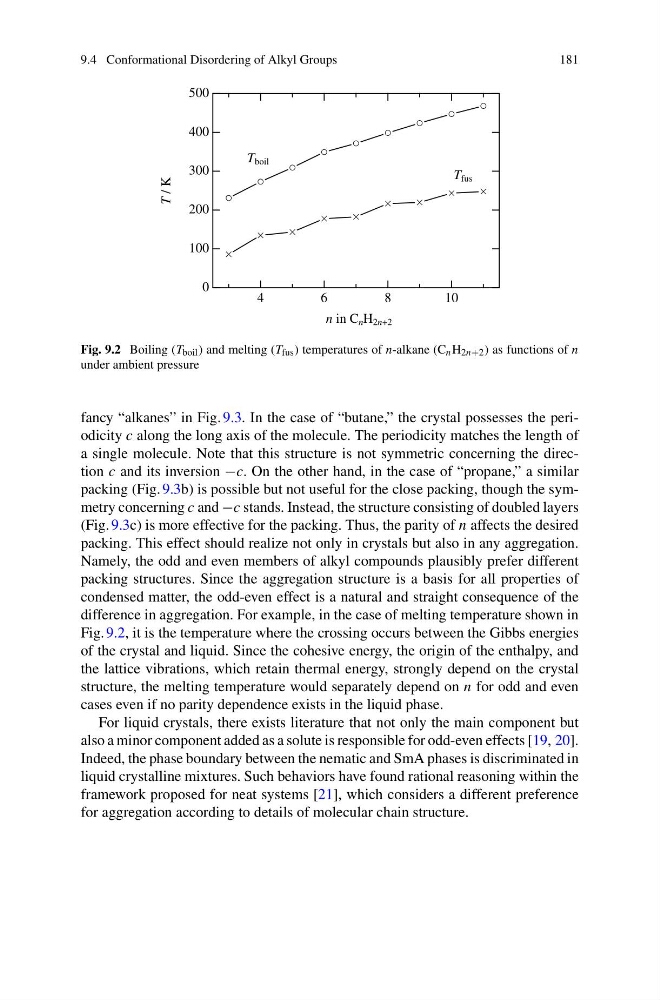
Fig. 9.2 Boiling (T boil ) and melting (T fus ) temperatures of n-alkane (C n H 2n+2 ) as functions of n
under ambient pressure
fancy “alkanes” in Fig. 9.3. In the case of “butane,” the crystal possesses the periodicity c along the long axis of the molecule. The periodicity matches the length of
a single molecule. Note that this structure is not symmetric concerning the direction c and its inversion −c. On the other hand, in the case of “propane,” a similar
packing (Fig. 9.3b) is possible but not useful for the close packing, though the symmetry concerning c and −c stands. Instead, the structure consisting of doubled layers
(Fig. 9.3c) is more effective for the packing. Thus, the parity of n affects the desired
packing. This effect should realize not only in crystals but also in any aggregation.
Namely, the odd and even members of alkyl compounds plausibly prefer different
packing structures. Since the aggregation structure is a basis for all properties of
condensed matter, the odd-even effect is a natural and straight consequence of the
difference in aggregation. For example, in the case of melting temperature shown in
Fig. 9.2, it is the temperature where the crossing occurs between the Gibbs energies
of the crystal and liquid. Since the cohesive energy, the origin of the enthalpy, and
the lattice vibrations, which retain thermal energy, strongly depend on the crystal
structure, the melting temperature would separately depend on n for odd and even
cases even if no parity dependence exists in the liquid phase.
For liquid crystals, there exists literature that not only the main component but
also a minor component added as a solute is responsible for odd-even effects [19, 20].
Indeed, the phase boundary between the nematic and SmA phases is discriminated in
liquid crystalline mixtures. Such behaviors have found rational reasoning within the
framework proposed for neat systems [21], which considers a different preference
for aggregation according to details of molecular chain structure.
181
500
400
300
200
100
0
T
/ K
10
8
6
4
n in C n H 2n+2
T boil
T fus
Fig. 9.2 Boiling (T boil ) and melting (T fus ) temperatures of n-alkane (C n H 2n+2 ) as functions of n
under ambient pressure
fancy “alkanes” in Fig. 9.3. In the case of “butane,” the crystal possesses the periodicity c along the long axis of the molecule. The periodicity matches the length of
a single molecule. Note that this structure is not symmetric concerning the direction c and its inversion −c. On the other hand, in the case of “propane,” a similar
packing (Fig. 9.3b) is possible but not useful for the close packing, though the symmetry concerning c and −c stands. Instead, the structure consisting of doubled layers
(Fig. 9.3c) is more effective for the packing. Thus, the parity of n affects the desired
packing. This effect should realize not only in crystals but also in any aggregation.
Namely, the odd and even members of alkyl compounds plausibly prefer different
packing structures. Since the aggregation structure is a basis for all properties of
condensed matter, the odd-even effect is a natural and straight consequence of the
difference in aggregation. For example, in the case of melting temperature shown in
Fig. 9.2, it is the temperature where the crossing occurs between the Gibbs energies
of the crystal and liquid. Since the cohesive energy, the origin of the enthalpy, and
the lattice vibrations, which retain thermal energy, strongly depend on the crystal
structure, the melting temperature would separately depend on n for odd and even
cases even if no parity dependence exists in the liquid phase.
For liquid crystals, there exists literature that not only the main component but
also a minor component added as a solute is responsible for odd-even effects [19, 20].
Indeed, the phase boundary between the nematic and SmA phases is discriminated in
liquid crystalline mixtures. Such behaviors have found rational reasoning within the
framework proposed for neat systems [21], which considers a different preference
for aggregation according to details of molecular chain structure.