

180
9 Molecular Flexibility and Material Properties
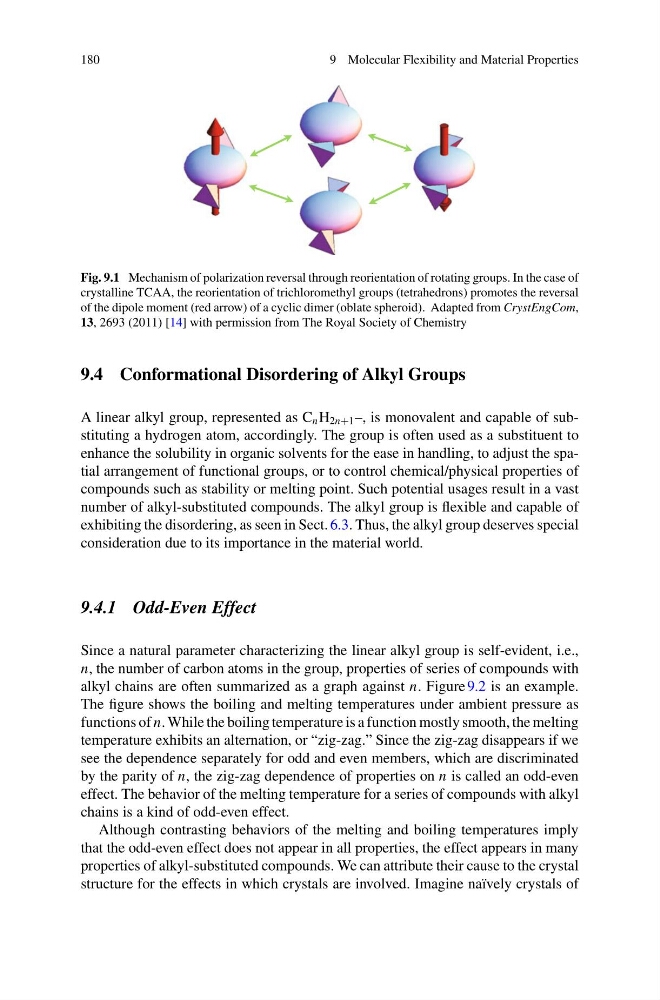
Fig. 9.1 Mechanism of polarization reversal through reorientation of rotating groups. In the case of
crystalline TCAA, the reorientation of trichloromethyl groups (tetrahedrons) promotes the reversal
of the dipole moment (red arrow) of a cyclic dimer (oblate spheroid). Adapted from CrystEngCom,
13, 2693 (2011) [14] with permission from The Royal Society of Chemistry
9.4 Conformational Disordering of Alkyl Groups
A linear alkyl group, represented as C n H 2n+1 –, is monovalent and capable of substituting a hydrogen atom, accordingly. The group is often used as a substituent to
enhance the solubility in organic solvents for the ease in handling, to adjust the spatial arrangement of functional groups, or to control chemical/physical properties of
compounds such as stability or melting point. Such potential usages result in a vast
number of alkyl-substituted compounds. The alkyl group is flexible and capable of
exhibiting the disordering, as seen in Sect. 6.3. Thus, the alkyl group deserves special
consideration due to its importance in the material world.
9.4.1 Odd-Even Effect
Since a natural parameter characterizing the linear alkyl group is self-evident, i.e.,
n, the number of carbon atoms in the group, properties of series of compounds with
alkyl chains are often summarized as a graph against n. Figure 9.2 is an example.
The figure shows the boiling and melting temperatures under ambient pressure as
functions of n. While the boiling temperature is a function mostly smooth, the melting
temperature exhibits an alternation, or “zig-zag.” Since the zig-zag disappears if we
see the dependence separately for odd and even members, which are discriminated
by the parity of n, the zig-zag dependence of properties on n is called an odd-even
effect. The behavior of the melting temperature for a series of compounds with alkyl
chains is a kind of odd-even effect.
Although contrasting behaviors of the melting and boiling temperatures imply
that the odd-even effect does not appear in all properties, the effect appears in many
properties of alkyl-substituted compounds. We can attribute their cause to the crystal
structure for the effects in which crystals are involved. Imagine naïvely crystals of
9 Molecular Flexibility and Material Properties
Fig. 9.1 Mechanism of polarization reversal through reorientation of rotating groups. In the case of
crystalline TCAA, the reorientation of trichloromethyl groups (tetrahedrons) promotes the reversal
of the dipole moment (red arrow) of a cyclic dimer (oblate spheroid). Adapted from CrystEngCom,
13, 2693 (2011) [14] with permission from The Royal Society of Chemistry
9.4 Conformational Disordering of Alkyl Groups
A linear alkyl group, represented as C n H 2n+1 –, is monovalent and capable of substituting a hydrogen atom, accordingly. The group is often used as a substituent to
enhance the solubility in organic solvents for the ease in handling, to adjust the spatial arrangement of functional groups, or to control chemical/physical properties of
compounds such as stability or melting point. Such potential usages result in a vast
number of alkyl-substituted compounds. The alkyl group is flexible and capable of
exhibiting the disordering, as seen in Sect. 6.3. Thus, the alkyl group deserves special
consideration due to its importance in the material world.
9.4.1 Odd-Even Effect
Since a natural parameter characterizing the linear alkyl group is self-evident, i.e.,
n, the number of carbon atoms in the group, properties of series of compounds with
alkyl chains are often summarized as a graph against n. Figure 9.2 is an example.
The figure shows the boiling and melting temperatures under ambient pressure as
functions of n. While the boiling temperature is a function mostly smooth, the melting
temperature exhibits an alternation, or “zig-zag.” Since the zig-zag disappears if we
see the dependence separately for odd and even members, which are discriminated
by the parity of n, the zig-zag dependence of properties on n is called an odd-even
effect. The behavior of the melting temperature for a series of compounds with alkyl
chains is a kind of odd-even effect.
Although contrasting behaviors of the melting and boiling temperatures imply
that the odd-even effect does not appear in all properties, the effect appears in many
properties of alkyl-substituted compounds. We can attribute their cause to the crystal
structure for the effects in which crystals are involved. Imagine naïvely crystals of