

8.2 Properties of Glasses
171
oscillator depends on temperature due to a quantum effect. Since some colloidal
suspension, which is free from quantum effects, also undergoes a glass transition,
the effects should be accounted for before comparison. Third, in ΔC p /C p,crystal (T g ),
no distinction is made between degrees of freedom relevant and irrelevant to the glass
transition. No universality in the relative contribution of many degrees of freedom
to heat capacity can be expected, accordingly
The first and second issues can be treated in rather reasonable ways. Due to the
difference in energy scale by one order of magnitude, intramolecular vibrational
frequencies scarcely change depending on aggregation state, leading to the possibility of reasonable corrections. Concerning anharmonicities, the so-called (C p − C v )
correction can be applied. These corrections applied to some organic LQG formers
[6] indicated that the heat capacity of LQG is similar to that of crystals in magnitude
(≈ 6k B per molecule for translational and librational vibrations) at T g and that there
remain significant differences in heat capacity of liquids. The resultant difference in
heat capacity should be attributed to the difference in degrees of freedom relevant to
the glass transitions (the third issue) or the number of particles in aggregation (unit
entities) most reasonable for the glass transition. Indeed, the step in heat capacity was
huge for the compound, of which the equilibrium of the hydrogen bond formation is
frozen at T g together with motional (translational and rotational) degrees of freedom
in the glass transition [6].
8.2.3 Residual Entropy
Since the heat capacity coming from the freezing degrees of freedom ceases below
the glass transition temperature, seeming entropy of the glass at the absolute zero does
not follow the third-law of thermodynamics, i.e., lim T →+0 S(T ) > 0. This magnitude
is known as the residual entropy. In reality, the residual entropy S res is calculated by
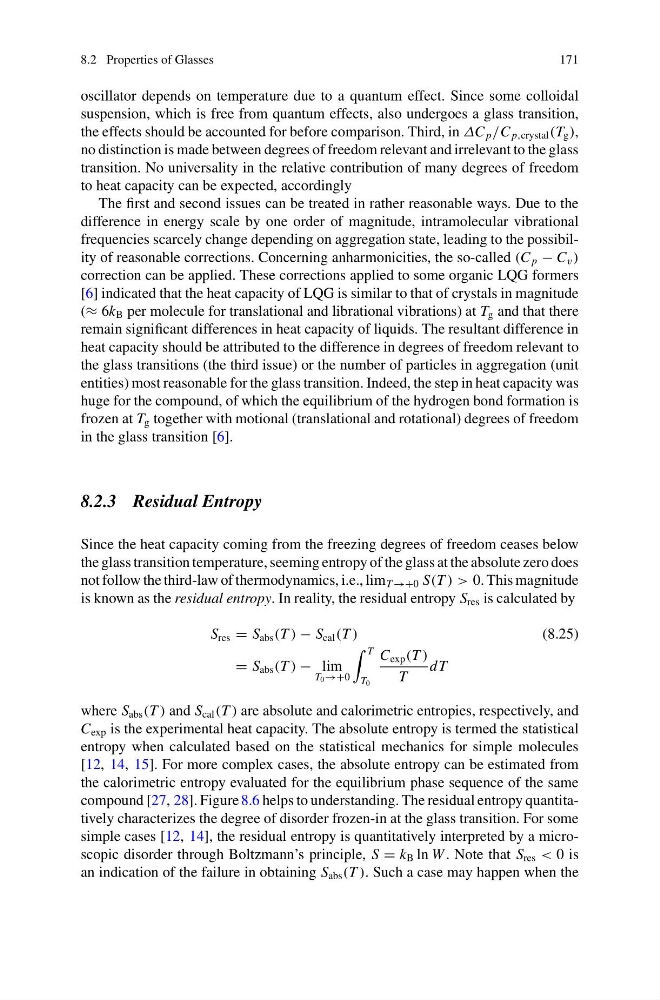
S res = S abs (T ) − S cal (T )
(8.25)
= S abs (T ) − lim
T 0 →+0
T
T 0
C exp (T )
T
dT
where S abs (T ) and S cal (T ) are absolute and calorimetric entropies, respectively, and
C exp is the experimental heat capacity. The absolute entropy is termed the statistical
entropy when calculated based on the statistical mechanics for simple molecules
[12, 14, 15]. For more complex cases, the absolute entropy can be estimated from
the calorimetric entropy evaluated for the equilibrium phase sequence of the same
compound [27, 28]. Figure 8.6 helps to understanding. The residual entropy quantitatively characterizes the degree of disorder frozen-in at the glass transition. For some
simple cases [12, 14], the residual entropy is quantitatively interpreted by a microscopic disorder through Boltzmann’s principle, S = k B ln W . Note that S res < 0 is
an indication of the failure in obtaining S abs (T ). Such a case may happen when the
171
oscillator depends on temperature due to a quantum effect. Since some colloidal
suspension, which is free from quantum effects, also undergoes a glass transition,
the effects should be accounted for before comparison. Third, in ΔC p /C p,crystal (T g ),
no distinction is made between degrees of freedom relevant and irrelevant to the glass
transition. No universality in the relative contribution of many degrees of freedom
to heat capacity can be expected, accordingly
The first and second issues can be treated in rather reasonable ways. Due to the
difference in energy scale by one order of magnitude, intramolecular vibrational
frequencies scarcely change depending on aggregation state, leading to the possibility of reasonable corrections. Concerning anharmonicities, the so-called (C p − C v )
correction can be applied. These corrections applied to some organic LQG formers
[6] indicated that the heat capacity of LQG is similar to that of crystals in magnitude
(≈ 6k B per molecule for translational and librational vibrations) at T g and that there
remain significant differences in heat capacity of liquids. The resultant difference in
heat capacity should be attributed to the difference in degrees of freedom relevant to
the glass transitions (the third issue) or the number of particles in aggregation (unit
entities) most reasonable for the glass transition. Indeed, the step in heat capacity was
huge for the compound, of which the equilibrium of the hydrogen bond formation is
frozen at T g together with motional (translational and rotational) degrees of freedom
in the glass transition [6].
8.2.3 Residual Entropy
Since the heat capacity coming from the freezing degrees of freedom ceases below
the glass transition temperature, seeming entropy of the glass at the absolute zero does
not follow the third-law of thermodynamics, i.e., lim T →+0 S(T ) > 0. This magnitude
is known as the residual entropy. In reality, the residual entropy S res is calculated by
S res = S abs (T ) − S cal (T )
(8.25)
= S abs (T ) − lim
T 0 →+0
T
T 0
C exp (T )
T
dT
where S abs (T ) and S cal (T ) are absolute and calorimetric entropies, respectively, and
C exp is the experimental heat capacity. The absolute entropy is termed the statistical
entropy when calculated based on the statistical mechanics for simple molecules
[12, 14, 15]. For more complex cases, the absolute entropy can be estimated from
the calorimetric entropy evaluated for the equilibrium phase sequence of the same
compound [27, 28]. Figure 8.6 helps to understanding. The residual entropy quantitatively characterizes the degree of disorder frozen-in at the glass transition. For some
simple cases [12, 14], the residual entropy is quantitatively interpreted by a microscopic disorder through Boltzmann’s principle, S = k B ln W . Note that S res < 0 is
an indication of the failure in obtaining S abs (T ). Such a case may happen when the