

172
8 Molecular Glasses
T
S
Cp
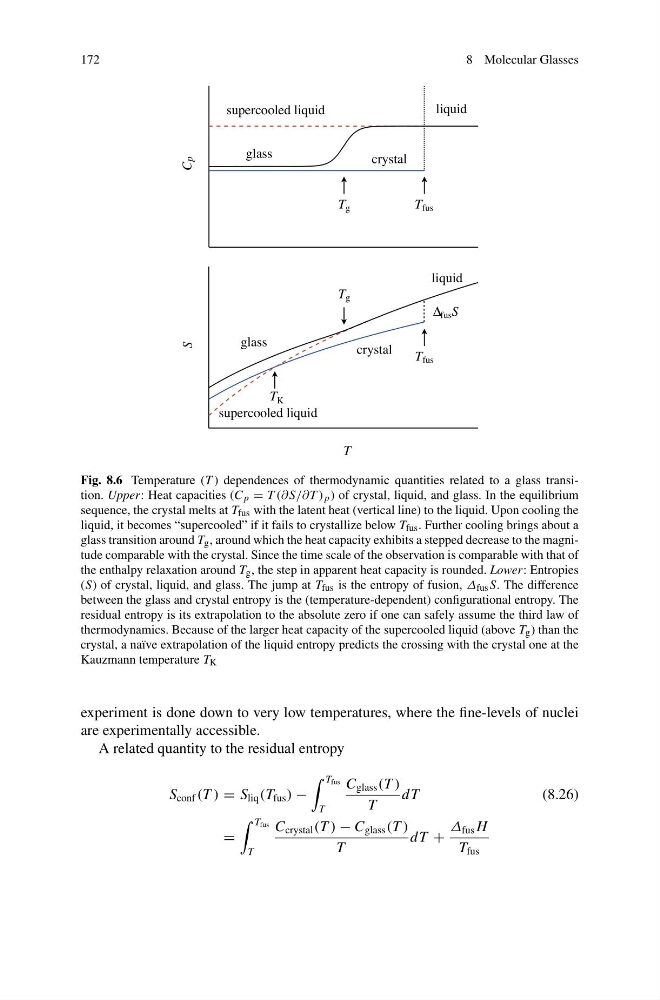
Fig. 8.6 Temperature (T ) dependences of thermodynamic quantities related to a glass transition. Upper: Heat capacities (C p = T (∂ S/∂T ) p ) of crystal, liquid, and glass. In the equilibrium
sequence, the crystal melts at T fus with the latent heat (vertical line) to the liquid. Upon cooling the
liquid, it becomes “supercooled” if it fails to crystallize below T fus . Further cooling brings about a
glass transition around T g , around which the heat capacity exhibits a stepped decrease to the magnitude comparable with the crystal. Since the time scale of the observation is comparable with that of
the enthalpy relaxation around T g , the step in apparent heat capacity is rounded. Lower: Entropies
(S) of crystal, liquid, and glass. The jump at T fus is the entropy of fusion, Δ fus S. The difference
between the glass and crystal entropy is the (temperature-dependent) configurational entropy. The
residual entropy is its extrapolation to the absolute zero if one can safely assume the third law of
thermodynamics. Because of the larger heat capacity of the supercooled liquid (above T g ) than the
crystal, a naïve extrapolation of the liquid entropy predicts the crossing with the crystal one at the
Kauzmann temperature T K
experiment is done down to very low temperatures, where the fine-levels of nuclei
are experimentally accessible.
A related quantity to the residual entropy
S conf (T ) = S liq (T fus ) −
T fus
T
C glass (T )
T
dT
(8.26)
=
T fus
T
C crystal (T ) − C glass (T )
T
dT +
Δ fus H
T fus
8 Molecular Glasses
T
S
Cp
Fig. 8.6 Temperature (T ) dependences of thermodynamic quantities related to a glass transition. Upper: Heat capacities (C p = T (∂ S/∂T ) p ) of crystal, liquid, and glass. In the equilibrium
sequence, the crystal melts at T fus with the latent heat (vertical line) to the liquid. Upon cooling the
liquid, it becomes “supercooled” if it fails to crystallize below T fus . Further cooling brings about a
glass transition around T g , around which the heat capacity exhibits a stepped decrease to the magnitude comparable with the crystal. Since the time scale of the observation is comparable with that of
the enthalpy relaxation around T g , the step in apparent heat capacity is rounded. Lower: Entropies
(S) of crystal, liquid, and glass. The jump at T fus is the entropy of fusion, Δ fus S. The difference
between the glass and crystal entropy is the (temperature-dependent) configurational entropy. The
residual entropy is its extrapolation to the absolute zero if one can safely assume the third law of
thermodynamics. Because of the larger heat capacity of the supercooled liquid (above T g ) than the
crystal, a naïve extrapolation of the liquid entropy predicts the crossing with the crystal one at the
Kauzmann temperature T K
experiment is done down to very low temperatures, where the fine-levels of nuclei
are experimentally accessible.
A related quantity to the residual entropy
S conf (T ) = S liq (T fus ) −
T fus
T
C glass (T )
T
dT
(8.26)
=
T fus
T
C crystal (T ) − C glass (T )
T
dT +
Δ fus H
T fus