

164
8 Molecular Glasses
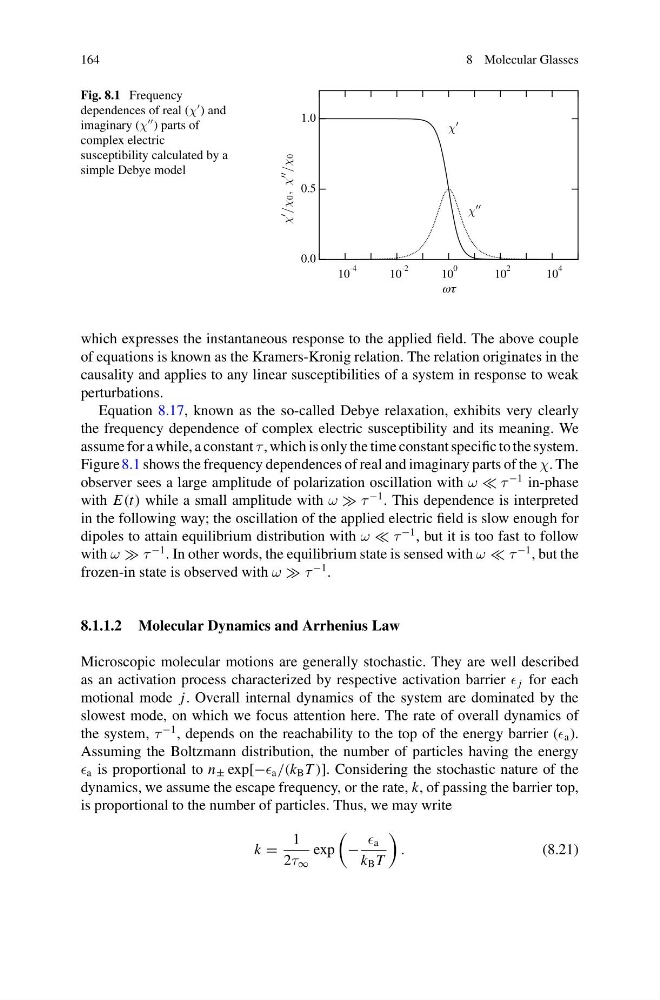
Fig. 8.1 Frequency
dependences of real (χ ) and
imaginary (χ ) parts of
complex electric
susceptibility calculated by a
simple Debye model
1.0
0.5
0.0
10
-4
10
-2
10
0
10
2
10
4
which expresses the instantaneous response to the applied field. The above couple
of equations is known as the Kramers-Kronig relation. The relation originates in the
causality and applies to any linear susceptibilities of a system in response to weak
perturbations.
Equation 8.17, known as the so-called Debye relaxation, exhibits very clearly
the frequency dependence of complex electric susceptibility and its meaning. We
assume for a while, a constant τ , which is only the time constant specific to the system.
Figure 8.1 shows the frequency dependences of real and imaginary parts of the χ. The
observer sees a large amplitude of polarization oscillation with ω τ
−1 in-phase
with E(t) while a small amplitude with ω τ
−1 . This dependence is interpreted
in the following way; the oscillation of the applied electric field is slow enough for
dipoles to attain equilibrium distribution with ω τ
−1 , but it is too fast to follow
with ω τ
−1 . In other words, the equilibrium state is sensed with ω τ
−1 , but the
frozen-in state is observed with ω τ
−1 .
8.1.1.2 Molecular Dynamics and Arrhenius Law
Microscopic molecular motions are generally stochastic. They are well described
as an activation process characterized by respective activation barrier j for each
motional mode j. Overall internal dynamics of the system are dominated by the
slowest mode, on which we focus attention here. The rate of overall dynamics of
the system, τ
−1 , depends on the reachability to the top of the energy barrier ( a ).
Assuming the Boltzmann distribution, the number of particles having the energy
a is proportional to n ± exp[− a /(k B T )]. Considering the stochastic nature of the
dynamics, we assume the escape frequency, or the rate, k, of passing the barrier top,
is proportional to the number of particles. Thus, we may write
k =
1
2τ ∞
exp
−
a
k B T
.
(8.21)
8 Molecular Glasses
Fig. 8.1 Frequency
dependences of real (χ ) and
imaginary (χ ) parts of
complex electric
susceptibility calculated by a
simple Debye model
1.0
0.5
0.0
10
-4
10
-2
10
0
10
2
10
4
which expresses the instantaneous response to the applied field. The above couple
of equations is known as the Kramers-Kronig relation. The relation originates in the
causality and applies to any linear susceptibilities of a system in response to weak
perturbations.
Equation 8.17, known as the so-called Debye relaxation, exhibits very clearly
the frequency dependence of complex electric susceptibility and its meaning. We
assume for a while, a constant τ , which is only the time constant specific to the system.
Figure 8.1 shows the frequency dependences of real and imaginary parts of the χ. The
observer sees a large amplitude of polarization oscillation with ω τ
−1 in-phase
with E(t) while a small amplitude with ω τ
−1 . This dependence is interpreted
in the following way; the oscillation of the applied electric field is slow enough for
dipoles to attain equilibrium distribution with ω τ
−1 , but it is too fast to follow
with ω τ
−1 . In other words, the equilibrium state is sensed with ω τ
−1 , but the
frozen-in state is observed with ω τ
−1 .
8.1.1.2 Molecular Dynamics and Arrhenius Law
Microscopic molecular motions are generally stochastic. They are well described
as an activation process characterized by respective activation barrier j for each
motional mode j. Overall internal dynamics of the system are dominated by the
slowest mode, on which we focus attention here. The rate of overall dynamics of
the system, τ
−1 , depends on the reachability to the top of the energy barrier ( a ).
Assuming the Boltzmann distribution, the number of particles having the energy
a is proportional to n ± exp[− a /(k B T )]. Considering the stochastic nature of the
dynamics, we assume the escape frequency, or the rate, k, of passing the barrier top,
is proportional to the number of particles. Thus, we may write
k =
1
2τ ∞
exp
−
a
k B T
.
(8.21)