

8.1 Glass as Frozen-in State
165
This is the so-called Arrhenius law. The τ
−1
∞ is often called an attempt frequency.
If two states differ in their energy by Δ = − − + > 0, the rate constant depends
on the direction of the change of states because the apparent hight of the energy barrier
differs from one side to another side. In the equilibrium, the following should hold
n + : n − = 1 : exp
−
Δ
k B T
.
(8.22)
This demands
k −
k +
= exp
−
Δ
k B T
.
(8.23)
This is an example of a requirement of detailed balance.
The attempt frequency usually has an order of those of molecular vibrations.
Equation 8.21 implies that the rate of the slowest mode decreases very rapidly with
decreasing temperature. Since thermal equilibrium is attained through visiting representative microscopic states by the system, the system cannot attain a thermal
equilibrium within a reasonable time if k becomes very small. Namely, on going
to low temperatures, one should consider the possibility of the state being out of
thermal equilibrium for any systems. Note that τ = k
−1 serves as a relaxation time
for thermalization because it determines the overall speed of the relaxation to the
equilibrium state.
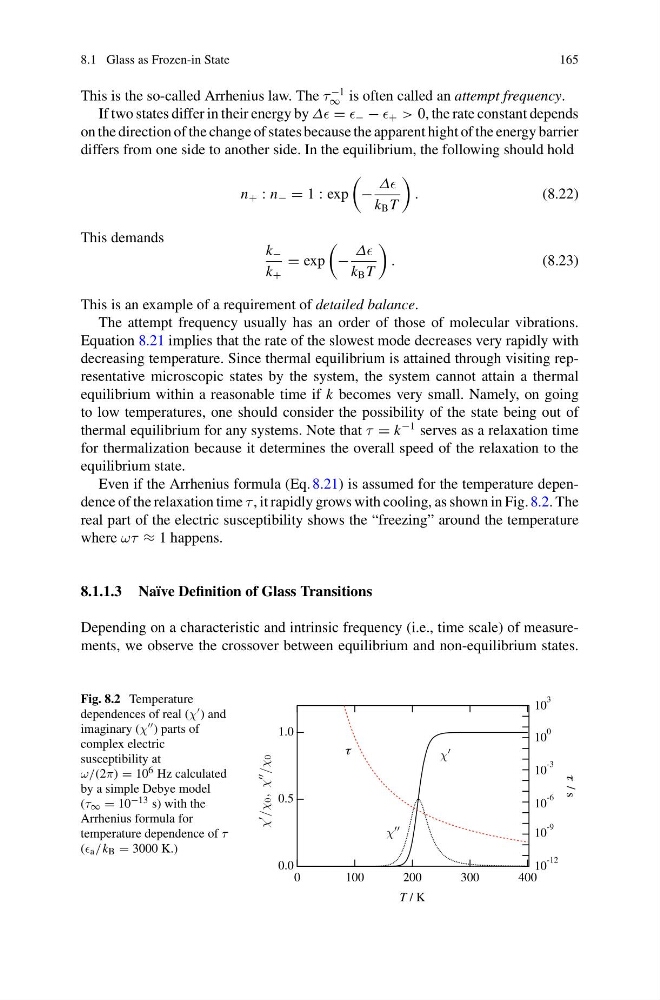
Even if the Arrhenius formula (Eq. 8.21) is assumed for the temperature dependence of the relaxation time τ , it rapidly grows with cooling, as shown in Fig. 8.2. The
real part of the electric susceptibility shows the “freezing” around the temperature
where ωτ ≈ 1 happens.
8.1.1.3 Naïve Definition of Glass Transitions
Depending on a characteristic and intrinsic frequency (i.e., time scale) of measurements, we observe the crossover between equilibrium and non-equilibrium states.
Fig. 8.2 Temperature
dependences of real (χ ) and
imaginary (χ ) parts of
complex electric
susceptibility at
ω/(2π) = 10 6 Hz calculated
by a simple Debye model
(τ ∞ = 10 −13 s) with the
Arrhenius formula for
temperature dependence of τ
( a /k B = 3000 K.)
1.0
0.5
0.0
400
300
200
100
0
T / K
10
-12
10
-9
10
-6
10
-3
10
0
10
3
/ s
165
This is the so-called Arrhenius law. The τ
−1
∞ is often called an attempt frequency.
If two states differ in their energy by Δ = − − + > 0, the rate constant depends
on the direction of the change of states because the apparent hight of the energy barrier
differs from one side to another side. In the equilibrium, the following should hold
n + : n − = 1 : exp
−
Δ
k B T
.
(8.22)
This demands
k −
k +
= exp
−
Δ
k B T
.
(8.23)
This is an example of a requirement of detailed balance.
The attempt frequency usually has an order of those of molecular vibrations.
Equation 8.21 implies that the rate of the slowest mode decreases very rapidly with
decreasing temperature. Since thermal equilibrium is attained through visiting representative microscopic states by the system, the system cannot attain a thermal
equilibrium within a reasonable time if k becomes very small. Namely, on going
to low temperatures, one should consider the possibility of the state being out of
thermal equilibrium for any systems. Note that τ = k
−1 serves as a relaxation time
for thermalization because it determines the overall speed of the relaxation to the
equilibrium state.
Even if the Arrhenius formula (Eq. 8.21) is assumed for the temperature dependence of the relaxation time τ , it rapidly grows with cooling, as shown in Fig. 8.2. The
real part of the electric susceptibility shows the “freezing” around the temperature
where ωτ ≈ 1 happens.
8.1.1.3 Naïve Definition of Glass Transitions
Depending on a characteristic and intrinsic frequency (i.e., time scale) of measurements, we observe the crossover between equilibrium and non-equilibrium states.
Fig. 8.2 Temperature
dependences of real (χ ) and
imaginary (χ ) parts of
complex electric
susceptibility at
ω/(2π) = 10 6 Hz calculated
by a simple Debye model
(τ ∞ = 10 −13 s) with the
Arrhenius formula for
temperature dependence of τ
( a /k B = 3000 K.)
1.0
0.5
0.0
400
300
200
100
0
T / K
10
-12
10
-9
10
-6
10
-3
10
0
10
3
/ s