

8.1 Glass as Frozen-in State
163
Using an averaged polarization per particle, p = Δn/n, the rate equation (Eq. 8.3)
becomes
dp
dt
= −
1
τ
( p − χ 0 E) .
(8.12)
When the electric field is oscillating like
E(t) = E 0 e
−iωt
,
(8.13)
the averaged polarization also oscillates in the same frequency ω as
p(t) = p 0 e
−iωt
(8.14)
in the steady state. Putting these into Eq. 8.12 leads to
− iω p(t) = −
1
τ
[ p(t) − χ 0 E(t)] ,
(8.15)
yielding
χ 0 E(t) = (1 − iωτ ) p(t).
(8.16)
Thus, the constant characterizing the polarization response to the electric field is
given by
χ(ω) =
1
1 − iωτ
χ 0
= χ 0
1
1 + (ωτ ) 2 + i
ωτ
1 + (ωτ ) 2
(8.17)
= χ
(ω) + iχ
(ω).
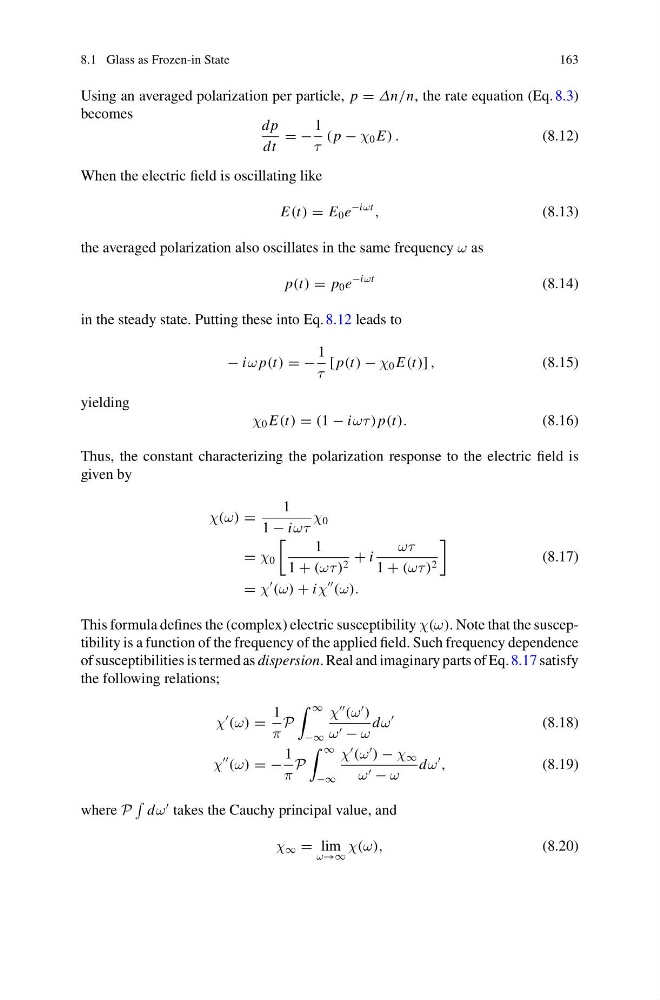
This formula defines the (complex) electric susceptibility χ(ω). Note that the susceptibility is a function of the frequency of the applied field. Such frequency dependence
of susceptibilities is termed as dispersion. Real and imaginary parts of Eq. 8.17 satisfy
the following relations;
χ
(ω) =
1
π
P
∞
−∞
χ
(ω
)
ω − ω
dω
(8.18)
χ
(ω) = −
1
π
P
∞
−∞
χ
(ω
) − χ ∞
ω − ω
dω
,
(8.19)
where P
dω
takes the Cauchy principal value, and
χ ∞ = lim
ω→∞
χ(ω),
(8.20)
163
Using an averaged polarization per particle, p = Δn/n, the rate equation (Eq. 8.3)
becomes
dp
dt
= −
1
τ
( p − χ 0 E) .
(8.12)
When the electric field is oscillating like
E(t) = E 0 e
−iωt
,
(8.13)
the averaged polarization also oscillates in the same frequency ω as
p(t) = p 0 e
−iωt
(8.14)
in the steady state. Putting these into Eq. 8.12 leads to
− iω p(t) = −
1
τ
[ p(t) − χ 0 E(t)] ,
(8.15)
yielding
χ 0 E(t) = (1 − iωτ ) p(t).
(8.16)
Thus, the constant characterizing the polarization response to the electric field is
given by
χ(ω) =
1
1 − iωτ
χ 0
= χ 0
1
1 + (ωτ ) 2 + i
ωτ
1 + (ωτ ) 2
(8.17)
= χ
(ω) + iχ
(ω).
This formula defines the (complex) electric susceptibility χ(ω). Note that the susceptibility is a function of the frequency of the applied field. Such frequency dependence
of susceptibilities is termed as dispersion. Real and imaginary parts of Eq. 8.17 satisfy
the following relations;
χ
(ω) =
1
π
P
∞
−∞
χ
(ω
)
ω − ω
dω
(8.18)
χ
(ω) = −
1
π
P
∞
−∞
χ
(ω
) − χ ∞
ω − ω
dω
,
(8.19)
where P
dω
takes the Cauchy principal value, and
χ ∞ = lim
ω→∞
χ(ω),
(8.20)