

162
8 Molecular Glasses
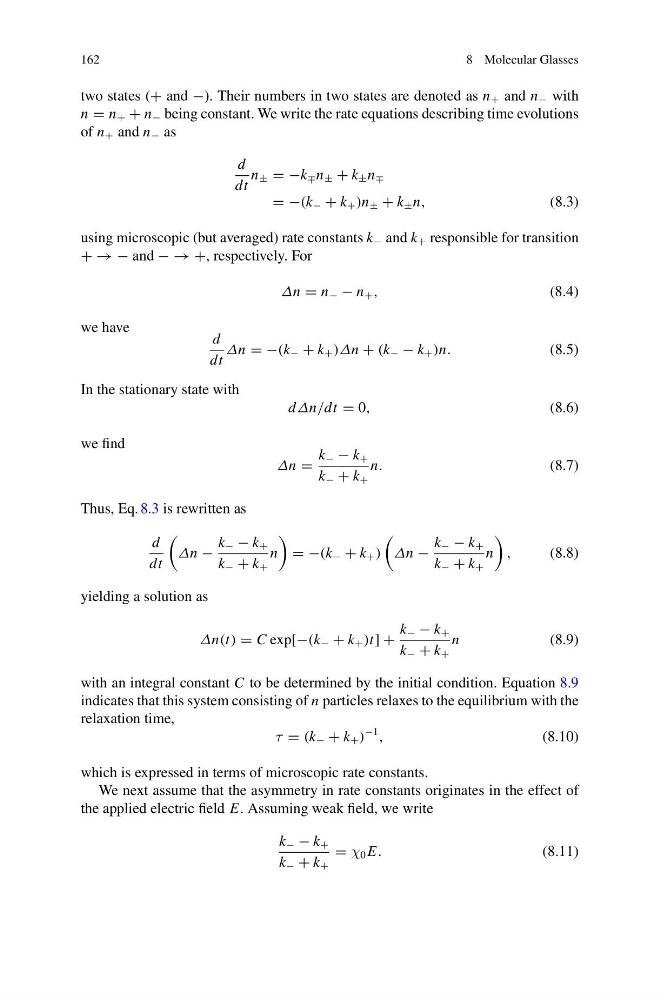
two states (+ and −). Their numbers in two states are denoted as n + and n − with
n = n + + n − being constant. We write the rate equations describing time evolutions
of n + and n − as
d
dt
n ± = −k ∓ n ± + k ± n ∓
= −(k − + k + )n ± + k ± n,
(8.3)
using microscopic (but averaged) rate constants k − and k + responsible for transition
+ → − and − → +, respectively. For
Δn = n − − n + ,
(8.4)
we have
d
dt
Δn = −(k − + k + )Δn + (k − − k + )n.
(8.5)
In the stationary state with
dΔn/dt = 0,
(8.6)
we find
Δn =
k − − k +
k − + k +
n.
(8.7)
Thus, Eq. 8.3 is rewritten as
d
dt
Δn −
k − − k +
k − + k +
n
= −(k − + k + )
Δn −
k − − k +
k − + k +
n
,
(8.8)
yielding a solution as
Δn(t) = C exp[−(k − + k + )t] +
k − − k +
k − + k +
n
(8.9)
with an integral constant C to be determined by the initial condition. Equation 8.9
indicates that this system consisting of n particles relaxes to the equilibrium with the
relaxation time,
τ = (k − + k + )
−1
,
(8.10)
which is expressed in terms of microscopic rate constants.
We next assume that the asymmetry in rate constants originates in the effect of
the applied electric field E. Assuming weak field, we write
k − − k +
k − + k +
= χ 0 E.
(8.11)
8 Molecular Glasses
two states (+ and −). Their numbers in two states are denoted as n + and n − with
n = n + + n − being constant. We write the rate equations describing time evolutions
of n + and n − as
d
dt
n ± = −k ∓ n ± + k ± n ∓
= −(k − + k + )n ± + k ± n,
(8.3)
using microscopic (but averaged) rate constants k − and k + responsible for transition
+ → − and − → +, respectively. For
Δn = n − − n + ,
(8.4)
we have
d
dt
Δn = −(k − + k + )Δn + (k − − k + )n.
(8.5)
In the stationary state with
dΔn/dt = 0,
(8.6)
we find
Δn =
k − − k +
k − + k +
n.
(8.7)
Thus, Eq. 8.3 is rewritten as
d
dt
Δn −
k − − k +
k − + k +
n
= −(k − + k + )
Δn −
k − − k +
k − + k +
n
,
(8.8)
yielding a solution as
Δn(t) = C exp[−(k − + k + )t] +
k − − k +
k − + k +
n
(8.9)
with an integral constant C to be determined by the initial condition. Equation 8.9
indicates that this system consisting of n particles relaxes to the equilibrium with the
relaxation time,
τ = (k − + k + )
−1
,
(8.10)
which is expressed in terms of microscopic rate constants.
We next assume that the asymmetry in rate constants originates in the effect of
the applied electric field E. Assuming weak field, we write
k − − k +
k − + k +
= χ 0 E.
(8.11)