

7.4 Molecular Shape and Aggregation in Lyotropics
159
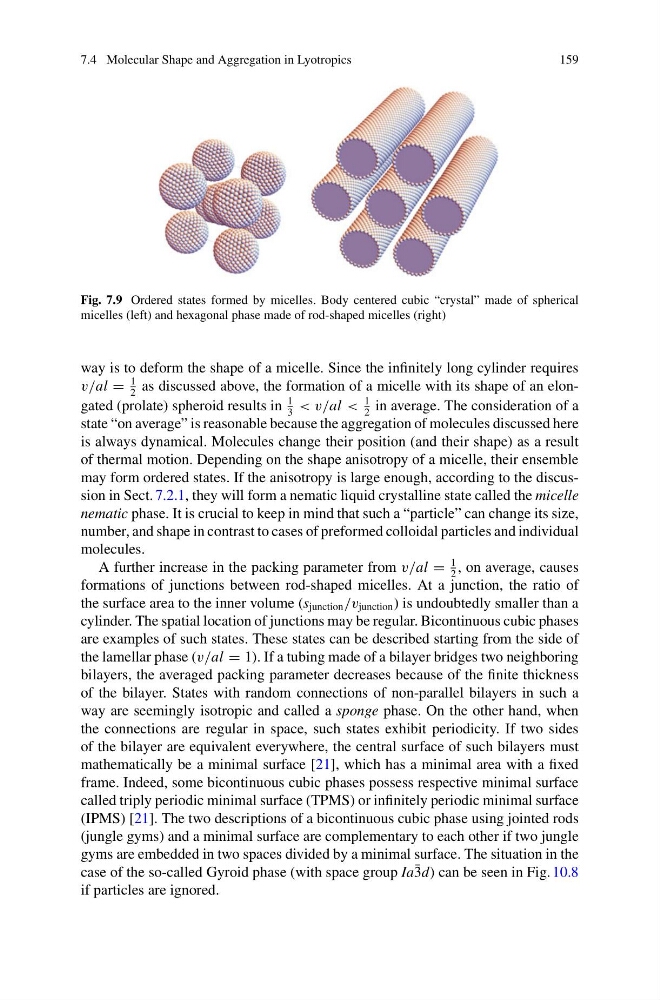
Fig. 7.9 Ordered states formed by micelles. Body centered cubic “crystal” made of spherical
micelles (left) and hexagonal phase made of rod-shaped micelles (right)
way is to deform the shape of a micelle. Since the infinitely long cylinder requires
v/al =
1
2
as discussed above, the formation of a micelle with its shape of an elongated (prolate) spheroid results in
1
3
< v/al <
1
2
in average. The consideration of a
state “on average” is reasonable because the aggregation of molecules discussed here
is always dynamical. Molecules change their position (and their shape) as a result
of thermal motion. Depending on the shape anisotropy of a micelle, their ensemble
may form ordered states. If the anisotropy is large enough, according to the discussion in Sect. 7.2.1, they will form a nematic liquid crystalline state called the micelle
nematic phase. It is crucial to keep in mind that such a “particle” can change its size,
number, and shape in contrast to cases of preformed colloidal particles and individual
molecules.
A further increase in the packing parameter from v/al =
1
2
, on average, causes
formations of junctions between rod-shaped micelles. At a junction, the ratio of
the surface area to the inner volume (s junction /v junction ) is undoubtedly smaller than a
cylinder. The spatial location of junctions may be regular. Bicontinuous cubic phases
are examples of such states. These states can be described starting from the side of
the lamellar phase (v/al = 1). If a tubing made of a bilayer bridges two neighboring
bilayers, the averaged packing parameter decreases because of the finite thickness
of the bilayer. States with random connections of non-parallel bilayers in such a
way are seemingly isotropic and called a sponge phase. On the other hand, when
the connections are regular in space, such states exhibit periodicity. If two sides
of the bilayer are equivalent everywhere, the central surface of such bilayers must
mathematically be a minimal surface [21], which has a minimal area with a fixed
frame. Indeed, some bicontinuous cubic phases possess respective minimal surface
called triply periodic minimal surface (TPMS) or infinitely periodic minimal surface
(IPMS) [21]. The two descriptions of a bicontinuous cubic phase using jointed rods
(jungle gyms) and a minimal surface are complementary to each other if two jungle
gyms are embedded in two spaces divided by a minimal surface. The situation in the
case of the so-called Gyroid phase (with space group Ia ¯
3d) can be seen in Fig. 10.8
if particles are ignored.
159
Fig. 7.9 Ordered states formed by micelles. Body centered cubic “crystal” made of spherical
micelles (left) and hexagonal phase made of rod-shaped micelles (right)
way is to deform the shape of a micelle. Since the infinitely long cylinder requires
v/al =
1
2
as discussed above, the formation of a micelle with its shape of an elongated (prolate) spheroid results in
1
3
< v/al <
1
2
in average. The consideration of a
state “on average” is reasonable because the aggregation of molecules discussed here
is always dynamical. Molecules change their position (and their shape) as a result
of thermal motion. Depending on the shape anisotropy of a micelle, their ensemble
may form ordered states. If the anisotropy is large enough, according to the discussion in Sect. 7.2.1, they will form a nematic liquid crystalline state called the micelle
nematic phase. It is crucial to keep in mind that such a “particle” can change its size,
number, and shape in contrast to cases of preformed colloidal particles and individual
molecules.
A further increase in the packing parameter from v/al =
1
2
, on average, causes
formations of junctions between rod-shaped micelles. At a junction, the ratio of
the surface area to the inner volume (s junction /v junction ) is undoubtedly smaller than a
cylinder. The spatial location of junctions may be regular. Bicontinuous cubic phases
are examples of such states. These states can be described starting from the side of
the lamellar phase (v/al = 1). If a tubing made of a bilayer bridges two neighboring
bilayers, the averaged packing parameter decreases because of the finite thickness
of the bilayer. States with random connections of non-parallel bilayers in such a
way are seemingly isotropic and called a sponge phase. On the other hand, when
the connections are regular in space, such states exhibit periodicity. If two sides
of the bilayer are equivalent everywhere, the central surface of such bilayers must
mathematically be a minimal surface [21], which has a minimal area with a fixed
frame. Indeed, some bicontinuous cubic phases possess respective minimal surface
called triply periodic minimal surface (TPMS) or infinitely periodic minimal surface
(IPMS) [21]. The two descriptions of a bicontinuous cubic phase using jointed rods
(jungle gyms) and a minimal surface are complementary to each other if two jungle
gyms are embedded in two spaces divided by a minimal surface. The situation in the
case of the so-called Gyroid phase (with space group Ia ¯
3d) can be seen in Fig. 10.8
if particles are ignored.