

158
7 Liquid Crystals
a a
l
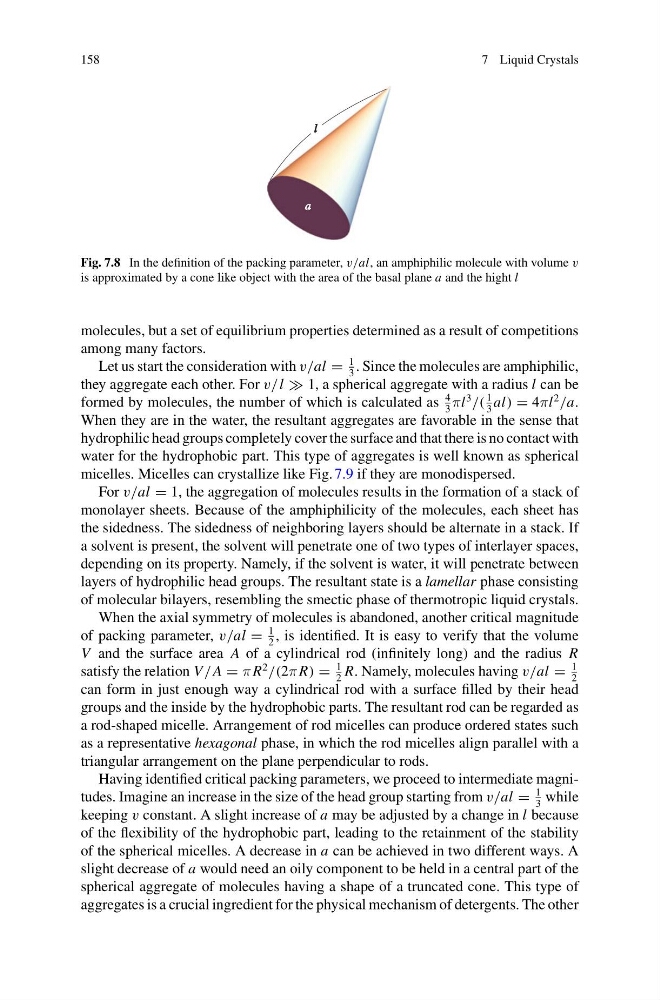
Fig. 7.8 In the definition of the packing parameter, v/al, an amphiphilic molecule with volume v
is approximated by a cone like object with the area of the basal plane a and the hight l
molecules, but a set of equilibrium properties determined as a result of competitions
among many factors.
Let us start the consideration with v/al =
1
3
. Since the molecules are amphiphilic,
they aggregate each other. For v/l 1, a spherical aggregate with a radius l can be
formed by molecules, the number of which is calculated as
4
3
πl
3
/(
1
3
al) = 4πl
2
/a.
When they are in the water, the resultant aggregates are favorable in the sense that
hydrophilic head groups completely cover the surface and that there is no contact with
water for the hydrophobic part. This type of aggregates is well known as spherical
micelles. Micelles can crystallize like Fig. 7.9 if they are monodispersed.
For v/al = 1, the aggregation of molecules results in the formation of a stack of
monolayer sheets. Because of the amphiphilicity of the molecules, each sheet has
the sidedness. The sidedness of neighboring layers should be alternate in a stack. If
a solvent is present, the solvent will penetrate one of two types of interlayer spaces,
depending on its property. Namely, if the solvent is water, it will penetrate between
layers of hydrophilic head groups. The resultant state is a lamellar phase consisting
of molecular bilayers, resembling the smectic phase of thermotropic liquid crystals.
When the axial symmetry of molecules is abandoned, another critical magnitude
of packing parameter, v/al =
1
2
, is identified. It is easy to verify that the volume
V and the surface area A of a cylindrical rod (infinitely long) and the radius R
satisfy the relation V /A = π R
2
/(2π R) =
1
2
R. Namely, molecules having v/al =
1
2
can form in just enough way a cylindrical rod with a surface filled by their head
groups and the inside by the hydrophobic parts. The resultant rod can be regarded as
a rod-shaped micelle. Arrangement of rod micelles can produce ordered states such
as a representative hexagonal phase, in which the rod micelles align parallel with a
triangular arrangement on the plane perpendicular to rods.
Having identified critical packing parameters, we proceed to intermediate magnitudes. Imagine an increase in the size of the head group starting from v/al =
1
3
while
keeping v constant. A slight increase of a may be adjusted by a change in l because
of the flexibility of the hydrophobic part, leading to the retainment of the stability
of the spherical micelles. A decrease in a can be achieved in two different ways. A
slight decrease of a would need an oily component to be held in a central part of the
spherical aggregate of molecules having a shape of a truncated cone. This type of
aggregates is a crucial ingredient for the physical mechanism of detergents. The other
7 Liquid Crystals
a a
l
Fig. 7.8 In the definition of the packing parameter, v/al, an amphiphilic molecule with volume v
is approximated by a cone like object with the area of the basal plane a and the hight l
molecules, but a set of equilibrium properties determined as a result of competitions
among many factors.
Let us start the consideration with v/al =
1
3
. Since the molecules are amphiphilic,
they aggregate each other. For v/l 1, a spherical aggregate with a radius l can be
formed by molecules, the number of which is calculated as
4
3
πl
3
/(
1
3
al) = 4πl
2
/a.
When they are in the water, the resultant aggregates are favorable in the sense that
hydrophilic head groups completely cover the surface and that there is no contact with
water for the hydrophobic part. This type of aggregates is well known as spherical
micelles. Micelles can crystallize like Fig. 7.9 if they are monodispersed.
For v/al = 1, the aggregation of molecules results in the formation of a stack of
monolayer sheets. Because of the amphiphilicity of the molecules, each sheet has
the sidedness. The sidedness of neighboring layers should be alternate in a stack. If
a solvent is present, the solvent will penetrate one of two types of interlayer spaces,
depending on its property. Namely, if the solvent is water, it will penetrate between
layers of hydrophilic head groups. The resultant state is a lamellar phase consisting
of molecular bilayers, resembling the smectic phase of thermotropic liquid crystals.
When the axial symmetry of molecules is abandoned, another critical magnitude
of packing parameter, v/al =
1
2
, is identified. It is easy to verify that the volume
V and the surface area A of a cylindrical rod (infinitely long) and the radius R
satisfy the relation V /A = π R
2
/(2π R) =
1
2
R. Namely, molecules having v/al =
1
2
can form in just enough way a cylindrical rod with a surface filled by their head
groups and the inside by the hydrophobic parts. The resultant rod can be regarded as
a rod-shaped micelle. Arrangement of rod micelles can produce ordered states such
as a representative hexagonal phase, in which the rod micelles align parallel with a
triangular arrangement on the plane perpendicular to rods.
Having identified critical packing parameters, we proceed to intermediate magnitudes. Imagine an increase in the size of the head group starting from v/al =
1
3
while
keeping v constant. A slight increase of a may be adjusted by a change in l because
of the flexibility of the hydrophobic part, leading to the retainment of the stability
of the spherical micelles. A decrease in a can be achieved in two different ways. A
slight decrease of a would need an oily component to be held in a central part of the
spherical aggregate of molecules having a shape of a truncated cone. This type of
aggregates is a crucial ingredient for the physical mechanism of detergents. The other