

7.3 Effects of Molecular Shape
157
To go beyond the nearest-neighbor interaction, the following interaction was
assumed for next-nearest neighbors:
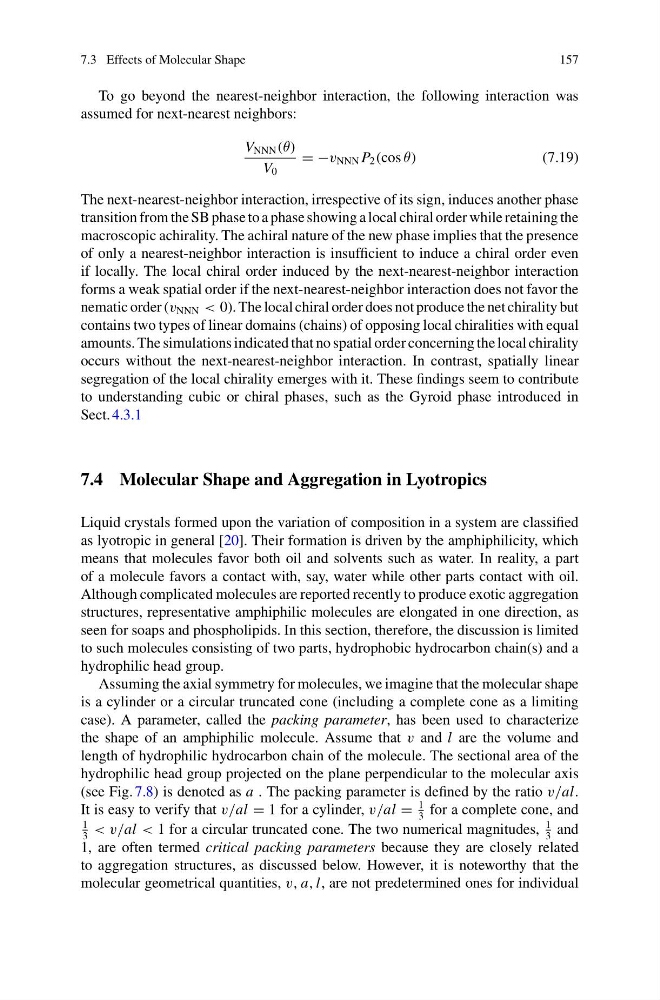
V NNN (θ)
V 0
= −v NNN P 2 (cos θ)
(7.19)
The next-nearest-neighbor interaction, irrespective of its sign, induces another phase
transition from the SB phase to a phase showing a local chiral order while retaining the
macroscopic achirality. The achiral nature of the new phase implies that the presence
of only a nearest-neighbor interaction is insufficient to induce a chiral order even
if locally. The local chiral order induced by the next-nearest-neighbor interaction
forms a weak spatial order if the next-nearest-neighbor interaction does not favor the
nematic order (v NNN < 0). The local chiral order does not produce the net chirality but
contains two types of linear domains (chains) of opposing local chiralities with equal
amounts. The simulations indicated that no spatial order concerning the local chirality
occurs without the next-nearest-neighbor interaction. In contrast, spatially linear
segregation of the local chirality emerges with it. These findings seem to contribute
to understanding cubic or chiral phases, such as the Gyroid phase introduced in
Sect. 4.3.1
7.4 Molecular Shape and Aggregation in Lyotropics
Liquid crystals formed upon the variation of composition in a system are classified
as lyotropic in general [20]. Their formation is driven by the amphiphilicity, which
means that molecules favor both oil and solvents such as water. In reality, a part
of a molecule favors a contact with, say, water while other parts contact with oil.
Although complicated molecules are reported recently to produce exotic aggregation
structures, representative amphiphilic molecules are elongated in one direction, as
seen for soaps and phospholipids. In this section, therefore, the discussion is limited
to such molecules consisting of two parts, hydrophobic hydrocarbon chain(s) and a
hydrophilic head group.
Assuming the axial symmetry for molecules, we imagine that the molecular shape
is a cylinder or a circular truncated cone (including a complete cone as a limiting
case). A parameter, called the packing parameter, has been used to characterize
the shape of an amphiphilic molecule. Assume that v and l are the volume and
length of hydrophilic hydrocarbon chain of the molecule. The sectional area of the
hydrophilic head group projected on the plane perpendicular to the molecular axis
(see Fig. 7.8) is denoted as a . The packing parameter is defined by the ratio v/al.
It is easy to verify that v/al = 1 for a cylinder, v/al =
1
3
for a complete cone, and
1
3
< v/al < 1 for a circular truncated cone. The two numerical magnitudes,
1
3
and
1, are often termed critical packing parameters because they are closely related
to aggregation structures, as discussed below. However, it is noteworthy that the
molecular geometrical quantities, v, a, l, are not predetermined ones for individual
157
To go beyond the nearest-neighbor interaction, the following interaction was
assumed for next-nearest neighbors:
V NNN (θ)
V 0
= −v NNN P 2 (cos θ)
(7.19)
The next-nearest-neighbor interaction, irrespective of its sign, induces another phase
transition from the SB phase to a phase showing a local chiral order while retaining the
macroscopic achirality. The achiral nature of the new phase implies that the presence
of only a nearest-neighbor interaction is insufficient to induce a chiral order even
if locally. The local chiral order induced by the next-nearest-neighbor interaction
forms a weak spatial order if the next-nearest-neighbor interaction does not favor the
nematic order (v NNN < 0). The local chiral order does not produce the net chirality but
contains two types of linear domains (chains) of opposing local chiralities with equal
amounts. The simulations indicated that no spatial order concerning the local chirality
occurs without the next-nearest-neighbor interaction. In contrast, spatially linear
segregation of the local chirality emerges with it. These findings seem to contribute
to understanding cubic or chiral phases, such as the Gyroid phase introduced in
Sect. 4.3.1
7.4 Molecular Shape and Aggregation in Lyotropics
Liquid crystals formed upon the variation of composition in a system are classified
as lyotropic in general [20]. Their formation is driven by the amphiphilicity, which
means that molecules favor both oil and solvents such as water. In reality, a part
of a molecule favors a contact with, say, water while other parts contact with oil.
Although complicated molecules are reported recently to produce exotic aggregation
structures, representative amphiphilic molecules are elongated in one direction, as
seen for soaps and phospholipids. In this section, therefore, the discussion is limited
to such molecules consisting of two parts, hydrophobic hydrocarbon chain(s) and a
hydrophilic head group.
Assuming the axial symmetry for molecules, we imagine that the molecular shape
is a cylinder or a circular truncated cone (including a complete cone as a limiting
case). A parameter, called the packing parameter, has been used to characterize
the shape of an amphiphilic molecule. Assume that v and l are the volume and
length of hydrophilic hydrocarbon chain of the molecule. The sectional area of the
hydrophilic head group projected on the plane perpendicular to the molecular axis
(see Fig. 7.8) is denoted as a . The packing parameter is defined by the ratio v/al.
It is easy to verify that v/al = 1 for a cylinder, v/al =
1
3
for a complete cone, and
1
3
< v/al < 1 for a circular truncated cone. The two numerical magnitudes,
1
3
and
1, are often termed critical packing parameters because they are closely related
to aggregation structures, as discussed below. However, it is noteworthy that the
molecular geometrical quantities, v, a, l, are not predetermined ones for individual