

152
7 Liquid Crystals
It is noteworthy that the volume of the considered system is kept from outside
because the treatment assumes the classical gas consisting of anisotropic particles.
The result can, therefore, be compared directly with gasses at extremely high density,
and colloidal dispersion, the volume of which is kept by that of the solvent. Attractive
interaction between particles is necessary for a system having its inherent volume.
7.2.2 Maier–Saupe Theory
The Onsager theory described in the previous section surely works for some class
of liquid crystals, especially of lyotropic ones. However, the theory is abstract for
a framework of molecular understanding of liquid crystals. A model for treating,
at least, “smooth” intermolecular interaction is necessary. The most concise yet
successful one is known as the Maier–Saupe theory [17]. The Maier–Saupe theory
considers only an angle-dependent part of intermolecular interaction between rodlike
(often termed “calamitic”) molecules. The assumed interaction is
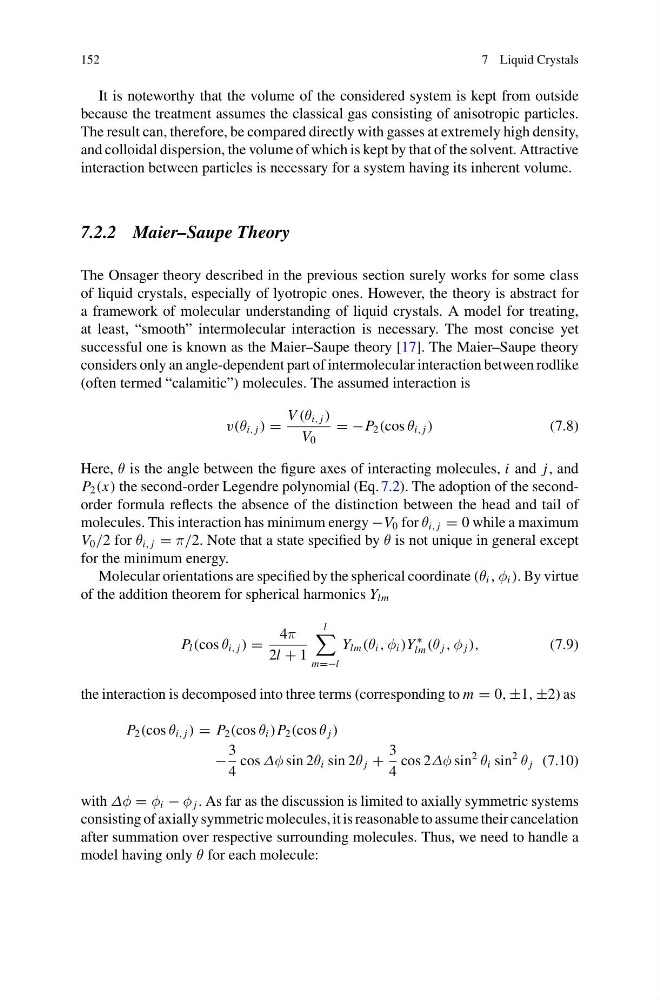
v(θ i, j ) =
V (θ i, j )
V 0
= −P 2 (cos θ i, j )
(7.8)
Here, θ is the angle between the figure axes of interacting molecules, i and j, and
P 2 (x) the second-order Legendre polynomial (Eq. 7.2). The adoption of the secondorder formula reflects the absence of the distinction between the head and tail of
molecules. This interaction has minimum energy −V 0 for θ i, j = 0 while a maximum
V 0 /2 for θ i, j = π/2. Note that a state specified by θ is not unique in general except
for the minimum energy.
Molecular orientations are specified by the spherical coordinate (θ i , φ i ). By virtue
of the addition theorem for spherical harmonics Y lm
P l (cos θ i, j ) =
4π
2l + 1
l
m=−l
Y lm (θ i , φ i )Y
∗
lm (θ j , φ j ),
(7.9)
the interaction is decomposed into three terms (corresponding to m = 0, ±1, ±2) as
P 2 (cos θ i, j ) = P 2 (cos θ i )P 2 (cos θ j )
−
3
4
cos Δφ sin 2θ i sin 2θ j +
3
4
cos 2Δφ sin
2
θ i sin
2
θ j (7.10)
with Δφ = φ i − φ j . As far as the discussion is limited to axially symmetric systems
consisting of axially symmetric molecules, it is reasonable to assume their cancelation
after summation over respective surrounding molecules. Thus, we need to handle a
model having only θ for each molecule:
7 Liquid Crystals
It is noteworthy that the volume of the considered system is kept from outside
because the treatment assumes the classical gas consisting of anisotropic particles.
The result can, therefore, be compared directly with gasses at extremely high density,
and colloidal dispersion, the volume of which is kept by that of the solvent. Attractive
interaction between particles is necessary for a system having its inherent volume.
7.2.2 Maier–Saupe Theory
The Onsager theory described in the previous section surely works for some class
of liquid crystals, especially of lyotropic ones. However, the theory is abstract for
a framework of molecular understanding of liquid crystals. A model for treating,
at least, “smooth” intermolecular interaction is necessary. The most concise yet
successful one is known as the Maier–Saupe theory [17]. The Maier–Saupe theory
considers only an angle-dependent part of intermolecular interaction between rodlike
(often termed “calamitic”) molecules. The assumed interaction is
v(θ i, j ) =
V (θ i, j )
V 0
= −P 2 (cos θ i, j )
(7.8)
Here, θ is the angle between the figure axes of interacting molecules, i and j, and
P 2 (x) the second-order Legendre polynomial (Eq. 7.2). The adoption of the secondorder formula reflects the absence of the distinction between the head and tail of
molecules. This interaction has minimum energy −V 0 for θ i, j = 0 while a maximum
V 0 /2 for θ i, j = π/2. Note that a state specified by θ is not unique in general except
for the minimum energy.
Molecular orientations are specified by the spherical coordinate (θ i , φ i ). By virtue
of the addition theorem for spherical harmonics Y lm
P l (cos θ i, j ) =
4π
2l + 1
l
m=−l
Y lm (θ i , φ i )Y
∗
lm (θ j , φ j ),
(7.9)
the interaction is decomposed into three terms (corresponding to m = 0, ±1, ±2) as
P 2 (cos θ i, j ) = P 2 (cos θ i )P 2 (cos θ j )
−
3
4
cos Δφ sin 2θ i sin 2θ j +
3
4
cos 2Δφ sin
2
θ i sin
2
θ j (7.10)
with Δφ = φ i − φ j . As far as the discussion is limited to axially symmetric systems
consisting of axially symmetric molecules, it is reasonable to assume their cancelation
after summation over respective surrounding molecules. Thus, we need to handle a
model having only θ for each molecule: