

7.2 Effects of Molecular Anisotropy
151
The orientational distribution function f (ω) should minimize the free energy
density given by Eq. 7.4, The uniform distribution f (ω) =
1
4π
, corresponding to
the isotropic fluid, satisfies the requirement, irrespective of the density c. On the
other hand, a variational determination of f (ω) in a general form is a formidable
task in general. Onsager showed that the integration in Eq. 7.4 could be performed
analytically if the following functional form is assumed:
f (ω) =
α
4π sinh α
cosh(α cos θ)
(7.7)
with α being a parameter characterizing the anisotropic distribution of particles’ orientations. The null value of α corresponds to the uniform distribution, and a more
positive α represents a more anisotropic distribution. After the analytical integration
in Eq. 7.4, free energy is obtained as a function of α. Standard procedure for finding
the minimum (d F(α)/dα = 0 and d
2 F(α)/dα
2
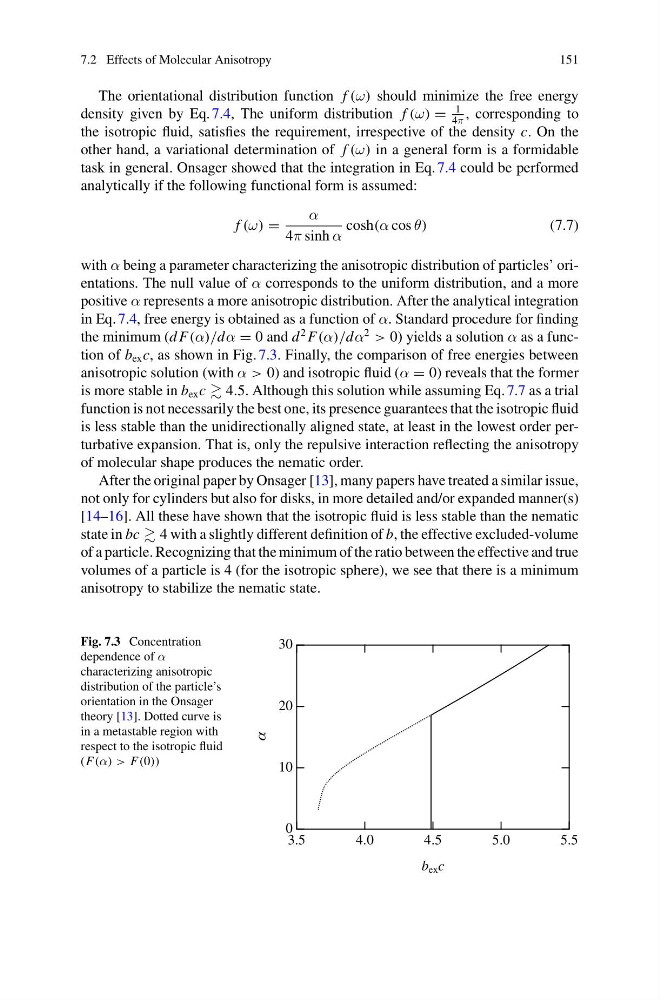
> 0) yields a solution α as a function of b ex c, as shown in Fig. 7.3. Finally, the comparison of free energies between
anisotropic solution (with α > 0) and isotropic fluid (α = 0) reveals that the former
is more stable in b ex c 4.5. Although this solution while assuming Eq. 7.7 as a trial
function is not necessarily the best one, its presence guarantees that the isotropic fluid
is less stable than the unidirectionally aligned state, at least in the lowest order perturbative expansion. That is, only the repulsive interaction reflecting the anisotropy
of molecular shape produces the nematic order.
After the original paper by Onsager [13], many papers have treated a similar issue,
not only for cylinders but also for disks, in more detailed and/or expanded manner(s)
[14–16]. All these have shown that the isotropic fluid is less stable than the nematic
state in bc 4 with a slightly different definition of b, the effective excluded-volume
of a particle. Recognizing that the minimum of the ratio between the effective and true
volumes of a particle is 4 (for the isotropic sphere), we see that there is a minimum
anisotropy to stabilize the nematic state.
Fig. 7.3 Concentration
dependence of α
characterizing anisotropic
distribution of the particle’s
orientation in the Onsager
theory [13]. Dotted curve is
in a metastable region with
respect to the isotropic fluid
(F(α) > F(0))
30
20
10
0
5.5
5.0
4.5
4.0
3.5
b ex c
151
The orientational distribution function f (ω) should minimize the free energy
density given by Eq. 7.4, The uniform distribution f (ω) =
1
4π
, corresponding to
the isotropic fluid, satisfies the requirement, irrespective of the density c. On the
other hand, a variational determination of f (ω) in a general form is a formidable
task in general. Onsager showed that the integration in Eq. 7.4 could be performed
analytically if the following functional form is assumed:
f (ω) =
α
4π sinh α
cosh(α cos θ)
(7.7)
with α being a parameter characterizing the anisotropic distribution of particles’ orientations. The null value of α corresponds to the uniform distribution, and a more
positive α represents a more anisotropic distribution. After the analytical integration
in Eq. 7.4, free energy is obtained as a function of α. Standard procedure for finding
the minimum (d F(α)/dα = 0 and d
2 F(α)/dα
2
> 0) yields a solution α as a function of b ex c, as shown in Fig. 7.3. Finally, the comparison of free energies between
anisotropic solution (with α > 0) and isotropic fluid (α = 0) reveals that the former
is more stable in b ex c 4.5. Although this solution while assuming Eq. 7.7 as a trial
function is not necessarily the best one, its presence guarantees that the isotropic fluid
is less stable than the unidirectionally aligned state, at least in the lowest order perturbative expansion. That is, only the repulsive interaction reflecting the anisotropy
of molecular shape produces the nematic order.
After the original paper by Onsager [13], many papers have treated a similar issue,
not only for cylinders but also for disks, in more detailed and/or expanded manner(s)
[14–16]. All these have shown that the isotropic fluid is less stable than the nematic
state in bc 4 with a slightly different definition of b, the effective excluded-volume
of a particle. Recognizing that the minimum of the ratio between the effective and true
volumes of a particle is 4 (for the isotropic sphere), we see that there is a minimum
anisotropy to stabilize the nematic state.
Fig. 7.3 Concentration
dependence of α
characterizing anisotropic
distribution of the particle’s
orientation in the Onsager
theory [13]. Dotted curve is
in a metastable region with
respect to the isotropic fluid
(F(α) > F(0))
30
20
10
0
5.5
5.0
4.5
4.0
3.5
b ex c