

150
7 Liquid Crystals
complicated and specific to the model (beyond the scope of this book, accordingly),
we here only trace the logic.
The treatment is based on the lowest-order perturbative (virial) expansion
(Eq. 1.76) of thermodynamics of the classical gas (fluid) discussed in Sect. 1.3.1.
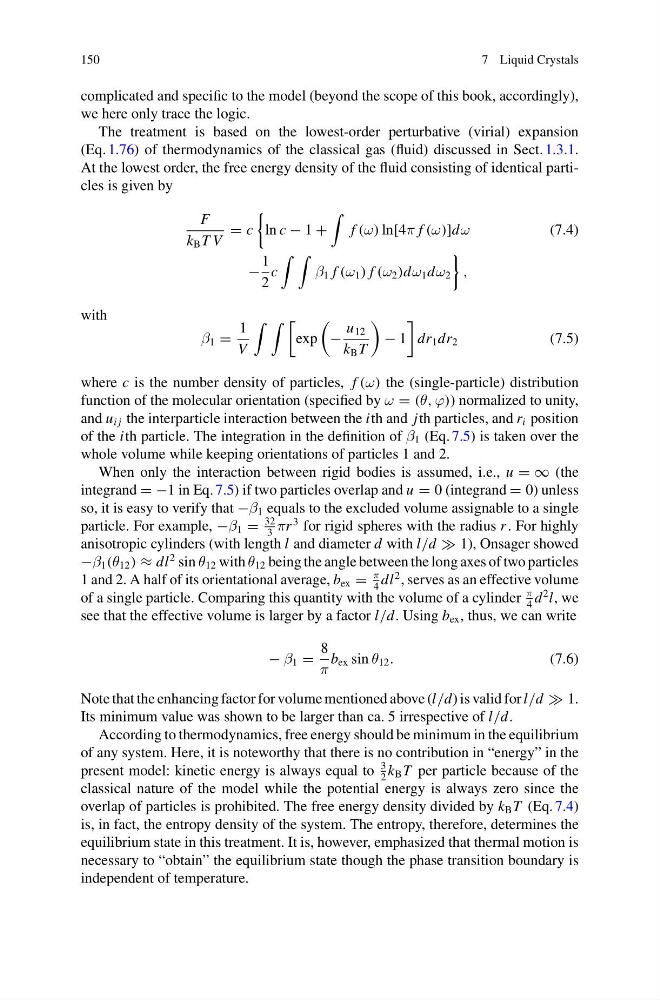
At the lowest order, the free energy density of the fluid consisting of identical particles is given by
F
k B T V
= c
ln c − 1 +
f (ω) ln[4π f (ω)]dω
(7.4)
−
1
2
c
β 1 f (ω 1 ) f (ω 2 )dω 1 dω 2
,
with
β 1 =
1
V
exp
−
u 12
k B T
− 1
dr 1 dr 2
(7.5)
where c is the number density of particles, f (ω) the (single-particle) distribution
function of the molecular orientation (specified by ω = (θ, ϕ)) normalized to unity,
and u i j the interparticle interaction between the ith and jth particles, and r i position
of the ith particle. The integration in the definition of β 1 (Eq. 7.5) is taken over the
whole volume while keeping orientations of particles 1 and 2.
When only the interaction between rigid bodies is assumed, i.e., u = ∞ (the
integrand = −1 in Eq. 7.5) if two particles overlap and u = 0 (integrand = 0) unless
so, it is easy to verify that −β 1 equals to the excluded volume assignable to a single
particle. For example, −β 1 =
32
3
πr
3 for rigid spheres with the radius r . For highly
anisotropic cylinders (with length l and diameter d with l/d 1), Onsager showed
−β 1 (θ 12 ) ≈ dl
2 sin θ 12 with θ 12 being the angle between the long axes of two particles
1 and 2. A half of its orientational average, b ex =
π
4
dl
2 , serves as an effective volume
of a single particle. Comparing this quantity with the volume of a cylinder
π
4
d
2 l, we
see that the effective volume is larger by a factor l/d. Using b ex , thus, we can write
− β 1 =
8
π
b ex sin θ 12 .
(7.6)
Note that the enhancing factor for volume mentioned above (l/d) is valid for l/d 1.
Its minimum value was shown to be larger than ca. 5 irrespective of l/d.
According to thermodynamics, free energy should be minimum in the equilibrium
of any system. Here, it is noteworthy that there is no contribution in “energy” in the
present model: kinetic energy is always equal to
3
2
k B T per particle because of the
classical nature of the model while the potential energy is always zero since the
overlap of particles is prohibited. The free energy density divided by k B T (Eq. 7.4)
is, in fact, the entropy density of the system. The entropy, therefore, determines the
equilibrium state in this treatment. It is, however, emphasized that thermal motion is
necessary to “obtain” the equilibrium state though the phase transition boundary is
independent of temperature.
7 Liquid Crystals
complicated and specific to the model (beyond the scope of this book, accordingly),
we here only trace the logic.
The treatment is based on the lowest-order perturbative (virial) expansion
(Eq. 1.76) of thermodynamics of the classical gas (fluid) discussed in Sect. 1.3.1.
At the lowest order, the free energy density of the fluid consisting of identical particles is given by
F
k B T V
= c
ln c − 1 +
f (ω) ln[4π f (ω)]dω
(7.4)
−
1
2
c
β 1 f (ω 1 ) f (ω 2 )dω 1 dω 2
,
with
β 1 =
1
V
exp
−
u 12
k B T
− 1
dr 1 dr 2
(7.5)
where c is the number density of particles, f (ω) the (single-particle) distribution
function of the molecular orientation (specified by ω = (θ, ϕ)) normalized to unity,
and u i j the interparticle interaction between the ith and jth particles, and r i position
of the ith particle. The integration in the definition of β 1 (Eq. 7.5) is taken over the
whole volume while keeping orientations of particles 1 and 2.
When only the interaction between rigid bodies is assumed, i.e., u = ∞ (the
integrand = −1 in Eq. 7.5) if two particles overlap and u = 0 (integrand = 0) unless
so, it is easy to verify that −β 1 equals to the excluded volume assignable to a single
particle. For example, −β 1 =
32
3
πr
3 for rigid spheres with the radius r . For highly
anisotropic cylinders (with length l and diameter d with l/d 1), Onsager showed
−β 1 (θ 12 ) ≈ dl
2 sin θ 12 with θ 12 being the angle between the long axes of two particles
1 and 2. A half of its orientational average, b ex =
π
4
dl
2 , serves as an effective volume
of a single particle. Comparing this quantity with the volume of a cylinder
π
4
d
2 l, we
see that the effective volume is larger by a factor l/d. Using b ex , thus, we can write
− β 1 =
8
π
b ex sin θ 12 .
(7.6)
Note that the enhancing factor for volume mentioned above (l/d) is valid for l/d 1.
Its minimum value was shown to be larger than ca. 5 irrespective of l/d.
According to thermodynamics, free energy should be minimum in the equilibrium
of any system. Here, it is noteworthy that there is no contribution in “energy” in the
present model: kinetic energy is always equal to
3
2
k B T per particle because of the
classical nature of the model while the potential energy is always zero since the
overlap of particles is prohibited. The free energy density divided by k B T (Eq. 7.4)
is, in fact, the entropy density of the system. The entropy, therefore, determines the
equilibrium state in this treatment. It is, however, emphasized that thermal motion is
necessary to “obtain” the equilibrium state though the phase transition boundary is
independent of temperature.