

7.1 Classification
149
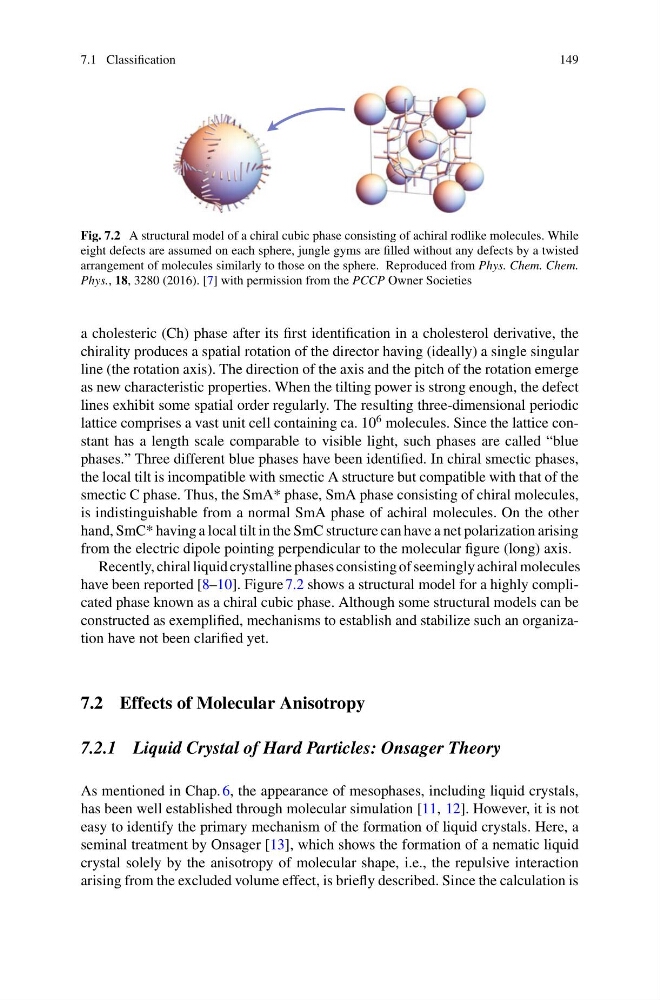
Fig. 7.2 A structural model of a chiral cubic phase consisting of achiral rodlike molecules. While
eight defects are assumed on each sphere, jungle gyms are filled without any defects by a twisted
arrangement of molecules similarly to those on the sphere. Reproduced from Phys. Chem. Chem.
Phys., 18, 3280 (2016). [7] with permission from the PCCP Owner Societies
a cholesteric (Ch) phase after its first identification in a cholesterol derivative, the
chirality produces a spatial rotation of the director having (ideally) a single singular
line (the rotation axis). The direction of the axis and the pitch of the rotation emerge
as new characteristic properties. When the tilting power is strong enough, the defect
lines exhibit some spatial order regularly. The resulting three-dimensional periodic
lattice comprises a vast unit cell containing ca. 10
6 molecules. Since the lattice constant has a length scale comparable to visible light, such phases are called “blue
phases.” Three different blue phases have been identified. In chiral smectic phases,
the local tilt is incompatible with smectic A structure but compatible with that of the
smectic C phase. Thus, the SmA* phase, SmA phase consisting of chiral molecules,
is indistinguishable from a normal SmA phase of achiral molecules. On the other
hand, SmC* having a local tilt in the SmC structure can have a net polarization arising
from the electric dipole pointing perpendicular to the molecular figure (long) axis.
Recently, chiral liquid crystalline phases consisting of seemingly achiral molecules
have been reported [8–10]. Figure 7.2 shows a structural model for a highly complicated phase known as a chiral cubic phase. Although some structural models can be
constructed as exemplified, mechanisms to establish and stabilize such an organization have not been clarified yet.
7.2 Effects of Molecular Anisotropy
7.2.1 Liquid Crystal of Hard Particles: Onsager Theory
As mentioned in Chap. 6, the appearance of mesophases, including liquid crystals,
has been well established through molecular simulation [11, 12]. However, it is not
easy to identify the primary mechanism of the formation of liquid crystals. Here, a
seminal treatment by Onsager [13], which shows the formation of a nematic liquid
crystal solely by the anisotropy of molecular shape, i.e., the repulsive interaction
arising from the excluded volume effect, is briefly described. Since the calculation is
149
Fig. 7.2 A structural model of a chiral cubic phase consisting of achiral rodlike molecules. While
eight defects are assumed on each sphere, jungle gyms are filled without any defects by a twisted
arrangement of molecules similarly to those on the sphere. Reproduced from Phys. Chem. Chem.
Phys., 18, 3280 (2016). [7] with permission from the PCCP Owner Societies
a cholesteric (Ch) phase after its first identification in a cholesterol derivative, the
chirality produces a spatial rotation of the director having (ideally) a single singular
line (the rotation axis). The direction of the axis and the pitch of the rotation emerge
as new characteristic properties. When the tilting power is strong enough, the defect
lines exhibit some spatial order regularly. The resulting three-dimensional periodic
lattice comprises a vast unit cell containing ca. 10
6 molecules. Since the lattice constant has a length scale comparable to visible light, such phases are called “blue
phases.” Three different blue phases have been identified. In chiral smectic phases,
the local tilt is incompatible with smectic A structure but compatible with that of the
smectic C phase. Thus, the SmA* phase, SmA phase consisting of chiral molecules,
is indistinguishable from a normal SmA phase of achiral molecules. On the other
hand, SmC* having a local tilt in the SmC structure can have a net polarization arising
from the electric dipole pointing perpendicular to the molecular figure (long) axis.
Recently, chiral liquid crystalline phases consisting of seemingly achiral molecules
have been reported [8–10]. Figure 7.2 shows a structural model for a highly complicated phase known as a chiral cubic phase. Although some structural models can be
constructed as exemplified, mechanisms to establish and stabilize such an organization have not been clarified yet.
7.2 Effects of Molecular Anisotropy
7.2.1 Liquid Crystal of Hard Particles: Onsager Theory
As mentioned in Chap. 6, the appearance of mesophases, including liquid crystals,
has been well established through molecular simulation [11, 12]. However, it is not
easy to identify the primary mechanism of the formation of liquid crystals. Here, a
seminal treatment by Onsager [13], which shows the formation of a nematic liquid
crystal solely by the anisotropy of molecular shape, i.e., the repulsive interaction
arising from the excluded volume effect, is briefly described. Since the calculation is