

7.2 Effects of Molecular Anisotropy
153
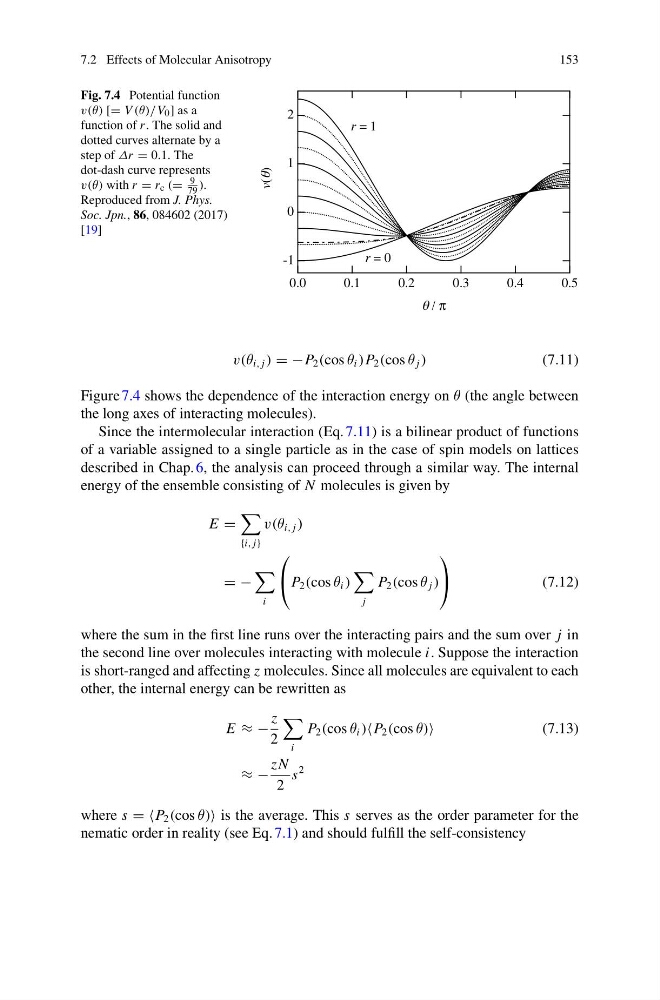
Fig. 7.4 Potential function
v(θ) [= V (θ)/V 0 ] as a
function of r . The solid and
dotted curves alternate by a
step of Δr = 0.1. The
dot-dash curve represents
v(θ) with r = r c (=
9
79 ).
Reproduced from J. Phys.
Soc. Jpn., 86, 084602 (2017)
[19]
2
1
0
-1
v(
)
0.5
0.4
0.3
0.2
0.1
0.0
/ π
r = 0
r = 1
v(θ i, j ) = −P 2 (cos θ i )P 2 (cos θ j )
(7.11)
Figure 7.4 shows the dependence of the interaction energy on θ (the angle between
the long axes of interacting molecules).
Since the intermolecular interaction (Eq. 7.11) is a bilinear product of functions
of a variable assigned to a single particle as in the case of spin models on lattices
described in Chap. 6, the analysis can proceed through a similar way. The internal
energy of the ensemble consisting of N molecules is given by
E =
{i, j}
v(θ i, j )
= −
i
⎛
⎝ P 2 (cos θ i )
j
P 2 (cos θ j )
⎞
⎠
(7.12)
where the sum in the first line runs over the interacting pairs and the sum over j in
the second line over molecules interacting with molecule i. Suppose the interaction
is short-ranged and affecting z molecules. Since all molecules are equivalent to each
other, the internal energy can be rewritten as
E ≈ −
z
2
i
P 2 (cos θ i ) 2 (cos θ)
(7.13)
≈ −
z N
2
s
2
where s = =P 2 (cos θ) is the average. This s serves as the order parameter for the
nematic order in reality (see Eq. 7.1) and should fulfill the self-consistency
153
Fig. 7.4 Potential function
v(θ) [= V (θ)/V 0 ] as a
function of r . The solid and
dotted curves alternate by a
step of Δr = 0.1. The
dot-dash curve represents
v(θ) with r = r c (=
9
79 ).
Reproduced from J. Phys.
Soc. Jpn., 86, 084602 (2017)
[19]
2
1
0
-1
v(
)
0.5
0.4
0.3
0.2
0.1
0.0
/ π
r = 0
r = 1
v(θ i, j ) = −P 2 (cos θ i )P 2 (cos θ j )
(7.11)
Figure 7.4 shows the dependence of the interaction energy on θ (the angle between
the long axes of interacting molecules).
Since the intermolecular interaction (Eq. 7.11) is a bilinear product of functions
of a variable assigned to a single particle as in the case of spin models on lattices
described in Chap. 6, the analysis can proceed through a similar way. The internal
energy of the ensemble consisting of N molecules is given by
E =
{i, j}
v(θ i, j )
= −
i
⎛
⎝ P 2 (cos θ i )
j
P 2 (cos θ j )
⎞
⎠
(7.12)
where the sum in the first line runs over the interacting pairs and the sum over j in
the second line over molecules interacting with molecule i. Suppose the interaction
is short-ranged and affecting z molecules. Since all molecules are equivalent to each
other, the internal energy can be rewritten as
E ≈ −
z
2
i
P 2 (cos θ i ) 2 (cos θ)
(7.13)
≈ −
z N
2
s
2
where s = =P 2 (cos θ) is the average. This s serves as the order parameter for the
nematic order in reality (see Eq. 7.1) and should fulfill the self-consistency