

130
6 Melting of Molecular Crystals
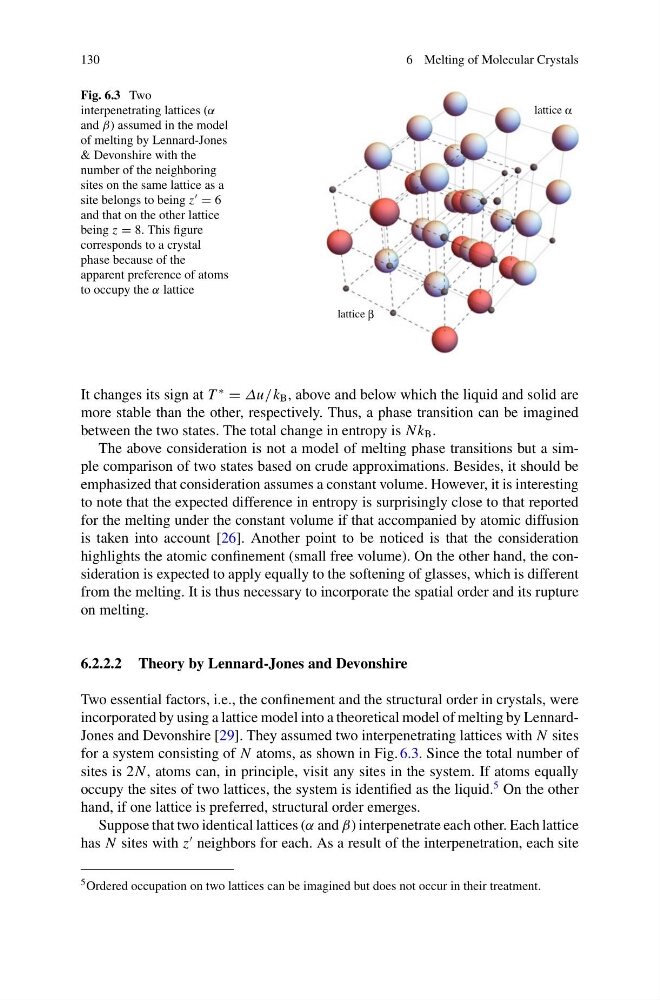
Fig. 6.3 Two
interpenetrating lattices (α
and β) assumed in the model
of melting by Lennard-Jones
& Devonshire with the
number of the neighboring
sites on the same lattice as a
site belongs to being z = 6
and that on the other lattice
being z = 8. This figure
corresponds to a crystal
phase because of the
apparent preference of atoms
to occupy the α lattice
lattice α
lattice β
It changes its sign at T
∗
= Δu/k B , above and below which the liquid and solid are
more stable than the other, respectively. Thus, a phase transition can be imagined
between the two states. The total change in entropy is N k B .
The above consideration is not a model of melting phase transitions but a simple comparison of two states based on crude approximations. Besides, it should be
emphasized that consideration assumes a constant volume. However, it is interesting
to note that the expected difference in entropy is surprisingly close to that reported
for the melting under the constant volume if that accompanied by atomic diffusion
is taken into account [26]. Another point to be noticed is that the consideration
highlights the atomic confinement (small free volume). On the other hand, the consideration is expected to apply equally to the softening of glasses, which is different
from the melting. It is thus necessary to incorporate the spatial order and its rupture
on melting.
6.2.2.2 Theory by Lennard-Jones and Devonshire
Two essential factors, i.e., the confinement and the structural order in crystals, were
incorporated by using a lattice model into a theoretical model of melting by LennardJones and Devonshire [29]. They assumed two interpenetrating lattices with N sites
for a system consisting of N atoms, as shown in Fig. 6.3. Since the total number of
sites is 2N , atoms can, in principle, visit any sites in the system. If atoms equally
occupy the sites of two lattices, the system is identified as the liquid.
5 On the other
hand, if one lattice is preferred, structural order emerges.
Suppose that two identical lattices (α and β) interpenetrate each other. Each lattice
has N sites with z
neighbors for each. As a result of the interpenetration, each site
5 Ordered occupation on two lattices can be imagined but does not occur in their treatment.
6 Melting of Molecular Crystals
Fig. 6.3 Two
interpenetrating lattices (α
and β) assumed in the model
of melting by Lennard-Jones
& Devonshire with the
number of the neighboring
sites on the same lattice as a
site belongs to being z = 6
and that on the other lattice
being z = 8. This figure
corresponds to a crystal
phase because of the
apparent preference of atoms
to occupy the α lattice
lattice α
lattice β
It changes its sign at T
∗
= Δu/k B , above and below which the liquid and solid are
more stable than the other, respectively. Thus, a phase transition can be imagined
between the two states. The total change in entropy is N k B .
The above consideration is not a model of melting phase transitions but a simple comparison of two states based on crude approximations. Besides, it should be
emphasized that consideration assumes a constant volume. However, it is interesting
to note that the expected difference in entropy is surprisingly close to that reported
for the melting under the constant volume if that accompanied by atomic diffusion
is taken into account [26]. Another point to be noticed is that the consideration
highlights the atomic confinement (small free volume). On the other hand, the consideration is expected to apply equally to the softening of glasses, which is different
from the melting. It is thus necessary to incorporate the spatial order and its rupture
on melting.
6.2.2.2 Theory by Lennard-Jones and Devonshire
Two essential factors, i.e., the confinement and the structural order in crystals, were
incorporated by using a lattice model into a theoretical model of melting by LennardJones and Devonshire [29]. They assumed two interpenetrating lattices with N sites
for a system consisting of N atoms, as shown in Fig. 6.3. Since the total number of
sites is 2N , atoms can, in principle, visit any sites in the system. If atoms equally
occupy the sites of two lattices, the system is identified as the liquid.
5 On the other
hand, if one lattice is preferred, structural order emerges.
Suppose that two identical lattices (α and β) interpenetrate each other. Each lattice
has N sites with z
neighbors for each. As a result of the interpenetration, each site
5 Ordered occupation on two lattices can be imagined but does not occur in their treatment.