

6.2 Plastic Crystals and Liquid Crystals
129
termed as fluctuations. The treatment erroneously predicts the occurrence of a phase
transition, even for a one-dimensional case (z = 2). In the case of two-dimension,
the temperature dependence of entropy is notably inconsistent, even qualitatively,
as seen in Fig. 6.2, whereas that of the order parameter m is qualitatively correct
in the sense that m is finite below but null above the transition temperature. The
inconsistency is due to neglecting the local correlation arising from the interaction
workable even above the transition temperature. Such a deficiency should be kept in
mind.
6.2.2 Simple Theory of Melting of Atomic Crystal
6.2.2.1 Free Volume Model and Communal Entropy
The most remarkable difference in macroscopic properties between a liquid and a
crystal is their mechanical properties. Namely, the former exhibits fluidity while the
latter does not. This contrast is due to a difference in microscopic states of particles
inside: they may visit a whole volume in the former, whereas they are confined in
a small volume in the latter. The volume assumed to be available to a particle is
often termed as free volume. The difference between a liquid and a solid is its vast
difference in terms of the free volume.
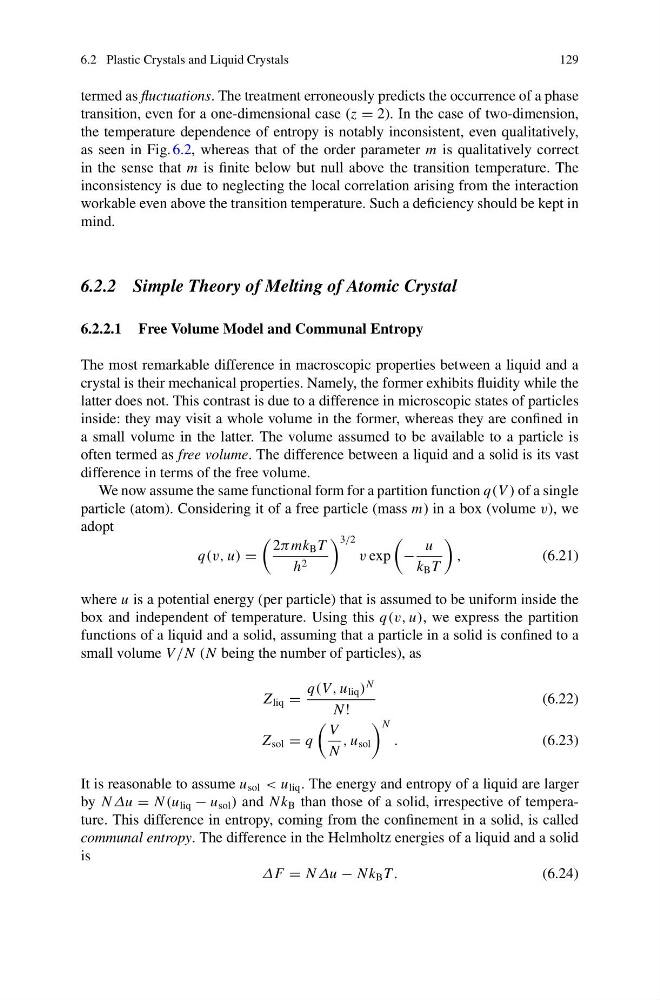
We now assume the same functional form for a partition function q(V ) of a single
particle (atom). Considering it of a free particle (mass m) in a box (volume v), we
adopt
q(v, u) =
2π mk B T
h 2
3/2
v exp
−
u
k B T
,
(6.21)
where u is a potential energy (per particle) that is assumed to be uniform inside the
box and independent of temperature. Using this q(v, u), we express the partition
functions of a liquid and a solid, assuming that a particle in a solid is confined to a
small volume V /N (N being the number of particles), as
Z liq =
q(V, u liq )
N
N !
(6.22)
Z sol = q
V
N
, u sol
N
.
(6.23)
It is reasonable to assume u sol < u liq . The energy and entropy of a liquid are larger
by N Δu = N (u liq − u sol ) and N k B than those of a solid, irrespective of temperature. This difference in entropy, coming from the confinement in a solid, is called
communal entropy. The difference in the Helmholtz energies of a liquid and a solid
is
ΔF = N Δu − N k B T.
(6.24)
129
termed as fluctuations. The treatment erroneously predicts the occurrence of a phase
transition, even for a one-dimensional case (z = 2). In the case of two-dimension,
the temperature dependence of entropy is notably inconsistent, even qualitatively,
as seen in Fig. 6.2, whereas that of the order parameter m is qualitatively correct
in the sense that m is finite below but null above the transition temperature. The
inconsistency is due to neglecting the local correlation arising from the interaction
workable even above the transition temperature. Such a deficiency should be kept in
mind.
6.2.2 Simple Theory of Melting of Atomic Crystal
6.2.2.1 Free Volume Model and Communal Entropy
The most remarkable difference in macroscopic properties between a liquid and a
crystal is their mechanical properties. Namely, the former exhibits fluidity while the
latter does not. This contrast is due to a difference in microscopic states of particles
inside: they may visit a whole volume in the former, whereas they are confined in
a small volume in the latter. The volume assumed to be available to a particle is
often termed as free volume. The difference between a liquid and a solid is its vast
difference in terms of the free volume.
We now assume the same functional form for a partition function q(V ) of a single
particle (atom). Considering it of a free particle (mass m) in a box (volume v), we
adopt
q(v, u) =
2π mk B T
h 2
3/2
v exp
−
u
k B T
,
(6.21)
where u is a potential energy (per particle) that is assumed to be uniform inside the
box and independent of temperature. Using this q(v, u), we express the partition
functions of a liquid and a solid, assuming that a particle in a solid is confined to a
small volume V /N (N being the number of particles), as
Z liq =
q(V, u liq )
N
N !
(6.22)
Z sol = q
V
N
, u sol
N
.
(6.23)
It is reasonable to assume u sol < u liq . The energy and entropy of a liquid are larger
by N Δu = N (u liq − u sol ) and N k B than those of a solid, irrespective of temperature. This difference in entropy, coming from the confinement in a solid, is called
communal entropy. The difference in the Helmholtz energies of a liquid and a solid
is
ΔF = N Δu − N k B T.
(6.24)