

128
6 Melting of Molecular Crystals
E = −
1
2
J
i
⎛
⎝ σ i
j∈{NN} i
σ j
⎞
⎠
≈ −
1
2
i
z J σ i σ i
= −
1
2
i
ε i ,
(6.18)
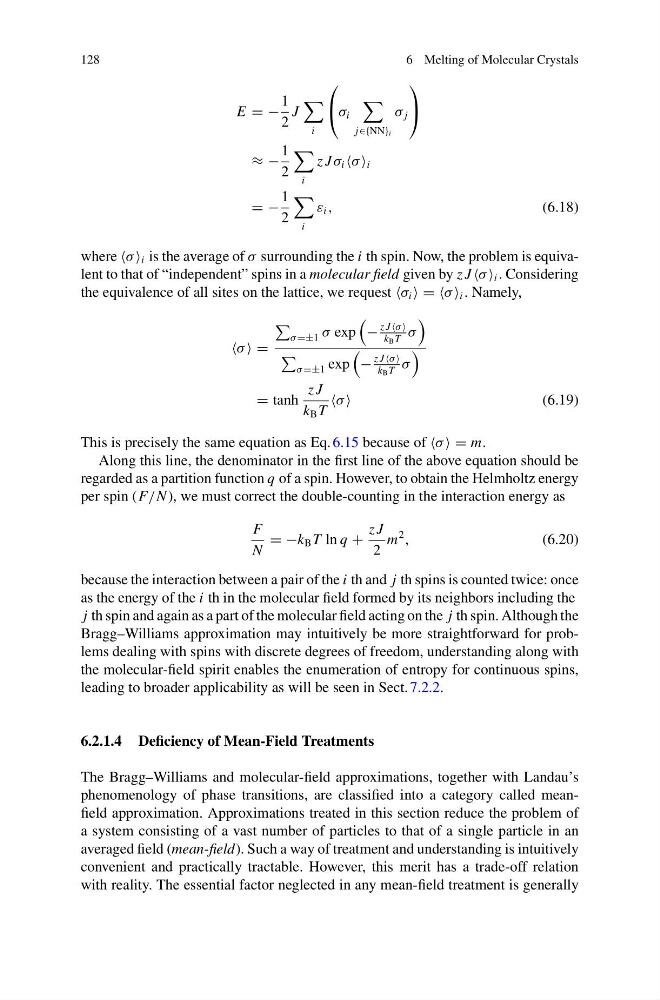
where σ i is the average of σ surrounding the i th spin. Now, the problem is equivalent to that of “independent” spins in a molecular field given by z J σ i . Considering
the equivalence of all sites on the lattice, we request σ i = =σ i . Namely,
σ =
σ =±1 σ exp
−
z Jσ
k B T
σ
σ =±1 exp
−
z Jσ
k B T
σ
= tanh
z J
k B T
σ
(6.19)
This is precisely the same equation as Eq. 6.15 because of σ = m.
Along this line, the denominator in the first line of the above equation should be
regarded as a partition function q of a spin. However, to obtain the Helmholtz energy
per spin (F/N ), we must correct the double-counting in the interaction energy as
F
N
= −k B T ln q +
z J
2
m
2
,
(6.20)
because the interaction between a pair of the i th and j th spins is counted twice: once
as the energy of the i th in the molecular field formed by its neighbors including the
j th spin and again as a part of the molecular field acting on the j th spin. Although the
Bragg–Williams approximation may intuitively be more straightforward for problems dealing with spins with discrete degrees of freedom, understanding along with
the molecular-field spirit enables the enumeration of entropy for continuous spins,
leading to broader applicability as will be seen in Sect. 7.2.2.
6.2.1.4 Deficiency of Mean-Field Treatments
The Bragg–Williams and molecular-field approximations, together with Landau’s
phenomenology of phase transitions, are classified into a category called meanfield approximation. Approximations treated in this section reduce the problem of
a system consisting of a vast number of particles to that of a single particle in an
averaged field (mean-field). Such a way of treatment and understanding is intuitively
convenient and practically tractable. However, this merit has a trade-off relation
with reality. The essential factor neglected in any mean-field treatment is generally
6 Melting of Molecular Crystals
E = −
1
2
J
i
⎛
⎝ σ i
j∈{NN} i
σ j
⎞
⎠
≈ −
1
2
i
z J σ i σ i
= −
1
2
i
ε i ,
(6.18)
where σ i is the average of σ surrounding the i th spin. Now, the problem is equivalent to that of “independent” spins in a molecular field given by z J σ i . Considering
the equivalence of all sites on the lattice, we request σ i = =σ i . Namely,
σ =
σ =±1 σ exp
−
z Jσ
k B T
σ
σ =±1 exp
−
z Jσ
k B T
σ
= tanh
z J
k B T
σ
(6.19)
This is precisely the same equation as Eq. 6.15 because of σ = m.
Along this line, the denominator in the first line of the above equation should be
regarded as a partition function q of a spin. However, to obtain the Helmholtz energy
per spin (F/N ), we must correct the double-counting in the interaction energy as
F
N
= −k B T ln q +
z J
2
m
2
,
(6.20)
because the interaction between a pair of the i th and j th spins is counted twice: once
as the energy of the i th in the molecular field formed by its neighbors including the
j th spin and again as a part of the molecular field acting on the j th spin. Although the
Bragg–Williams approximation may intuitively be more straightforward for problems dealing with spins with discrete degrees of freedom, understanding along with
the molecular-field spirit enables the enumeration of entropy for continuous spins,
leading to broader applicability as will be seen in Sect. 7.2.2.
6.2.1.4 Deficiency of Mean-Field Treatments
The Bragg–Williams and molecular-field approximations, together with Landau’s
phenomenology of phase transitions, are classified into a category called meanfield approximation. Approximations treated in this section reduce the problem of
a system consisting of a vast number of particles to that of a single particle in an
averaged field (mean-field). Such a way of treatment and understanding is intuitively
convenient and practically tractable. However, this merit has a trade-off relation
with reality. The essential factor neglected in any mean-field treatment is generally