

6.2 Plastic Crystals and Liquid Crystals
127
1.0
0.5
0.0
m
0.1
2
3
4 5 6 7 8 9
1
2
T / T MF
1.0
0.5
0.0
S/Nk B ln2
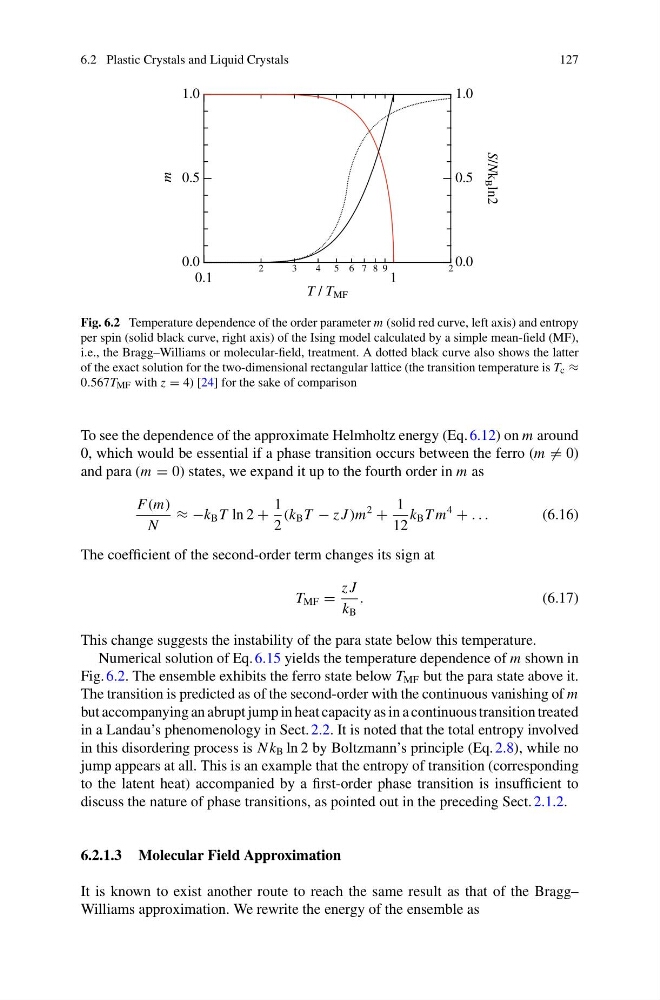
Fig. 6.2 Temperature dependence of the order parameter m (solid red curve, left axis) and entropy
per spin (solid black curve, right axis) of the Ising model calculated by a simple mean-field (MF),
i.e., the Bragg–Williams or molecular-field, treatment. A dotted black curve also shows the latter
of the exact solution for the two-dimensional rectangular lattice (the transition temperature is T c ≈
0.567T MF with z = 4) [24] for the sake of comparison
To see the dependence of the approximate Helmholtz energy (Eq. 6.12) on m around
0, which would be essential if a phase transition occurs between the ferro (m = 0)
and para (m = 0) states, we expand it up to the fourth order in m as
F(m)
N
≈ −k B T ln 2 +
1
2
(k B T − z J )m
2
+
1
12
k B T m
4
+ . . .
(6.16)
The coefficient of the second-order term changes its sign at
T MF =
z J
k B
.
(6.17)
This change suggests the instability of the para state below this temperature.
Numerical solution of Eq. 6.15 yields the temperature dependence of m shown in
Fig. 6.2. The ensemble exhibits the ferro state below T MF but the para state above it.
The transition is predicted as of the second-order with the continuous vanishing of m
but accompanying an abrupt jump in heat capacity as in a continuous transition treated
in a Landau’s phenomenology in Sect. 2.2. It is noted that the total entropy involved
in this disordering process is N k B ln 2 by Boltzmann’s principle (Eq. 2.8), while no
jump appears at all. This is an example that the entropy of transition (corresponding
to the latent heat) accompanied by a first-order phase transition is insufficient to
discuss the nature of phase transitions, as pointed out in the preceding Sect. 2.1.2.
6.2.1.3 Molecular Field Approximation
It is known to exist another route to reach the same result as that of the Bragg–
Williams approximation. We rewrite the energy of the ensemble as
127
1.0
0.5
0.0
m
0.1
2
3
4 5 6 7 8 9
1
2
T / T MF
1.0
0.5
0.0
S/Nk B ln2
Fig. 6.2 Temperature dependence of the order parameter m (solid red curve, left axis) and entropy
per spin (solid black curve, right axis) of the Ising model calculated by a simple mean-field (MF),
i.e., the Bragg–Williams or molecular-field, treatment. A dotted black curve also shows the latter
of the exact solution for the two-dimensional rectangular lattice (the transition temperature is T c ≈
0.567T MF with z = 4) [24] for the sake of comparison
To see the dependence of the approximate Helmholtz energy (Eq. 6.12) on m around
0, which would be essential if a phase transition occurs between the ferro (m = 0)
and para (m = 0) states, we expand it up to the fourth order in m as
F(m)
N
≈ −k B T ln 2 +
1
2
(k B T − z J )m
2
+
1
12
k B T m
4
+ . . .
(6.16)
The coefficient of the second-order term changes its sign at
T MF =
z J
k B
.
(6.17)
This change suggests the instability of the para state below this temperature.
Numerical solution of Eq. 6.15 yields the temperature dependence of m shown in
Fig. 6.2. The ensemble exhibits the ferro state below T MF but the para state above it.
The transition is predicted as of the second-order with the continuous vanishing of m
but accompanying an abrupt jump in heat capacity as in a continuous transition treated
in a Landau’s phenomenology in Sect. 2.2. It is noted that the total entropy involved
in this disordering process is N k B ln 2 by Boltzmann’s principle (Eq. 2.8), while no
jump appears at all. This is an example that the entropy of transition (corresponding
to the latent heat) accompanied by a first-order phase transition is insufficient to
discuss the nature of phase transitions, as pointed out in the preceding Sect. 2.1.2.
6.2.1.3 Molecular Field Approximation
It is known to exist another route to reach the same result as that of the Bragg–
Williams approximation. We rewrite the energy of the ensemble as