

126
6 Melting of Molecular Crystals
where Stirling’s formula, ln N ! ≈ N (ln N − 1) for N 1, is adopted while considering identities like m + 1 = 2n U /N .
The energy of the ensemble may vary from state to state even if m is specified.
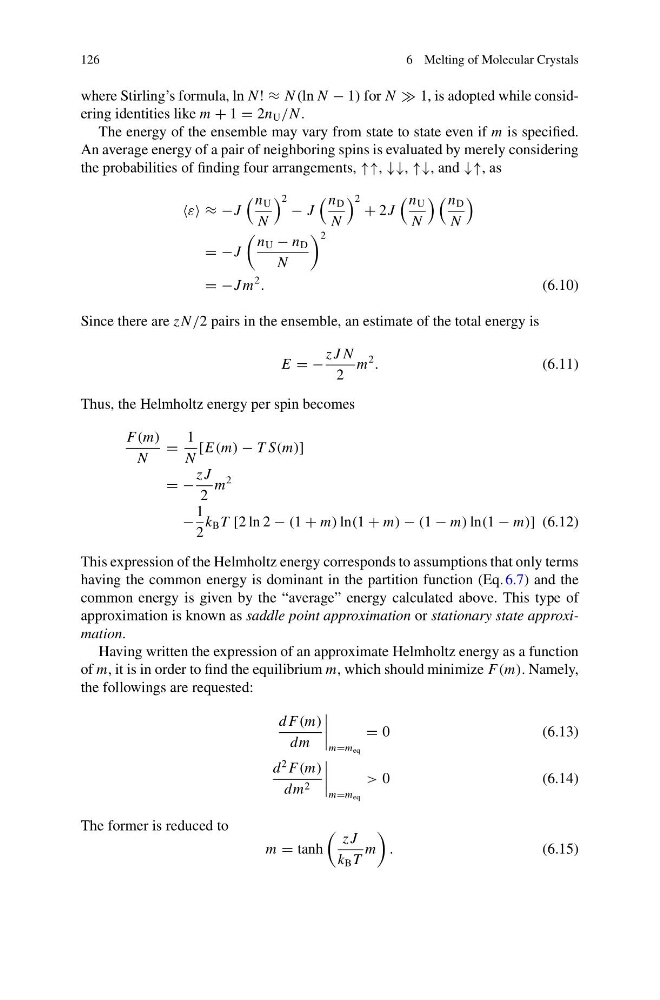
An average energy of a pair of neighboring spins is evaluated by merely considering
the probabilities of finding four arrangements, ↑↑, ↓↓, ↑↓, and ↓↑, as
ε ≈ −J
n U
N
2 − J
n D
N
2 + 2J
n U
N
n D
N
= −J
n U − n D
N
2
= −J m
2
.
(6.10)
Since there are z N/2 pairs in the ensemble, an estimate of the total energy is
E = −
z J N
2
m
2
.
(6.11)
Thus, the Helmholtz energy per spin becomes
F(m)
N
=
1
N
[E(m) − T S(m)]
= −
z J
2
m
2
−
1
2
k B T [2 ln 2 − (1 + m) ln(1 + m) − (1 − m) ln(1 − m)] (6.12)
This expression of the Helmholtz energy corresponds to assumptions that only terms
having the common energy is dominant in the partition function (Eq. 6.7) and the
common energy is given by the “average” energy calculated above. This type of
approximation is known as saddle point approximation or stationary state approximation.
Having written the expression of an approximate Helmholtz energy as a function
of m, it is in order to find the equilibrium m, which should minimize F(m). Namely,
the followings are requested:
d F(m)
dm
m=m eq
= 0
(6.13)
d
2 F(m)
dm 2
m=m eq
> 0
(6.14)
The former is reduced to
m = tanh
z J
k B T
m
.
(6.15)
6 Melting of Molecular Crystals
where Stirling’s formula, ln N ! ≈ N (ln N − 1) for N 1, is adopted while considering identities like m + 1 = 2n U /N .
The energy of the ensemble may vary from state to state even if m is specified.
An average energy of a pair of neighboring spins is evaluated by merely considering
the probabilities of finding four arrangements, ↑↑, ↓↓, ↑↓, and ↓↑, as
ε ≈ −J
n U
N
2 − J
n D
N
2 + 2J
n U
N
n D
N
= −J
n U − n D
N
2
= −J m
2
.
(6.10)
Since there are z N/2 pairs in the ensemble, an estimate of the total energy is
E = −
z J N
2
m
2
.
(6.11)
Thus, the Helmholtz energy per spin becomes
F(m)
N
=
1
N
[E(m) − T S(m)]
= −
z J
2
m
2
−
1
2
k B T [2 ln 2 − (1 + m) ln(1 + m) − (1 − m) ln(1 − m)] (6.12)
This expression of the Helmholtz energy corresponds to assumptions that only terms
having the common energy is dominant in the partition function (Eq. 6.7) and the
common energy is given by the “average” energy calculated above. This type of
approximation is known as saddle point approximation or stationary state approximation.
Having written the expression of an approximate Helmholtz energy as a function
of m, it is in order to find the equilibrium m, which should minimize F(m). Namely,
the followings are requested:
d F(m)
dm
m=m eq
= 0
(6.13)
d
2 F(m)
dm 2
m=m eq
> 0
(6.14)
The former is reduced to
m = tanh
z J
k B T
m
.
(6.15)