

6.2 Plastic Crystals and Liquid Crystals
131
on one lattice also has neighbors on the other lattice. Let this number be z. Since
all sites are equivalent, the partition function of a single particle without any atoms
on its neighbors (both on α and β) is assumed to depend only on the total volume
V (and temperature). The partition function is written as q(V ). Considering only
the interaction between neighboring atoms on different lattices, we can express the
microscopic information of each state by specifying the number of such neighboring
pairs denoted as n αβ . The partition function of the system is then expressed as
Z =
q(V )
N exp
−
n αβ w
k B T
,
(6.25)
where w is the energy penalty for the disordering. The summation runs over all
possible states.
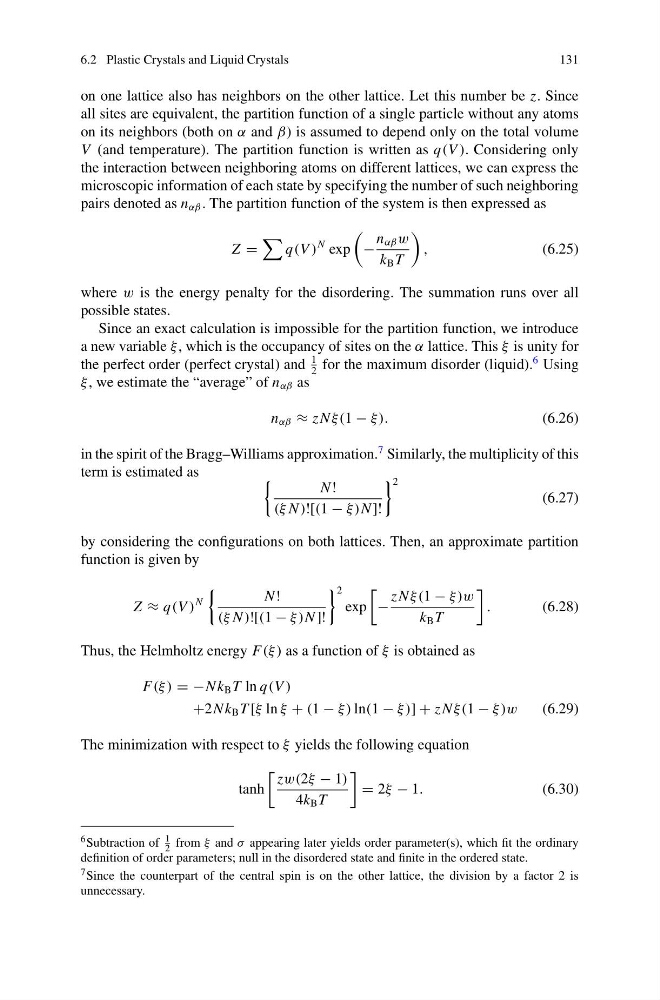
Since an exact calculation is impossible for the partition function, we introduce
a new variable ξ , which is the occupancy of sites on the α lattice. This ξ is unity for
the perfect order (perfect crystal) and
1
2
for the maximum disorder (liquid).
6 Using
ξ , we estimate the “average” of n αβ as
n αβ ≈ z N ξ(1 − ξ).
(6.26)
in the spirit of the Bragg–Williams approximation.
7 Similarly, the multiplicity of this
term is estimated as
N !
(ξ N )![(1 − ξ)N ]!
2
(6.27)
by considering the configurations on both lattices. Then, an approximate partition
function is given by
Z ≈ q(V )
N
N !
(ξ N )![(1 − ξ)N ]!
2
exp
−
z N ξ(1 − ξ)w
k B T
.
(6.28)
Thus, the Helmholtz energy F(ξ ) as a function of ξ is obtained as
F(ξ ) = −N k B T ln q(V )
+2N k B T [ξ ln ξ + (1 − ξ) ln(1 − ξ)] + z N ξ(1 − ξ)w
(6.29)
The minimization with respect to ξ yields the following equation
tanh
zw(2ξ − 1)
4k B T
= 2ξ − 1.
(6.30)
6 Subtraction of
1
2 from ξ and σ appearing later yields order parameter(s), which fit the ordinary
definition of order parameters; null in the disordered state and finite in the ordered state.
7 Since the counterpart of the central spin is on the other lattice, the division by a factor 2 is
unnecessary.
131
on one lattice also has neighbors on the other lattice. Let this number be z. Since
all sites are equivalent, the partition function of a single particle without any atoms
on its neighbors (both on α and β) is assumed to depend only on the total volume
V (and temperature). The partition function is written as q(V ). Considering only
the interaction between neighboring atoms on different lattices, we can express the
microscopic information of each state by specifying the number of such neighboring
pairs denoted as n αβ . The partition function of the system is then expressed as
Z =
q(V )
N exp
−
n αβ w
k B T
,
(6.25)
where w is the energy penalty for the disordering. The summation runs over all
possible states.
Since an exact calculation is impossible for the partition function, we introduce
a new variable ξ , which is the occupancy of sites on the α lattice. This ξ is unity for
the perfect order (perfect crystal) and
1
2
for the maximum disorder (liquid).
6 Using
ξ , we estimate the “average” of n αβ as
n αβ ≈ z N ξ(1 − ξ).
(6.26)
in the spirit of the Bragg–Williams approximation.
7 Similarly, the multiplicity of this
term is estimated as
N !
(ξ N )![(1 − ξ)N ]!
2
(6.27)
by considering the configurations on both lattices. Then, an approximate partition
function is given by
Z ≈ q(V )
N
N !
(ξ N )![(1 − ξ)N ]!
2
exp
−
z N ξ(1 − ξ)w
k B T
.
(6.28)
Thus, the Helmholtz energy F(ξ ) as a function of ξ is obtained as
F(ξ ) = −N k B T ln q(V )
+2N k B T [ξ ln ξ + (1 − ξ) ln(1 − ξ)] + z N ξ(1 − ξ)w
(6.29)
The minimization with respect to ξ yields the following equation
tanh
zw(2ξ − 1)
4k B T
= 2ξ − 1.
(6.30)
6 Subtraction of
1
2 from ξ and σ appearing later yields order parameter(s), which fit the ordinary
definition of order parameters; null in the disordered state and finite in the ordered state.
7 Since the counterpart of the central spin is on the other lattice, the division by a factor 2 is
unnecessary.