

114
5 Lattice Dynamics of Molecular Crystals
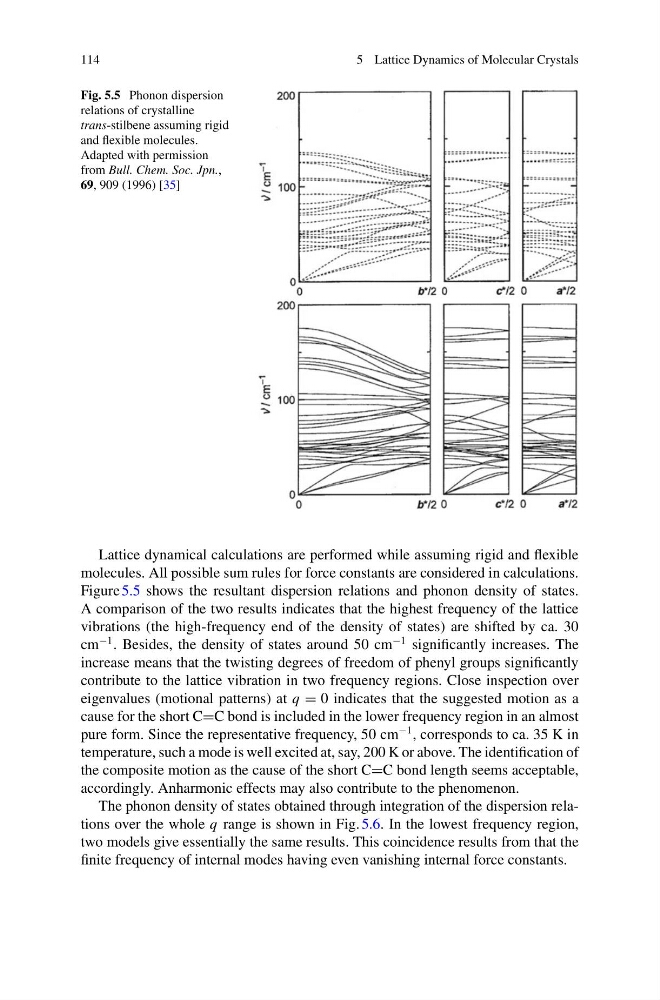
Fig. 5.5 Phonon dispersion
relations of crystalline
trans-stilbene assuming rigid
and flexible molecules.
Adapted with permission
from Bull. Chem. Soc. Jpn.,
69, 909 (1996) [35]
Lattice dynamical calculations are performed while assuming rigid and flexible
molecules. All possible sum rules for force constants are considered in calculations.
Figure 5.5 shows the resultant dispersion relations and phonon density of states.
A comparison of the two results indicates that the highest frequency of the lattice
vibrations (the high-frequency end of the density of states) are shifted by ca. 30
cm
−1 . Besides, the density of states around 50 cm
−1 significantly increases. The
increase means that the twisting degrees of freedom of phenyl groups significantly
contribute to the lattice vibration in two frequency regions. Close inspection over
eigenvalues (motional patterns) at q = 0 indicates that the suggested motion as a
cause for the short C=C bond is included in the lower frequency region in an almost
pure form. Since the representative frequency, 50 cm
−1 , corresponds to ca. 35 K in
temperature, such a mode is well excited at, say, 200 K or above. The identification of
the composite motion as the cause of the short C=C bond length seems acceptable,
accordingly. Anharmonic effects may also contribute to the phenomenon.
The phonon density of states obtained through integration of the dispersion relations over the whole q range is shown in Fig. 5.6. In the lowest frequency region,
two models give essentially the same results. This coincidence results from that the
finite frequency of internal modes having even vanishing internal force constants.
5 Lattice Dynamics of Molecular Crystals
Fig. 5.5 Phonon dispersion
relations of crystalline
trans-stilbene assuming rigid
and flexible molecules.
Adapted with permission
from Bull. Chem. Soc. Jpn.,
69, 909 (1996) [35]
Lattice dynamical calculations are performed while assuming rigid and flexible
molecules. All possible sum rules for force constants are considered in calculations.
Figure 5.5 shows the resultant dispersion relations and phonon density of states.
A comparison of the two results indicates that the highest frequency of the lattice
vibrations (the high-frequency end of the density of states) are shifted by ca. 30
cm
−1 . Besides, the density of states around 50 cm
−1 significantly increases. The
increase means that the twisting degrees of freedom of phenyl groups significantly
contribute to the lattice vibration in two frequency regions. Close inspection over
eigenvalues (motional patterns) at q = 0 indicates that the suggested motion as a
cause for the short C=C bond is included in the lower frequency region in an almost
pure form. Since the representative frequency, 50 cm
−1 , corresponds to ca. 35 K in
temperature, such a mode is well excited at, say, 200 K or above. The identification of
the composite motion as the cause of the short C=C bond length seems acceptable,
accordingly. Anharmonic effects may also contribute to the phenomenon.
The phonon density of states obtained through integration of the dispersion relations over the whole q range is shown in Fig. 5.6. In the lowest frequency region,
two models give essentially the same results. This coincidence results from that the
finite frequency of internal modes having even vanishing internal force constants.