

5.5 Related Issues and Examples
115
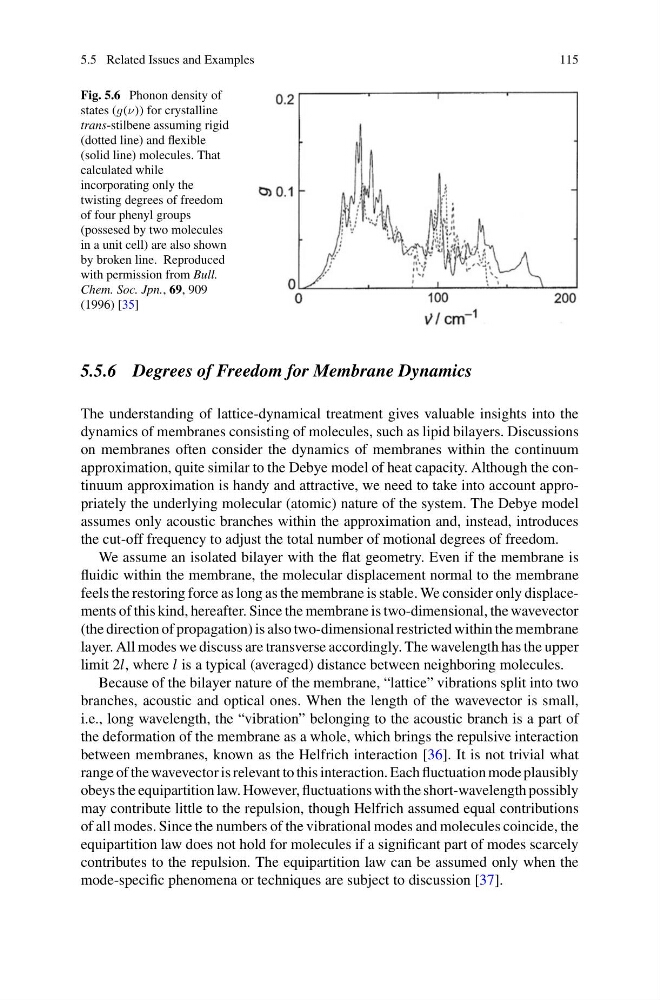
Fig. 5.6 Phonon density of
states (g(ν)) for crystalline
trans-stilbene assuming rigid
(dotted line) and flexible
(solid line) molecules. That
calculated while
incorporating only the
twisting degrees of freedom
of four phenyl groups
(possesed by two molecules
in a unit cell) are also shown
by broken line. Reproduced
with permission from Bull.
Chem. Soc. Jpn., 69, 909
(1996) [35]
5.5.6 Degrees of Freedom for Membrane Dynamics
The understanding of lattice-dynamical treatment gives valuable insights into the
dynamics of membranes consisting of molecules, such as lipid bilayers. Discussions
on membranes often consider the dynamics of membranes within the continuum
approximation, quite similar to the Debye model of heat capacity. Although the continuum approximation is handy and attractive, we need to take into account appropriately the underlying molecular (atomic) nature of the system. The Debye model
assumes only acoustic branches within the approximation and, instead, introduces
the cut-off frequency to adjust the total number of motional degrees of freedom.
We assume an isolated bilayer with the flat geometry. Even if the membrane is
fluidic within the membrane, the molecular displacement normal to the membrane
feels the restoring force as long as the membrane is stable. We consider only displacements of this kind, hereafter. Since the membrane is two-dimensional, the wavevector
(the direction of propagation) is also two-dimensional restricted within the membrane
layer. All modes we discuss are transverse accordingly. The wavelength has the upper
limit 2l, where l is a typical (averaged) distance between neighboring molecules.
Because of the bilayer nature of the membrane, “lattice” vibrations split into two
branches, acoustic and optical ones. When the length of the wavevector is small,
i.e., long wavelength, the “vibration” belonging to the acoustic branch is a part of
the deformation of the membrane as a whole, which brings the repulsive interaction
between membranes, known as the Helfrich interaction [36]. It is not trivial what
range of the wavevector is relevant to this interaction. Each fluctuation mode plausibly
obeys the equipartition law. However, fluctuations with the short-wavelength possibly
may contribute little to the repulsion, though Helfrich assumed equal contributions
of all modes. Since the numbers of the vibrational modes and molecules coincide, the
equipartition law does not hold for molecules if a significant part of modes scarcely
contributes to the repulsion. The equipartition law can be assumed only when the
mode-specific phenomena or techniques are subject to discussion [37].
115
Fig. 5.6 Phonon density of
states (g(ν)) for crystalline
trans-stilbene assuming rigid
(dotted line) and flexible
(solid line) molecules. That
calculated while
incorporating only the
twisting degrees of freedom
of four phenyl groups
(possesed by two molecules
in a unit cell) are also shown
by broken line. Reproduced
with permission from Bull.
Chem. Soc. Jpn., 69, 909
(1996) [35]
5.5.6 Degrees of Freedom for Membrane Dynamics
The understanding of lattice-dynamical treatment gives valuable insights into the
dynamics of membranes consisting of molecules, such as lipid bilayers. Discussions
on membranes often consider the dynamics of membranes within the continuum
approximation, quite similar to the Debye model of heat capacity. Although the continuum approximation is handy and attractive, we need to take into account appropriately the underlying molecular (atomic) nature of the system. The Debye model
assumes only acoustic branches within the approximation and, instead, introduces
the cut-off frequency to adjust the total number of motional degrees of freedom.
We assume an isolated bilayer with the flat geometry. Even if the membrane is
fluidic within the membrane, the molecular displacement normal to the membrane
feels the restoring force as long as the membrane is stable. We consider only displacements of this kind, hereafter. Since the membrane is two-dimensional, the wavevector
(the direction of propagation) is also two-dimensional restricted within the membrane
layer. All modes we discuss are transverse accordingly. The wavelength has the upper
limit 2l, where l is a typical (averaged) distance between neighboring molecules.
Because of the bilayer nature of the membrane, “lattice” vibrations split into two
branches, acoustic and optical ones. When the length of the wavevector is small,
i.e., long wavelength, the “vibration” belonging to the acoustic branch is a part of
the deformation of the membrane as a whole, which brings the repulsive interaction
between membranes, known as the Helfrich interaction [36]. It is not trivial what
range of the wavevector is relevant to this interaction. Each fluctuation mode plausibly
obeys the equipartition law. However, fluctuations with the short-wavelength possibly
may contribute little to the repulsion, though Helfrich assumed equal contributions
of all modes. Since the numbers of the vibrational modes and molecules coincide, the
equipartition law does not hold for molecules if a significant part of modes scarcely
contributes to the repulsion. The equipartition law can be assumed only when the
mode-specific phenomena or techniques are subject to discussion [37].