

5.5 Related Issues and Examples
113
5.5.5 Large Amplitude Motion
A molecule of trans-stilbene (C 6 H 5 –CH=CH–C 6 H 5 ) has two “soft” intra-molecular
vibrational modes: the twist of phenyl groups around respective single bonds to
the central CH=CH moiety. Spectroscopic studies [29–31] have revealed that the
characteristic energy of these twisting degrees of freedom is within a range expected
for external lattice vibrations of molecular crystals. trans-Stilbene crystallizes into a
monoclinic lattice with a unit cell containing two molecules on inversion centers [32–
34]. One molecule is orientationally disordered while the other has an abnormally
short C=C bond without seeming disorder. Based on the principles and practical
application of structural determination through scattering experiments (irrespective
of X-ray or neutron beam), a large amplitude of a molecular motion was suggested as
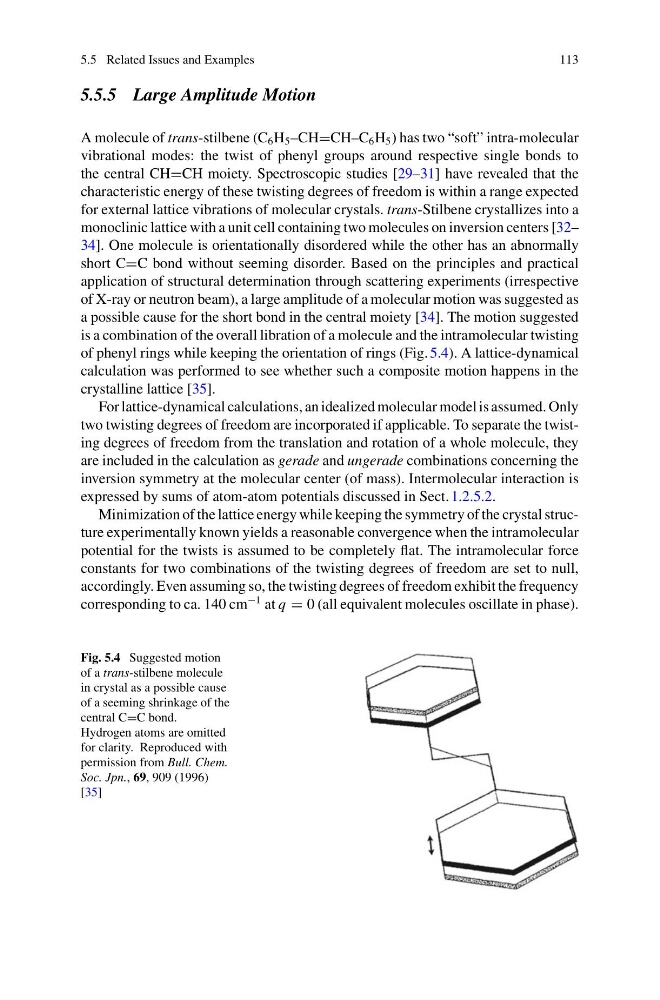
a possible cause for the short bond in the central moiety [34]. The motion suggested
is a combination of the overall libration of a molecule and the intramolecular twisting
of phenyl rings while keeping the orientation of rings (Fig. 5.4). A lattice-dynamical
calculation was performed to see whether such a composite motion happens in the
crystalline lattice [35].
For lattice-dynamical calculations, an idealized molecular model is assumed. Only
two twisting degrees of freedom are incorporated if applicable. To separate the twisting degrees of freedom from the translation and rotation of a whole molecule, they
are included in the calculation as gerade and ungerade combinations concerning the
inversion symmetry at the molecular center (of mass). Intermolecular interaction is
expressed by sums of atom-atom potentials discussed in Sect. 1.2.5.2.
Minimization of the lattice energy while keeping the symmetry of the crystal structure experimentally known yields a reasonable convergence when the intramolecular
potential for the twists is assumed to be completely flat. The intramolecular force
constants for two combinations of the twisting degrees of freedom are set to null,
accordingly. Even assuming so, the twisting degrees of freedom exhibit the frequency
corresponding to ca. 140 cm
−1 at q = 0 (all equivalent molecules oscillate in phase).
Fig. 5.4 Suggested motion
of a trans-stilbene molecule
in crystal as a possible cause
of a seeming shrinkage of the
central C=C bond.
Hydrogen atoms are omitted
for clarity. Reproduced with
permission from Bull. Chem.
Soc. Jpn., 69, 909 (1996)
[35]
113
5.5.5 Large Amplitude Motion
A molecule of trans-stilbene (C 6 H 5 –CH=CH–C 6 H 5 ) has two “soft” intra-molecular
vibrational modes: the twist of phenyl groups around respective single bonds to
the central CH=CH moiety. Spectroscopic studies [29–31] have revealed that the
characteristic energy of these twisting degrees of freedom is within a range expected
for external lattice vibrations of molecular crystals. trans-Stilbene crystallizes into a
monoclinic lattice with a unit cell containing two molecules on inversion centers [32–
34]. One molecule is orientationally disordered while the other has an abnormally
short C=C bond without seeming disorder. Based on the principles and practical
application of structural determination through scattering experiments (irrespective
of X-ray or neutron beam), a large amplitude of a molecular motion was suggested as
a possible cause for the short bond in the central moiety [34]. The motion suggested
is a combination of the overall libration of a molecule and the intramolecular twisting
of phenyl rings while keeping the orientation of rings (Fig. 5.4). A lattice-dynamical
calculation was performed to see whether such a composite motion happens in the
crystalline lattice [35].
For lattice-dynamical calculations, an idealized molecular model is assumed. Only
two twisting degrees of freedom are incorporated if applicable. To separate the twisting degrees of freedom from the translation and rotation of a whole molecule, they
are included in the calculation as gerade and ungerade combinations concerning the
inversion symmetry at the molecular center (of mass). Intermolecular interaction is
expressed by sums of atom-atom potentials discussed in Sect. 1.2.5.2.
Minimization of the lattice energy while keeping the symmetry of the crystal structure experimentally known yields a reasonable convergence when the intramolecular
potential for the twists is assumed to be completely flat. The intramolecular force
constants for two combinations of the twisting degrees of freedom are set to null,
accordingly. Even assuming so, the twisting degrees of freedom exhibit the frequency
corresponding to ca. 140 cm
−1 at q = 0 (all equivalent molecules oscillate in phase).
Fig. 5.4 Suggested motion
of a trans-stilbene molecule
in crystal as a possible cause
of a seeming shrinkage of the
central C=C bond.
Hydrogen atoms are omitted
for clarity. Reproduced with
permission from Bull. Chem.
Soc. Jpn., 69, 909 (1996)
[35]