

112
5 Lattice Dynamics of Molecular Crystals
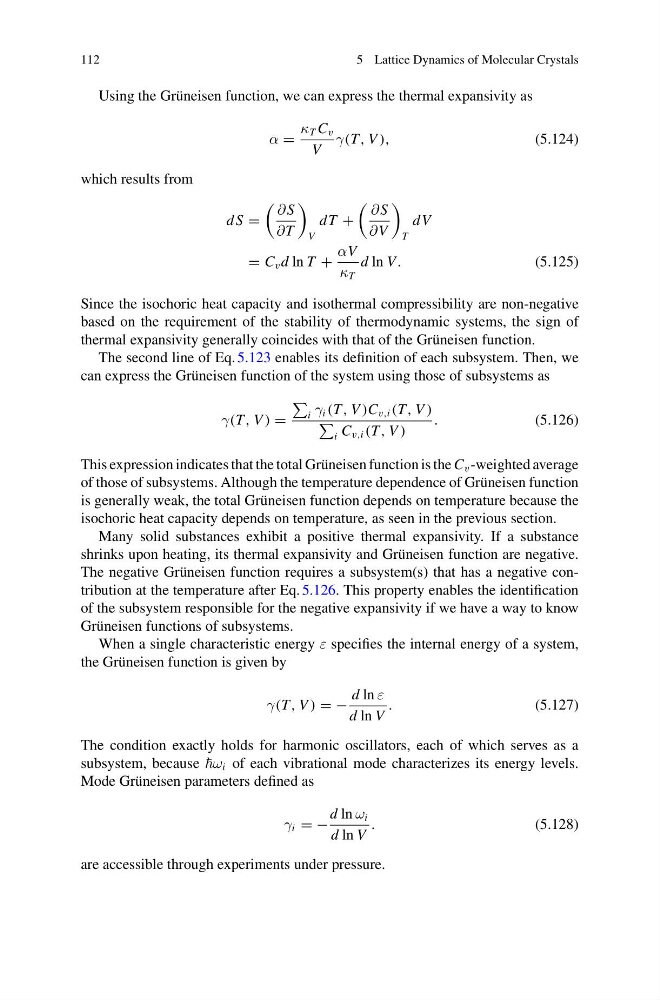
Using the Grüneisen function, we can express the thermal expansivity as
α =
κ T C v
V
γ(T, V ),
(5.124)
which results from
d S =
∂ S
∂T
V
dT +
∂ S
∂V
T
dV
= C v d ln T +
αV
κ T
d ln V.
(5.125)
Since the isochoric heat capacity and isothermal compressibility are non-negative
based on the requirement of the stability of thermodynamic systems, the sign of
thermal expansivity generally coincides with that of the Grüneisen function.
The second line of Eq. 5.123 enables its definition of each subsystem. Then, we
can express the Grüneisen function of the system using those of subsystems as
γ(T, V ) =
i γ i (T, V )C v,i (T, V )
i C v,i (T, V )
.
(5.126)
This expression indicates that the total Grüneisen function is the C v -weighted average
of those of subsystems. Although the temperature dependence of Grüneisen function
is generally weak, the total Grüneisen function depends on temperature because the
isochoric heat capacity depends on temperature, as seen in the previous section.
Many solid substances exhibit a positive thermal expansivity. If a substance
shrinks upon heating, its thermal expansivity and Grüneisen function are negative.
The negative Grüneisen function requires a subsystem(s) that has a negative contribution at the temperature after Eq. 5.126. This property enables the identification
of the subsystem responsible for the negative expansivity if we have a way to know
Grüneisen functions of subsystems.
When a single characteristic energy ε specifies the internal energy of a system,
the Grüneisen function is given by
γ(T, V ) = −
d ln ε
d ln V
.
(5.127)
The condition exactly holds for harmonic oscillators, each of which serves as a
subsystem, because ω i of each vibrational mode characterizes its energy levels.
Mode Grüneisen parameters defined as
γ i = −
d ln ω i
d ln V
.
(5.128)
are accessible through experiments under pressure.
5 Lattice Dynamics of Molecular Crystals
Using the Grüneisen function, we can express the thermal expansivity as
α =
κ T C v
V
γ(T, V ),
(5.124)
which results from
d S =
∂ S
∂T
V
dT +
∂ S
∂V
T
dV
= C v d ln T +
αV
κ T
d ln V.
(5.125)
Since the isochoric heat capacity and isothermal compressibility are non-negative
based on the requirement of the stability of thermodynamic systems, the sign of
thermal expansivity generally coincides with that of the Grüneisen function.
The second line of Eq. 5.123 enables its definition of each subsystem. Then, we
can express the Grüneisen function of the system using those of subsystems as
γ(T, V ) =
i γ i (T, V )C v,i (T, V )
i C v,i (T, V )
.
(5.126)
This expression indicates that the total Grüneisen function is the C v -weighted average
of those of subsystems. Although the temperature dependence of Grüneisen function
is generally weak, the total Grüneisen function depends on temperature because the
isochoric heat capacity depends on temperature, as seen in the previous section.
Many solid substances exhibit a positive thermal expansivity. If a substance
shrinks upon heating, its thermal expansivity and Grüneisen function are negative.
The negative Grüneisen function requires a subsystem(s) that has a negative contribution at the temperature after Eq. 5.126. This property enables the identification
of the subsystem responsible for the negative expansivity if we have a way to know
Grüneisen functions of subsystems.
When a single characteristic energy ε specifies the internal energy of a system,
the Grüneisen function is given by
γ(T, V ) = −
d ln ε
d ln V
.
(5.127)
The condition exactly holds for harmonic oscillators, each of which serves as a
subsystem, because ω i of each vibrational mode characterizes its energy levels.
Mode Grüneisen parameters defined as
γ i = −
d ln ω i
d ln V
.
(5.128)
are accessible through experiments under pressure.