

5.5 Related Issues and Examples
111
We see that the anharmonicity brings about a thermal variation in the atomic position,
which is linear both in temperature and the anharmonicity parameter within the
lowest-order approximation. Since any vibrational modes in real crystals are more
or less anharmonic, thermal “expansion” always occurs. It is noteworthy that the
direction of the variation depends on the sign of the anharmonicity parameter f .
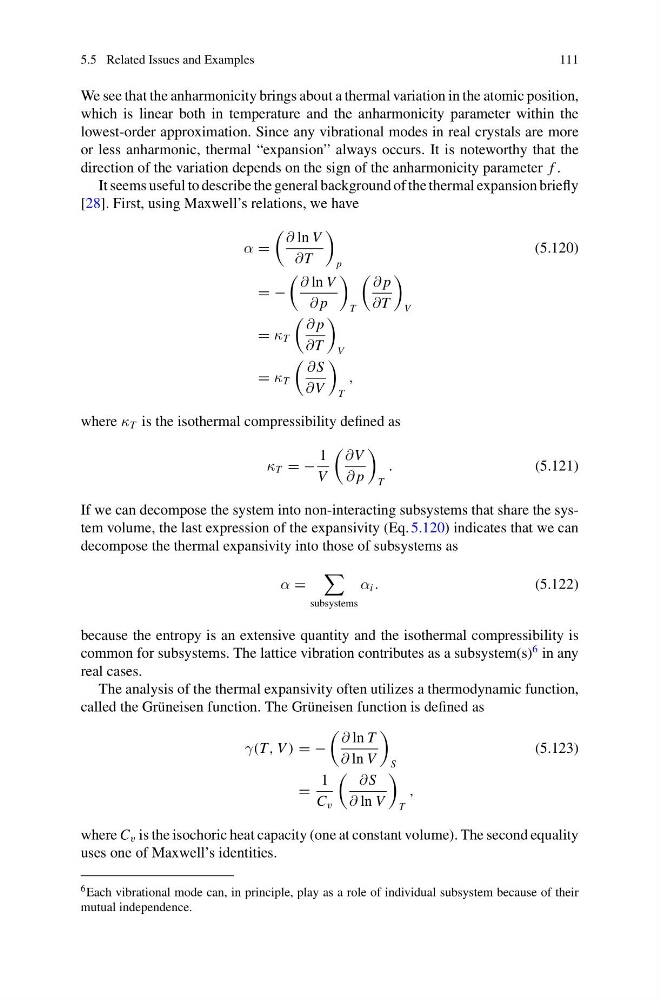
It seems useful to describe the general background of the thermal expansion briefly
[28]. First, using Maxwell’s relations, we have
α =
∂ ln V
∂T
p
(5.120)
= −
∂ ln V
∂ p
T
∂ p
∂T
V
= κ T
∂ p
∂T
V
= κ T
∂ S
∂V
T
,
where κ T is the isothermal compressibility defined as
κ T = −
1
V
∂V
∂ p
T
.
(5.121)
If we can decompose the system into non-interacting subsystems that share the system volume, the last expression of the expansivity (Eq. 5.120) indicates that we can
decompose the thermal expansivity into those of subsystems as
α =
subsystems
α i .
(5.122)
because the entropy is an extensive quantity and the isothermal compressibility is
common for subsystems. The lattice vibration contributes as a subsystem(s)
6 in any
real cases.
The analysis of the thermal expansivity often utilizes a thermodynamic function,
called the Grüneisen function. The Grüneisen function is defined as
γ(T, V ) = −
∂ ln T
∂ ln V
S
(5.123)
=
1
C v
∂ S
∂ ln V
T
,
where C v is the isochoric heat capacity (one at constant volume). The second equality
uses one of Maxwell’s identities.
6 Each vibrational mode can, in principle, play as a role of individual subsystem because of their
mutual independence.
111
We see that the anharmonicity brings about a thermal variation in the atomic position,
which is linear both in temperature and the anharmonicity parameter within the
lowest-order approximation. Since any vibrational modes in real crystals are more
or less anharmonic, thermal “expansion” always occurs. It is noteworthy that the
direction of the variation depends on the sign of the anharmonicity parameter f .
It seems useful to describe the general background of the thermal expansion briefly
[28]. First, using Maxwell’s relations, we have
α =
∂ ln V
∂T
p
(5.120)
= −
∂ ln V
∂ p
T
∂ p
∂T
V
= κ T
∂ p
∂T
V
= κ T
∂ S
∂V
T
,
where κ T is the isothermal compressibility defined as
κ T = −
1
V
∂V
∂ p
T
.
(5.121)
If we can decompose the system into non-interacting subsystems that share the system volume, the last expression of the expansivity (Eq. 5.120) indicates that we can
decompose the thermal expansivity into those of subsystems as
α =
subsystems
α i .
(5.122)
because the entropy is an extensive quantity and the isothermal compressibility is
common for subsystems. The lattice vibration contributes as a subsystem(s)
6 in any
real cases.
The analysis of the thermal expansivity often utilizes a thermodynamic function,
called the Grüneisen function. The Grüneisen function is defined as
γ(T, V ) = −
∂ ln T
∂ ln V
S
(5.123)
=
1
C v
∂ S
∂ ln V
T
,
where C v is the isochoric heat capacity (one at constant volume). The second equality
uses one of Maxwell’s identities.
6 Each vibrational mode can, in principle, play as a role of individual subsystem because of their
mutual independence.