

110
5 Lattice Dynamics of Molecular Crystals
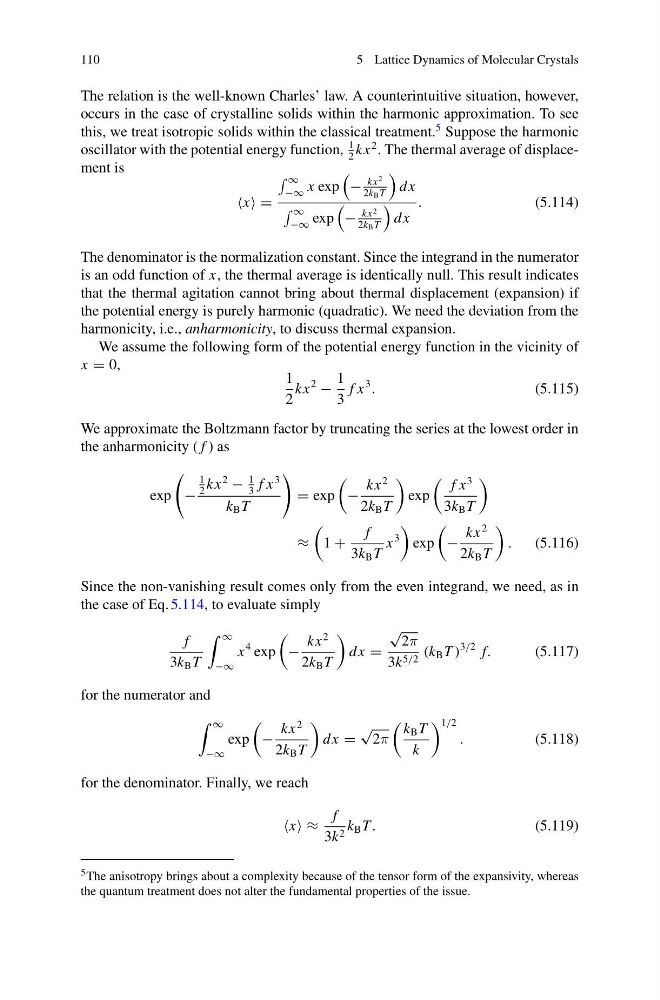
The relation is the well-known Charles’ law. A counterintuitive situation, however,
occurs in the case of crystalline solids within the harmonic approximation. To see
this, we treat isotropic solids within the classical treatment.
5 Suppose the harmonic
oscillator with the potential energy function,
1
2
kx
2 . The thermal average of displacement is
x =
∞
−∞ x exp
−
kx
2
2k B T
dx
∞
−∞ exp
−
kx 2
2k B T
dx
.
(5.114)
The denominator is the normalization constant. Since the integrand in the numerator
is an odd function of x, the thermal average is identically null. This result indicates
that the thermal agitation cannot bring about thermal displacement (expansion) if
the potential energy is purely harmonic (quadratic). We need the deviation from the
harmonicity, i.e., anharmonicity, to discuss thermal expansion.
We assume the following form of the potential energy function in the vicinity of
x = 0,
1
2
kx
2
−
1
3
f x
3
.
(5.115)
We approximate the Boltzmann factor by truncating the series at the lowest order in
the anharmonicity ( f ) as
exp
−
1
2
kx
2
−
1
3
f x
3
k B T
= exp
−
kx
2
2k B T
exp
f x
3
3k B T
≈
1 +
f
3k B T
x
3
exp
−
kx
2
2k B T
.
(5.116)
Since the non-vanishing result comes only from the even integrand, we need, as in
the case of Eq. 5.114, to evaluate simply
f
3k B T
∞
−∞
x
4 exp
−
kx
2
2k B T
dx =
√
2π
3k 5/2 (k B T )
3/2 f.
(5.117)
for the numerator and
∞
−∞
exp
−
kx
2
2k B T
dx =
√
2π
k B T
k
1/2
.
(5.118)
for the denominator. Finally, we reach
x ≈
f
3k 2 k B T.
(5.119)
5 The anisotropy brings about a complexity because of the tensor form of the expansivity, whereas
the quantum treatment does not alter the fundamental properties of the issue.
5 Lattice Dynamics of Molecular Crystals
The relation is the well-known Charles’ law. A counterintuitive situation, however,
occurs in the case of crystalline solids within the harmonic approximation. To see
this, we treat isotropic solids within the classical treatment.
5 Suppose the harmonic
oscillator with the potential energy function,
1
2
kx
2 . The thermal average of displacement is
x =
∞
−∞ x exp
−
kx
2
2k B T
dx
∞
−∞ exp
−
kx 2
2k B T
dx
.
(5.114)
The denominator is the normalization constant. Since the integrand in the numerator
is an odd function of x, the thermal average is identically null. This result indicates
that the thermal agitation cannot bring about thermal displacement (expansion) if
the potential energy is purely harmonic (quadratic). We need the deviation from the
harmonicity, i.e., anharmonicity, to discuss thermal expansion.
We assume the following form of the potential energy function in the vicinity of
x = 0,
1
2
kx
2
−
1
3
f x
3
.
(5.115)
We approximate the Boltzmann factor by truncating the series at the lowest order in
the anharmonicity ( f ) as
exp
−
1
2
kx
2
−
1
3
f x
3
k B T
= exp
−
kx
2
2k B T
exp
f x
3
3k B T
≈
1 +
f
3k B T
x
3
exp
−
kx
2
2k B T
.
(5.116)
Since the non-vanishing result comes only from the even integrand, we need, as in
the case of Eq. 5.114, to evaluate simply
f
3k B T
∞
−∞
x
4 exp
−
kx
2
2k B T
dx =
√
2π
3k 5/2 (k B T )
3/2 f.
(5.117)
for the numerator and
∞
−∞
exp
−
kx
2
2k B T
dx =
√
2π
k B T
k
1/2
.
(5.118)
for the denominator. Finally, we reach
x ≈
f
3k 2 k B T.
(5.119)
5 The anisotropy brings about a complexity because of the tensor form of the expansivity, whereas
the quantum treatment does not alter the fundamental properties of the issue.