

5.5 Related Issues and Examples
109
0
50
100
0
0
0
c*
c*
c*
ν / cm
–1
c
b
a
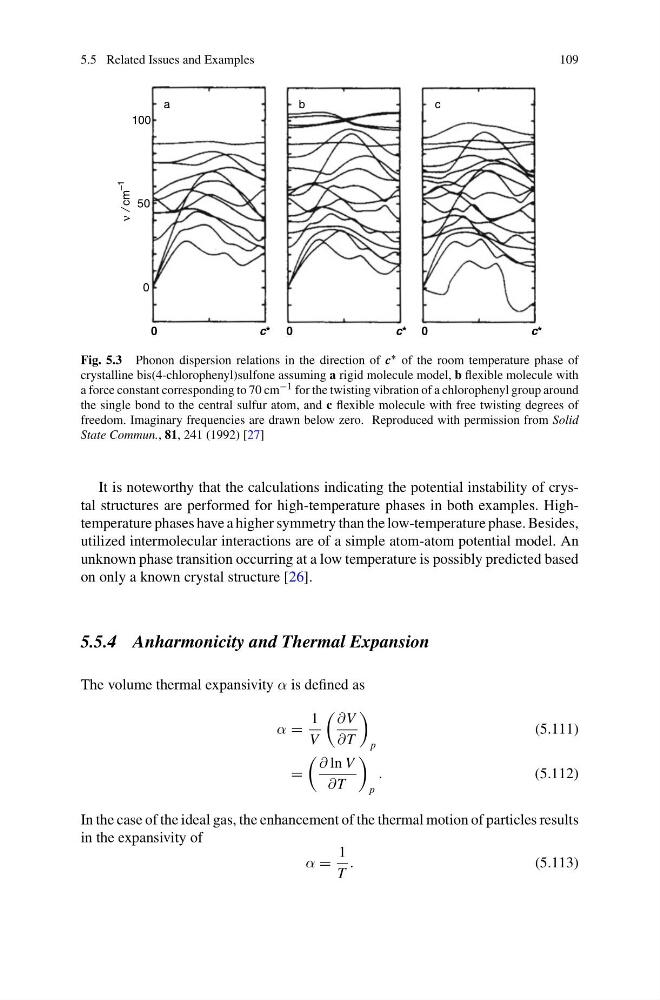
Fig. 5.3 Phonon dispersion relations in the direction of c ∗ of the room temperature phase of
crystalline bis(4-chlorophenyl)sulfone assuming a rigid molecule model, b flexible molecule with
a force constant corresponding to 70 cm −1 for the twisting vibration of a chlorophenyl group around
the single bond to the central sulfur atom, and c flexible molecule with free twisting degrees of
freedom. Imaginary frequencies are drawn below zero. Reproduced with permission from Solid
State Commun., 81, 241 (1992) [27]
It is noteworthy that the calculations indicating the potential instability of crystal structures are performed for high-temperature phases in both examples. Hightemperature phases have a higher symmetry than the low-temperature phase. Besides,
utilized intermolecular interactions are of a simple atom-atom potential model. An
unknown phase transition occurring at a low temperature is possibly predicted based
on only a known crystal structure [26].
5.5.4 Anharmonicity and Thermal Expansion
The volume thermal expansivity α is defined as
α =
1
V
∂V
∂T
p
(5.111)
=
∂ ln V
∂T
p
.
(5.112)
In the case of the ideal gas, the enhancement of the thermal motion of particles results
in the expansivity of
α =
1
T
.
(5.113)
109
0
50
100
0
0
0
c*
c*
c*
ν / cm
–1
c
b
a
Fig. 5.3 Phonon dispersion relations in the direction of c ∗ of the room temperature phase of
crystalline bis(4-chlorophenyl)sulfone assuming a rigid molecule model, b flexible molecule with
a force constant corresponding to 70 cm −1 for the twisting vibration of a chlorophenyl group around
the single bond to the central sulfur atom, and c flexible molecule with free twisting degrees of
freedom. Imaginary frequencies are drawn below zero. Reproduced with permission from Solid
State Commun., 81, 241 (1992) [27]
It is noteworthy that the calculations indicating the potential instability of crystal structures are performed for high-temperature phases in both examples. Hightemperature phases have a higher symmetry than the low-temperature phase. Besides,
utilized intermolecular interactions are of a simple atom-atom potential model. An
unknown phase transition occurring at a low temperature is possibly predicted based
on only a known crystal structure [26].
5.5.4 Anharmonicity and Thermal Expansion
The volume thermal expansivity α is defined as
α =
1
V
∂V
∂T
p
(5.111)
=
∂ ln V
∂T
p
.
(5.112)
In the case of the ideal gas, the enhancement of the thermal motion of particles results
in the expansivity of
α =
1
T
.
(5.113)