

5.3 Crystals of Rigid Molecules
99
V =
1
2
p
p
v(r p , r p
).
(5.82)
Then, the force constants for p = p
are expressed as
φ
ab
αβ ( p, p
) =
∂
2
v(r p , r p
)
∂x a
α, p ∂x
b
β, p
eq
,
(5.83)
where x
a
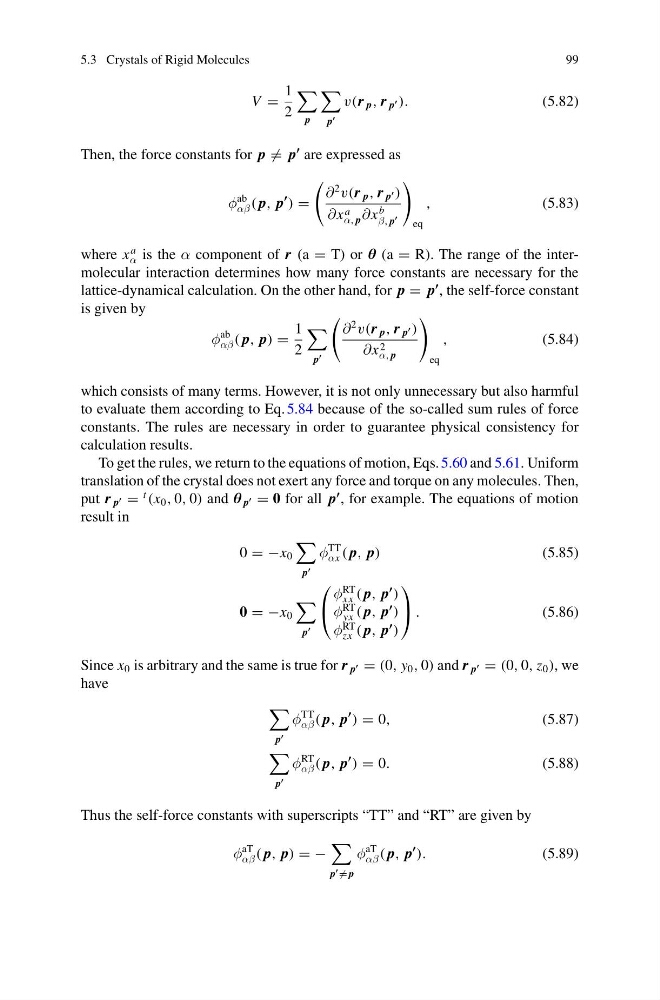
α is the α component of r (a = T) or θ (a = R). The range of the intermolecular interaction determines how many force constants are necessary for the
lattice-dynamical calculation. On the other hand, for p = p
, the self-force constant
is given by
φ
ab
αβ ( p, p) =
1
2
p
∂
2
v(r p , r p
)
∂x 2
α, p
eq
,
(5.84)
which consists of many terms. However, it is not only unnecessary but also harmful
to evaluate them according to Eq. 5.84 because of the so-called sum rules of force
constants. The rules are necessary in order to guarantee physical consistency for
calculation results.
To get the rules, we return to the equations of motion, Eqs. 5.60 and 5.61. Uniform
translation of the crystal does not exert any force and torque on any molecules. Then,
put r p
=
t
(x 0 , 0, 0) and θ p
= 0 for all p
, for example. The equations of motion
result in
0 = −x 0
p
φ
TT
αx ( p, p)
(5.85)
0 = −x 0
p
⎛
⎝
φ
RT
xx ( p, p
)
φ
RT
yx ( p, p
)
φ
RT
zx ( p, p
)
⎞
⎠ .
(5.86)
Since x 0 is arbitrary and the same is true for r p
= (0, y 0 , 0) and r p
= (0, 0, z 0 ), we
have
p
φ
TT
αβ ( p, p
) = 0,
(5.87)
p
φ
RT
αβ ( p, p
) = 0.
(5.88)
Thus the self-force constants with superscripts “TT” and “RT” are given by
φ
aT
αβ ( p, p) = −
p
= p
φ
aT
αβ ( p, p
).
(5.89)
99
V =
1
2
p
p
v(r p , r p
).
(5.82)
Then, the force constants for p = p
are expressed as
φ
ab
αβ ( p, p
) =
∂
2
v(r p , r p
)
∂x a
α, p ∂x
b
β, p
eq
,
(5.83)
where x
a
α is the α component of r (a = T) or θ (a = R). The range of the intermolecular interaction determines how many force constants are necessary for the
lattice-dynamical calculation. On the other hand, for p = p
, the self-force constant
is given by
φ
ab
αβ ( p, p) =
1
2
p
∂
2
v(r p , r p
)
∂x 2
α, p
eq
,
(5.84)
which consists of many terms. However, it is not only unnecessary but also harmful
to evaluate them according to Eq. 5.84 because of the so-called sum rules of force
constants. The rules are necessary in order to guarantee physical consistency for
calculation results.
To get the rules, we return to the equations of motion, Eqs. 5.60 and 5.61. Uniform
translation of the crystal does not exert any force and torque on any molecules. Then,
put r p
=
t
(x 0 , 0, 0) and θ p
= 0 for all p
, for example. The equations of motion
result in
0 = −x 0
p
φ
TT
αx ( p, p)
(5.85)
0 = −x 0
p
⎛
⎝
φ
RT
xx ( p, p
)
φ
RT
yx ( p, p
)
φ
RT
zx ( p, p
)
⎞
⎠ .
(5.86)
Since x 0 is arbitrary and the same is true for r p
= (0, y 0 , 0) and r p
= (0, 0, z 0 ), we
have
p
φ
TT
αβ ( p, p
) = 0,
(5.87)
p
φ
RT
αβ ( p, p
) = 0.
(5.88)
Thus the self-force constants with superscripts “TT” and “RT” are given by
φ
aT
αβ ( p, p) = −
p
= p
φ
aT
αβ ( p, p
).
(5.89)