

100
5 Lattice Dynamics of Molecular Crystals
Further, the symmetry between φ
RT
αβ ( p, p
) and φ
TR
βα ( p
, p) yields
φ
TR
αβ ( p, p) = φ
RT
βα ( p, p).
(5.90)
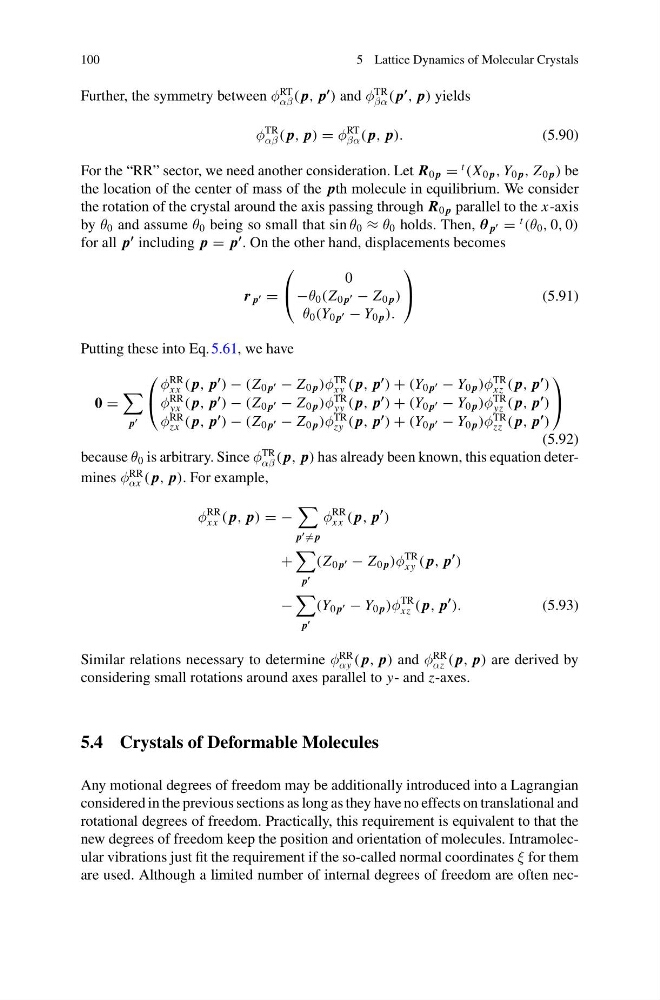
For the “RR” sector, we need another consideration. Let R 0 p =
t
(X 0 p , Y 0 p , Z 0 p ) be
the location of the center of mass of the pth molecule in equilibrium. We consider
the rotation of the crystal around the axis passing through R 0 p parallel to the x-axis
by θ 0 and assume θ 0 being so small that sin θ 0 ≈ θ 0 holds. Then, θ p
=
t
(θ 0 , 0, 0)
for all p
including p = p
. On the other hand, displacements becomes
r p
=
⎛
⎝
0
−θ 0 (Z 0 p
− Z 0 p )
θ 0 (Y 0 p
− Y 0 p ).
⎞
⎠
(5.91)
Putting these into Eq. 5.61, we have
0 =
p
⎛
⎝
φ
RR
xx ( p, p
) − (Z 0 p
− Z 0 p )φ
TR
xy ( p, p
) + (Y 0 p
− Y 0 p )φ
TR
xz ( p, p
)
φ
RR
yx ( p, p
) − (Z 0 p
− Z 0 p )φ
TR
yy ( p, p
) + (Y 0 p
− Y 0 p )φ
TR
yz ( p, p
)
φ
RR
zx ( p, p
) − (Z 0 p
− Z 0 p )φ
TR
zy ( p, p
) + (Y 0 p
− Y 0 p )φ
TR
zz ( p, p
)
⎞
⎠
(5.92)
because θ 0 is arbitrary. Since φ
TR
αβ ( p, p) has already been known, this equation determines φ
RR
αx ( p, p). For example,
φ
RR
xx ( p, p) = −
p
= p
φ
RR
xx ( p, p
)
+
p
(Z 0 p
− Z 0 p )φ
TR
xy ( p, p
)
−
p
(Y 0 p
− Y 0 p )φ
TR
xz ( p, p
).
(5.93)
Similar relations necessary to determine φ
RR
αy ( p, p) and φ
RR
αz ( p, p) are derived by
considering small rotations around axes parallel to y- and z-axes.
5.4 Crystals of Deformable Molecules
Any motional degrees of freedom may be additionally introduced into a Lagrangian
considered in the previous sections as long as they have no effects on translational and
rotational degrees of freedom. Practically, this requirement is equivalent to that the
new degrees of freedom keep the position and orientation of molecules. Intramolecular vibrations just fit the requirement if the so-called normal coordinates ξ for them
are used. Although a limited number of internal degrees of freedom are often nec-
5 Lattice Dynamics of Molecular Crystals
Further, the symmetry between φ
RT
αβ ( p, p
) and φ
TR
βα ( p
, p) yields
φ
TR
αβ ( p, p) = φ
RT
βα ( p, p).
(5.90)
For the “RR” sector, we need another consideration. Let R 0 p =
t
(X 0 p , Y 0 p , Z 0 p ) be
the location of the center of mass of the pth molecule in equilibrium. We consider
the rotation of the crystal around the axis passing through R 0 p parallel to the x-axis
by θ 0 and assume θ 0 being so small that sin θ 0 ≈ θ 0 holds. Then, θ p
=
t
(θ 0 , 0, 0)
for all p
including p = p
. On the other hand, displacements becomes
r p
=
⎛
⎝
0
−θ 0 (Z 0 p
− Z 0 p )
θ 0 (Y 0 p
− Y 0 p ).
⎞
⎠
(5.91)
Putting these into Eq. 5.61, we have
0 =
p
⎛
⎝
φ
RR
xx ( p, p
) − (Z 0 p
− Z 0 p )φ
TR
xy ( p, p
) + (Y 0 p
− Y 0 p )φ
TR
xz ( p, p
)
φ
RR
yx ( p, p
) − (Z 0 p
− Z 0 p )φ
TR
yy ( p, p
) + (Y 0 p
− Y 0 p )φ
TR
yz ( p, p
)
φ
RR
zx ( p, p
) − (Z 0 p
− Z 0 p )φ
TR
zy ( p, p
) + (Y 0 p
− Y 0 p )φ
TR
zz ( p, p
)
⎞
⎠
(5.92)
because θ 0 is arbitrary. Since φ
TR
αβ ( p, p) has already been known, this equation determines φ
RR
αx ( p, p). For example,
φ
RR
xx ( p, p) = −
p
= p
φ
RR
xx ( p, p
)
+
p
(Z 0 p
− Z 0 p )φ
TR
xy ( p, p
)
−
p
(Y 0 p
− Y 0 p )φ
TR
xz ( p, p
).
(5.93)
Similar relations necessary to determine φ
RR
αy ( p, p) and φ
RR
αz ( p, p) are derived by
considering small rotations around axes parallel to y- and z-axes.
5.4 Crystals of Deformable Molecules
Any motional degrees of freedom may be additionally introduced into a Lagrangian
considered in the previous sections as long as they have no effects on translational and
rotational degrees of freedom. Practically, this requirement is equivalent to that the
new degrees of freedom keep the position and orientation of molecules. Intramolecular vibrations just fit the requirement if the so-called normal coordinates ξ for them
are used. Although a limited number of internal degrees of freedom are often nec-