

98
5 Lattice Dynamics of Molecular Crystals
i =
⎛
⎝
m j (y
2
j + z
2
j ) −
m j x j y j −
m j x j z j
−
m j y j x j
m j (z
2
j + x
2
j ) −
m j y j z j
−
m j z j x j −
m j z j y j
m j (y
2
j + z
2
j )
⎞
⎠ .
(5.77)
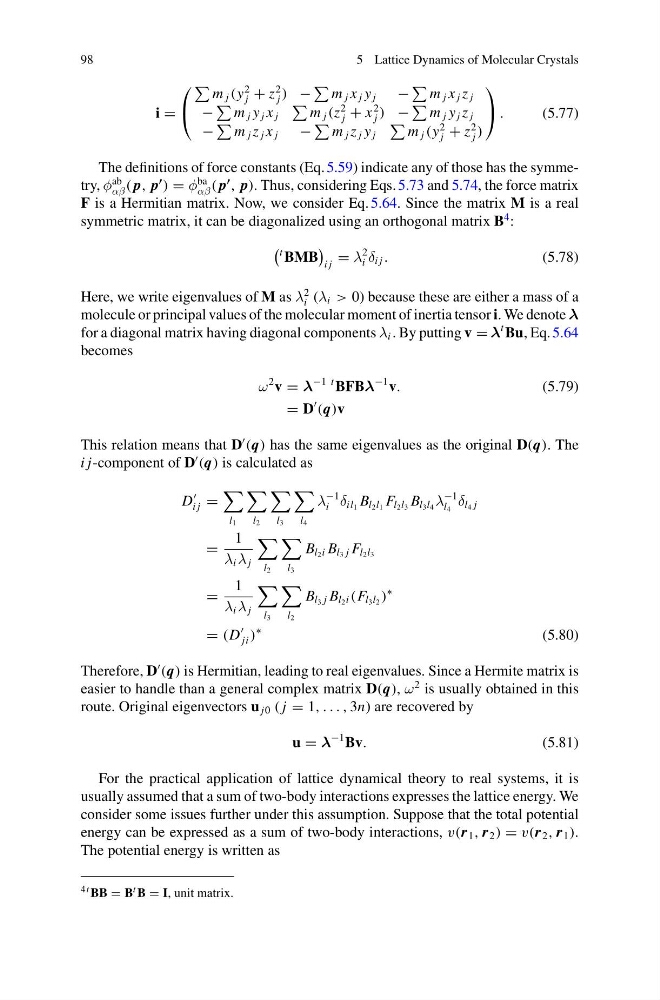
The definitions of force constants (Eq. 5.59) indicate any of those has the symmetry, φ
ab
αβ ( p, p
) = φ
ba
αβ ( p
, p). Thus, considering Eqs. 5.73 and 5.74, the force matrix
F is a Hermitian matrix. Now, we consider Eq. 5.64. Since the matrix M is a real
symmetric matrix, it can be diagonalized using an orthogonal matrix B
4 :
t BMB
i j
= λ
2
i δ i j .
(5.78)
Here, we write eigenvalues of M as λ
2
i (λ i > 0) because these are either a mass of a
molecule or principal values of the molecular moment of inertia tensor i. We denote λ
for a diagonal matrix having diagonal components λ i . By putting v = λ
t Bu, Eq. 5.64
becomes
ω
2 v = λ
−1 t BFBλ
−1 v.
(5.79)
= D
(q)v
This relation means that D
(q) has the same eigenvalues as the original D(q). The
i j-component of D
(q) is calculated as
D
i j =
l 1
l 2
l 3
l 4
λ
−1
i δ il 1 B l 2 l 1 F l 2 l 3 B l 3 l 4 λ
−1
l 4
δ l 4 j
=
1
λ i λ j
l 2
l 3
B l 2 i B l 3 j F l 2 l 3
=
1
λ i λ j
l 3
l 2
B l 3 j B l 2 i (F l 3 l 2 )
∗
= (D
ji )
∗
(5.80)
Therefore, D
(q) is Hermitian, leading to real eigenvalues. Since a Hermite matrix is
easier to handle than a general complex matrix D(q), ω
2 is usually obtained in this
route. Original eigenvectors u j0 ( j = 1, . . . , 3n) are recovered by
u = λ
−1 Bv.
(5.81)
For the practical application of lattice dynamical theory to real systems, it is
usually assumed that a sum of two-body interactions expresses the lattice energy. We
consider some issues further under this assumption. Suppose that the total potential
energy can be expressed as a sum of two-body interactions, v(r 1 , r 2 ) = v(r 2 , r 1 ).
The potential energy is written as
4t BB = B t B = I, unit matrix.
5 Lattice Dynamics of Molecular Crystals
i =
⎛
⎝
m j (y
2
j + z
2
j ) −
m j x j y j −
m j x j z j
−
m j y j x j
m j (z
2
j + x
2
j ) −
m j y j z j
−
m j z j x j −
m j z j y j
m j (y
2
j + z
2
j )
⎞
⎠ .
(5.77)
The definitions of force constants (Eq. 5.59) indicate any of those has the symmetry, φ
ab
αβ ( p, p
) = φ
ba
αβ ( p
, p). Thus, considering Eqs. 5.73 and 5.74, the force matrix
F is a Hermitian matrix. Now, we consider Eq. 5.64. Since the matrix M is a real
symmetric matrix, it can be diagonalized using an orthogonal matrix B
4 :
t BMB
i j
= λ
2
i δ i j .
(5.78)
Here, we write eigenvalues of M as λ
2
i (λ i > 0) because these are either a mass of a
molecule or principal values of the molecular moment of inertia tensor i. We denote λ
for a diagonal matrix having diagonal components λ i . By putting v = λ
t Bu, Eq. 5.64
becomes
ω
2 v = λ
−1 t BFBλ
−1 v.
(5.79)
= D
(q)v
This relation means that D
(q) has the same eigenvalues as the original D(q). The
i j-component of D
(q) is calculated as
D
i j =
l 1
l 2
l 3
l 4
λ
−1
i δ il 1 B l 2 l 1 F l 2 l 3 B l 3 l 4 λ
−1
l 4
δ l 4 j
=
1
λ i λ j
l 2
l 3
B l 2 i B l 3 j F l 2 l 3
=
1
λ i λ j
l 3
l 2
B l 3 j B l 2 i (F l 3 l 2 )
∗
= (D
ji )
∗
(5.80)
Therefore, D
(q) is Hermitian, leading to real eigenvalues. Since a Hermite matrix is
easier to handle than a general complex matrix D(q), ω
2 is usually obtained in this
route. Original eigenvectors u j0 ( j = 1, . . . , 3n) are recovered by
u = λ
−1 Bv.
(5.81)
For the practical application of lattice dynamical theory to real systems, it is
usually assumed that a sum of two-body interactions expresses the lattice energy. We
consider some issues further under this assumption. Suppose that the total potential
energy can be expressed as a sum of two-body interactions, v(r 1 , r 2 ) = v(r 2 , r 1 ).
The potential energy is written as
4t BB = B t B = I, unit matrix.