

5.3 Crystals of Rigid Molecules
97
u(t) =
⎛
⎜
⎜
⎜
⎜
⎜
⎜
⎜
⎜
⎝
r 1 (t)
. . .
r n (t)
θ 1 (t)
. . .
θ n (t)
⎞
⎟
⎟
⎟
⎟
⎟
⎟
⎟
⎟
⎠
,
(5.69)
F =
F
TT F
TR
F
RT F
RR
,
(5.70)
F
ab
=
⎛
⎜
⎝
F
ab
11 . . . F
ab
1n
. . . F
ab
j j
. . .
F
ab
n1 . . . F
ab
nn
⎞
⎟
⎠ ,
(5.71)
F
ab
j j =
⎛
⎜
⎝
F
ab
j x j x F
ab
j x j y F
ab
j x j z
F
ab
j yj x F
ab
j yj y F
ab
j yj z
F
ab
jzj x F
ab
jzj y F
ab
jzj z
⎞
⎟
⎠
(5.72)
and
F
ab
jα j β =
p
φ
ab
αβ ( p, p
) exp(−i d l q),
(5.73)
d l = r
◦
0 − r
◦
l ,
(5.74)
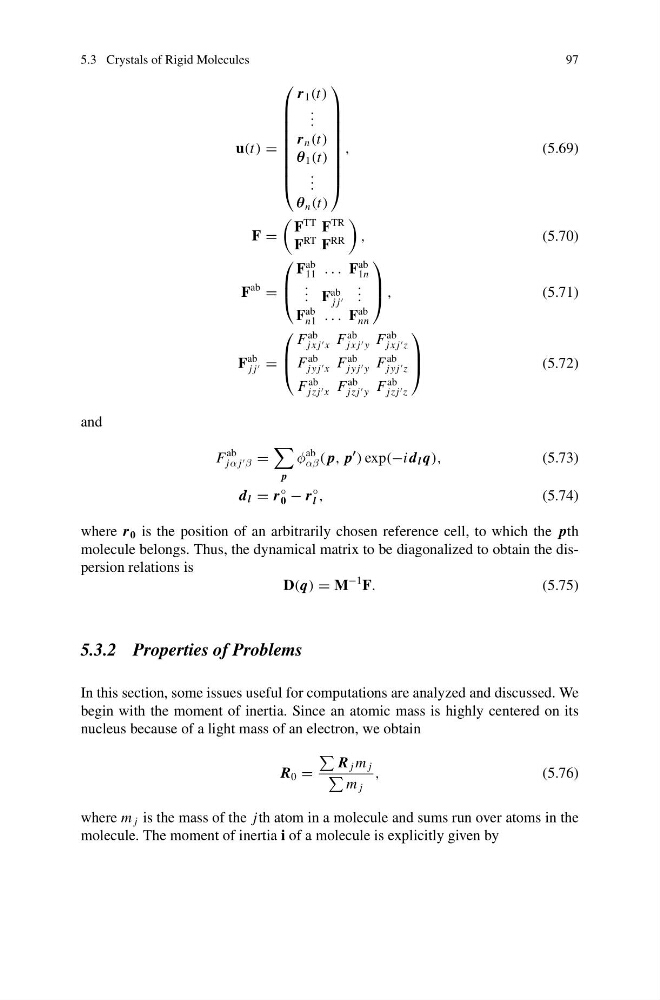
where r 0 is the position of an arbitrarily chosen reference cell, to which the pth
molecule belongs. Thus, the dynamical matrix to be diagonalized to obtain the dispersion relations is
D(q) = M
−1 F.
(5.75)
5.3.2 Properties of Problems
In this section, some issues useful for computations are analyzed and discussed. We
begin with the moment of inertia. Since an atomic mass is highly centered on its
nucleus because of a light mass of an electron, we obtain
R 0 =
R j m j
m j
,
(5.76)
where m j is the mass of the jth atom in a molecule and sums run over atoms in the
molecule. The moment of inertia i of a molecule is explicitly given by
97
u(t) =
⎛
⎜
⎜
⎜
⎜
⎜
⎜
⎜
⎜
⎝
r 1 (t)
. . .
r n (t)
θ 1 (t)
. . .
θ n (t)
⎞
⎟
⎟
⎟
⎟
⎟
⎟
⎟
⎟
⎠
,
(5.69)
F =
F
TT F
TR
F
RT F
RR
,
(5.70)
F
ab
=
⎛
⎜
⎝
F
ab
11 . . . F
ab
1n
. . . F
ab
j j
. . .
F
ab
n1 . . . F
ab
nn
⎞
⎟
⎠ ,
(5.71)
F
ab
j j =
⎛
⎜
⎝
F
ab
j x j x F
ab
j x j y F
ab
j x j z
F
ab
j yj x F
ab
j yj y F
ab
j yj z
F
ab
jzj x F
ab
jzj y F
ab
jzj z
⎞
⎟
⎠
(5.72)
and
F
ab
jα j β =
p
φ
ab
αβ ( p, p
) exp(−i d l q),
(5.73)
d l = r
◦
0 − r
◦
l ,
(5.74)
where r 0 is the position of an arbitrarily chosen reference cell, to which the pth
molecule belongs. Thus, the dynamical matrix to be diagonalized to obtain the dispersion relations is
D(q) = M
−1 F.
(5.75)
5.3.2 Properties of Problems
In this section, some issues useful for computations are analyzed and discussed. We
begin with the moment of inertia. Since an atomic mass is highly centered on its
nucleus because of a light mass of an electron, we obtain
R 0 =
R j m j
m j
,
(5.76)
where m j is the mass of the jth atom in a molecule and sums run over atoms in the
molecule. The moment of inertia i of a molecule is explicitly given by