

This is because the salt-damaged soil in its natural state is always exposed to a
high salt concentration; thus, lower salt concentrations might not be suitable for
extremely halotolerant anaerobic microorganisms to grow. Another reason for this is
that the food to microorganism (F/M) ratio at 1.5 [mg/L volatile suspended solids
(VSS)]/[mg/L of the substrate] might not be ideal for production for 3–10% salinity
conditions.
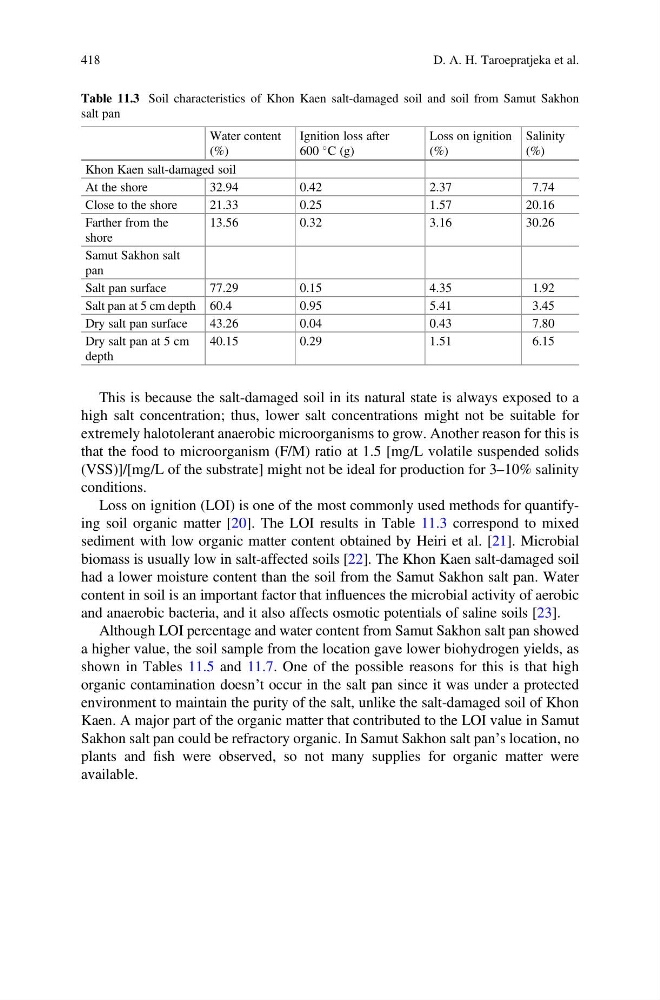
Loss on ignition (LOI) is one of the most commonly used methods for quantifying soil organic matter [20]. The LOI results in Table 11.3 correspond to mixed
sediment with low organic matter content obtained by Heiri et al. [21]. Microbial
biomass is usually low in salt-affected soils [22]. The Khon Kaen salt-damaged soil
had a lower moisture content than the soil from the Samut Sakhon salt pan. Water
content in soil is an important factor that influences the microbial activity of aerobic
and anaerobic bacteria, and it also affects osmotic potentials of saline soils [23].
Although LOI percentage and water content from Samut Sakhon salt pan showed
a higher value, the soil sample from the location gave lower biohydrogen yields, as
shown in Tables 11.5 and 11.7. One of the possible reasons for this is that high
organic contamination doesn’t occur in the salt pan since it was under a protected
environment to maintain the purity of the salt, unlike the salt-damaged soil of Khon
Kaen. A major part of the organic matter that contributed to the LOI value in Samut
Sakhon salt pan could be refractory organic. In Samut Sakhon salt pan’s location, no
plants and fish were observed, so not many supplies for organic matter were
available.
Table 11.3 Soil characteristics of Khon Kaen salt-damaged soil and soil from Samut Sakhon
salt pan
Water content
(%)
Ignition loss after
600
C (g)
Loss on ignition
(%)
Salinity
(%)
Khon Kaen salt-damaged soil
At the shore
32.94
0.42
2.37
7.74
Close to the shore
21.33
0.25
1.57
20.16
Farther from the
shore
13.56
0.32
3.16
30.26
Samut Sakhon salt
pan
Salt pan surface
77.29
0.15
4.35
1.92
Salt pan at 5 cm depth 60.4
0.95
5.41
3.45
Dry salt pan surface
43.26
0.04
0.43
7.80
Dry salt pan at 5 cm
depth
40.15
0.29
1.51
6.15
418
D. A. H. Taroepratjeka et al.
high salt concentration; thus, lower salt concentrations might not be suitable for
extremely halotolerant anaerobic microorganisms to grow. Another reason for this is
that the food to microorganism (F/M) ratio at 1.5 [mg/L volatile suspended solids
(VSS)]/[mg/L of the substrate] might not be ideal for production for 3–10% salinity
conditions.
Loss on ignition (LOI) is one of the most commonly used methods for quantifying soil organic matter [20]. The LOI results in Table 11.3 correspond to mixed
sediment with low organic matter content obtained by Heiri et al. [21]. Microbial
biomass is usually low in salt-affected soils [22]. The Khon Kaen salt-damaged soil
had a lower moisture content than the soil from the Samut Sakhon salt pan. Water
content in soil is an important factor that influences the microbial activity of aerobic
and anaerobic bacteria, and it also affects osmotic potentials of saline soils [23].
Although LOI percentage and water content from Samut Sakhon salt pan showed
a higher value, the soil sample from the location gave lower biohydrogen yields, as
shown in Tables 11.5 and 11.7. One of the possible reasons for this is that high
organic contamination doesn’t occur in the salt pan since it was under a protected
environment to maintain the purity of the salt, unlike the salt-damaged soil of Khon
Kaen. A major part of the organic matter that contributed to the LOI value in Samut
Sakhon salt pan could be refractory organic. In Samut Sakhon salt pan’s location, no
plants and fish were observed, so not many supplies for organic matter were
available.
Table 11.3 Soil characteristics of Khon Kaen salt-damaged soil and soil from Samut Sakhon
salt pan
Water content
(%)
Ignition loss after
600
C (g)
Loss on ignition
(%)
Salinity
(%)
Khon Kaen salt-damaged soil
At the shore
32.94
0.42
2.37
7.74
Close to the shore
21.33
0.25
1.57
20.16
Farther from the
shore
13.56
0.32
3.16
30.26
Samut Sakhon salt
pan
Salt pan surface
77.29
0.15
4.35
1.92
Salt pan at 5 cm depth 60.4
0.95
5.41
3.45
Dry salt pan surface
43.26
0.04
0.43
7.80
Dry salt pan at 5 cm
depth
40.15
0.29
1.51
6.15
418
D. A. H. Taroepratjeka et al.