

glucose will produce 2 mol of hydrogen; hence, 1 g of glucose at STP conditions is
required to produce 249 mL of H 2 via the butyric acid (HBu) pathway.
Theoretical maximum H 2 production reached is the comparison of observed
cumulative H 2 in the experiments (mL) to the multiplication of glucose provided
in the substrate (gr) with 498 mL of H 2 produced via the HAc pathway. Hydrogen
molar yield (HMY) is the observed cumulative H 2 (mol) divided by glucose provided in substrate (mol).
3 Results and Discussion
3.1 Biohydrogen Production at 3–10% Salinity
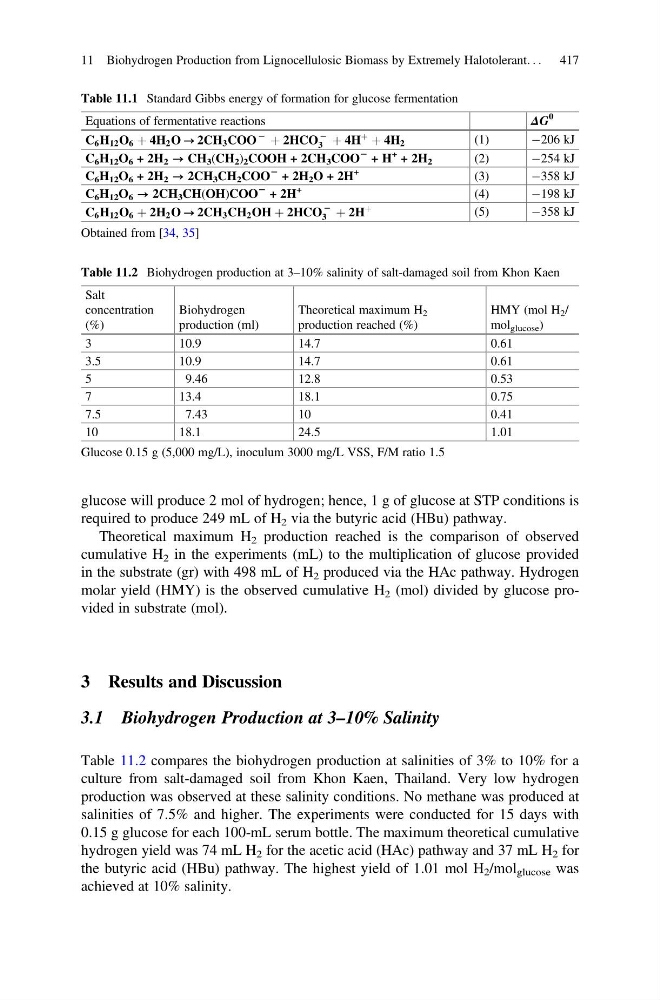
Table 11.2 compares the biohydrogen production at salinities of 3% to 10% for a
culture from salt-damaged soil from Khon Kaen, Thailand. Very low hydrogen
production was observed at these salinity conditions. No methane was produced at
salinities of 7.5% and higher. The experiments were conducted for 15 days with
0.15 g glucose for each 100-mL serum bottle. The maximum theoretical cumulative
hydrogen yield was 74 mL H 2 for the acetic acid (HAc) pathway and 37 mL H 2 for
the butyric acid (HBu) pathway. The highest yield of 1.01 mol H 2 /mol glucose was
achieved at 10% salinity.
Table 11.1 Standard Gibbs energy of formation for glucose fermentation
Equations of fermentative reactions
ΔG
0
C 6 H 12 O 6 þ 4H 2 O → 2CH 3 COO
2 þ 2HCO
2
3 þ 4H
þ þ 4H 2
(1)
À206 kJ
C 6 H 12 O 6 + 2H 2 → CH 3 (CH 2 ) 2 COOH + 2CH 3 COO
2 + H
+ + 2H 2
(2)
À254 kJ
C 6 H 12 O 6 + 2H 2 → 2CH 3 CH 2 COO
2 + 2H 2 O + 2H
+
(3)
À358 kJ
C 6 H 12 O 6 → 2CH 3 CH(OH)COO
2 + 2H
+
(4)
À198 kJ
C 6 H 12 O 6 þ 2H 2 O → 2CH 3 CH 2 OH þ 2HCO
2
3 þ 2H
þ
(5)
À358 kJ
Obtained from [34, 35]
Table 11.2 Biohydrogen production at 3–10% salinity of salt-damaged soil from Khon Kaen
Salt
concentration
(%)
Biohydrogen
production (ml)
Theoretical maximum H 2
production reached (%)
HMY (mol H 2 /
mol glucose )
3
10.9
14.7
0.61
3.5
10.9
14.7
0.61
5
9.46
12.8
0.53
7
13.4
18.1
0.75
7.5
7.43
10
0.41
10
18.1
24.5
1.01
Glucose 0.15 g (5,000 mg/L), inoculum 3000 mg/L VSS, F/M ratio 1.5
11 Biohydrogen Production from Lignocellulosic Biomass by Extremely Halotolerant. . . 417
required to produce 249 mL of H 2 via the butyric acid (HBu) pathway.
Theoretical maximum H 2 production reached is the comparison of observed
cumulative H 2 in the experiments (mL) to the multiplication of glucose provided
in the substrate (gr) with 498 mL of H 2 produced via the HAc pathway. Hydrogen
molar yield (HMY) is the observed cumulative H 2 (mol) divided by glucose provided in substrate (mol).
3 Results and Discussion
3.1 Biohydrogen Production at 3–10% Salinity
Table 11.2 compares the biohydrogen production at salinities of 3% to 10% for a
culture from salt-damaged soil from Khon Kaen, Thailand. Very low hydrogen
production was observed at these salinity conditions. No methane was produced at
salinities of 7.5% and higher. The experiments were conducted for 15 days with
0.15 g glucose for each 100-mL serum bottle. The maximum theoretical cumulative
hydrogen yield was 74 mL H 2 for the acetic acid (HAc) pathway and 37 mL H 2 for
the butyric acid (HBu) pathway. The highest yield of 1.01 mol H 2 /mol glucose was
achieved at 10% salinity.
Table 11.1 Standard Gibbs energy of formation for glucose fermentation
Equations of fermentative reactions
ΔG
0
C 6 H 12 O 6 þ 4H 2 O → 2CH 3 COO
2 þ 2HCO
2
3 þ 4H
þ þ 4H 2
(1)
À206 kJ
C 6 H 12 O 6 + 2H 2 → CH 3 (CH 2 ) 2 COOH + 2CH 3 COO
2 + H
+ + 2H 2
(2)
À254 kJ
C 6 H 12 O 6 + 2H 2 → 2CH 3 CH 2 COO
2 + 2H 2 O + 2H
+
(3)
À358 kJ
C 6 H 12 O 6 → 2CH 3 CH(OH)COO
2 + 2H
+
(4)
À198 kJ
C 6 H 12 O 6 þ 2H 2 O → 2CH 3 CH 2 OH þ 2HCO
2
3 þ 2H
þ
(5)
À358 kJ
Obtained from [34, 35]
Table 11.2 Biohydrogen production at 3–10% salinity of salt-damaged soil from Khon Kaen
Salt
concentration
(%)
Biohydrogen
production (ml)
Theoretical maximum H 2
production reached (%)
HMY (mol H 2 /
mol glucose )
3
10.9
14.7
0.61
3.5
10.9
14.7
0.61
5
9.46
12.8
0.53
7
13.4
18.1
0.75
7.5
7.43
10
0.41
10
18.1
24.5
1.01
Glucose 0.15 g (5,000 mg/L), inoculum 3000 mg/L VSS, F/M ratio 1.5
11 Biohydrogen Production from Lignocellulosic Biomass by Extremely Halotolerant. . . 417