

Magnetism is defined as a phenomenon associated with magnetic fields. It has the
power to attract magnetic materials such as iron, steel, nickel, or cobalt. There are
five types of magnetism: diamagnetism, paramagnetism, ferromagnetism, antiferromagnetism, and ferrimagnetism [9, 10]. In magnetic materials, a magnetic field is
formed due to the movement of electrons within the material. However, ferromagnetic materials exhibit magnetism on a microscopic scale even without an applied
field [11].
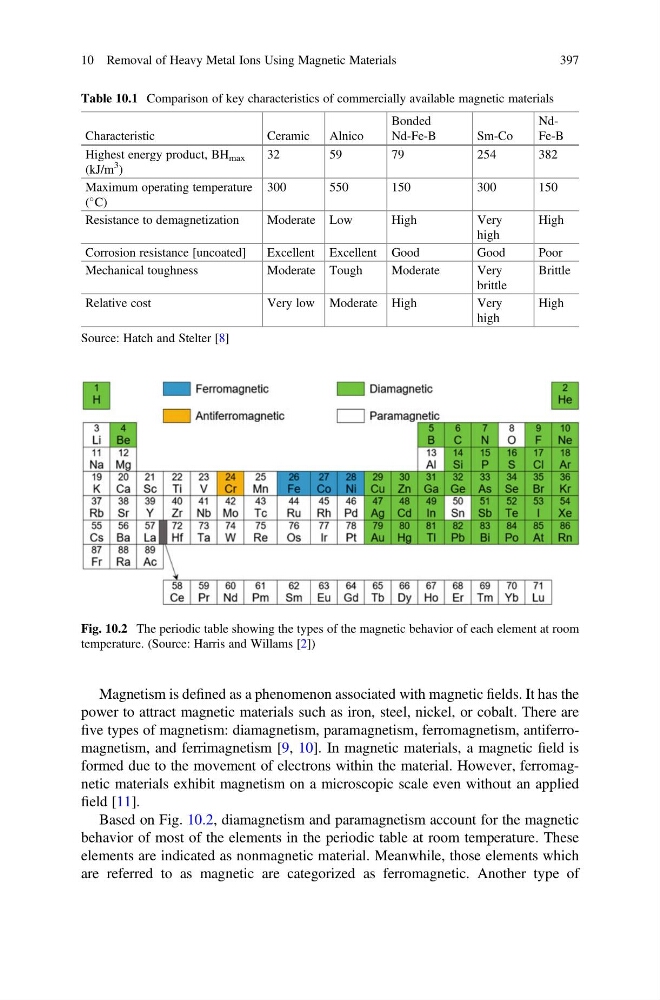
Based on Fig. 10.2, diamagnetism and paramagnetism account for the magnetic
behavior of most of the elements in the periodic table at room temperature. These
elements are indicated as nonmagnetic material. Meanwhile, those elements which
are referred to as magnetic are categorized as ferromagnetic. Another type of
Table 10.1 Comparison of key characteristics of commercially available magnetic materials
Characteristic
Ceramic
Alnico
Bonded
Nd-Fe-B
Sm-Co
NdFe-B
Highest energy product, BH max
(kJ/m
3
)
32
59
79
254
382
Maximum operating temperature
(
C)
300
550
150
300
150
Resistance to demagnetization
Moderate Low
High
Very
high
High
Corrosion resistance [uncoated]
Excellent Excellent Good
Good
Poor
Mechanical toughness
Moderate Tough
Moderate
Very
brittle
Brittle
Relative cost
Very low Moderate High
Very
high
High
Source: Hatch and Stelter [8]
Fig. 10.2 The periodic table showing the types of the magnetic behavior of each element at room
temperature. (Source: Harris and Willams [2])
10 Removal of Heavy Metal Ions Using Magnetic Materials
397
power to attract magnetic materials such as iron, steel, nickel, or cobalt. There are
five types of magnetism: diamagnetism, paramagnetism, ferromagnetism, antiferromagnetism, and ferrimagnetism [9, 10]. In magnetic materials, a magnetic field is
formed due to the movement of electrons within the material. However, ferromagnetic materials exhibit magnetism on a microscopic scale even without an applied
field [11].
Based on Fig. 10.2, diamagnetism and paramagnetism account for the magnetic
behavior of most of the elements in the periodic table at room temperature. These
elements are indicated as nonmagnetic material. Meanwhile, those elements which
are referred to as magnetic are categorized as ferromagnetic. Another type of
Table 10.1 Comparison of key characteristics of commercially available magnetic materials
Characteristic
Ceramic
Alnico
Bonded
Nd-Fe-B
Sm-Co
NdFe-B
Highest energy product, BH max
(kJ/m
3
)
32
59
79
254
382
Maximum operating temperature
(
C)
300
550
150
300
150
Resistance to demagnetization
Moderate Low
High
Very
high
High
Corrosion resistance [uncoated]
Excellent Excellent Good
Good
Poor
Mechanical toughness
Moderate Tough
Moderate
Very
brittle
Brittle
Relative cost
Very low Moderate High
Very
high
High
Source: Hatch and Stelter [8]
Fig. 10.2 The periodic table showing the types of the magnetic behavior of each element at room
temperature. (Source: Harris and Willams [2])
10 Removal of Heavy Metal Ions Using Magnetic Materials
397