

magnetism observed in pure elements is antiferromagnetism. Additionally, magnetic
materials can also be classified as ferromagnetic. This material is not detected in any
pure element but can be found in compounds such as the mixed oxides (ferrites).
The magnetic properties of materials are mostly determined by their structure and
the several magnetic interactions between neighboring atoms. There are only 16 elements that have magnetically ordered ground state, and all but oxygen belongs to the
3d or 4f transition series [12]. The magnetic materials are divided into few categories
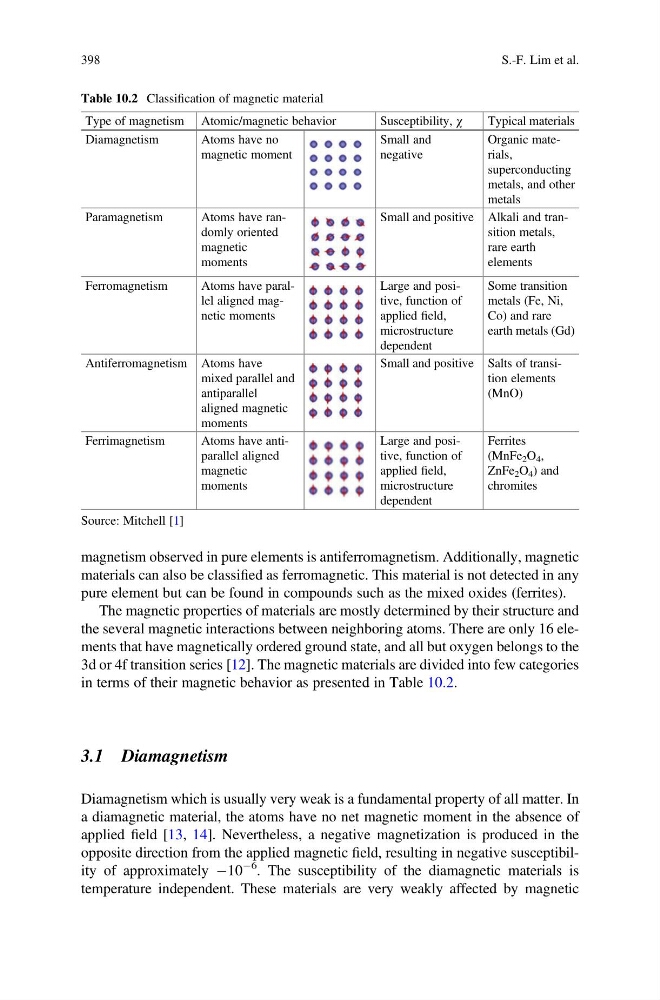
in terms of their magnetic behavior as presented in Table 10.2.
3.1 Diamagnetism
Diamagnetism which is usually very weak is a fundamental property of all matter. In
a diamagnetic material, the atoms have no net magnetic moment in the absence of
applied field [13, 14]. Nevertheless, a negative magnetization is produced in the
opposite direction from the applied magnetic field, resulting in negative susceptibility of approximately À10
À6
. The susceptibility of the diamagnetic materials is
temperature independent. These materials are very weakly affected by magnetic
Table 10.2 Classification of magnetic material
Type of magnetism Atomic/magnetic behavior
Susceptibility, χ
Typical materials
Diamagnetism
Atoms have no
magnetic moment
Small and
negative
Organic materials,
superconducting
metals, and other
metals
Paramagnetism
Atoms have randomly oriented
magnetic
moments
Small and positive Alkali and transition metals,
rare earth
elements
Ferromagnetism
Atoms have parallel aligned magnetic moments
Large and positive, function of
applied field,
microstructure
dependent
Some transition
metals (Fe, Ni,
Co) and rare
earth metals (Gd)
Antiferromagnetism Atoms have
mixed parallel and
antiparallel
aligned magnetic
moments
Small and positive Salts of transition elements
(MnO)
Ferrimagnetism
Atoms have antiparallel aligned
magnetic
moments
Large and positive, function of
applied field,
microstructure
dependent
Ferrites
(MnFe 2 O 4 ,
ZnFe 2 O 4 ) and
chromites
Source: Mitchell [1]
398
S.-F. Lim et al.
materials can also be classified as ferromagnetic. This material is not detected in any
pure element but can be found in compounds such as the mixed oxides (ferrites).
The magnetic properties of materials are mostly determined by their structure and
the several magnetic interactions between neighboring atoms. There are only 16 elements that have magnetically ordered ground state, and all but oxygen belongs to the
3d or 4f transition series [12]. The magnetic materials are divided into few categories
in terms of their magnetic behavior as presented in Table 10.2.
3.1 Diamagnetism
Diamagnetism which is usually very weak is a fundamental property of all matter. In
a diamagnetic material, the atoms have no net magnetic moment in the absence of
applied field [13, 14]. Nevertheless, a negative magnetization is produced in the
opposite direction from the applied magnetic field, resulting in negative susceptibility of approximately À10
À6
. The susceptibility of the diamagnetic materials is
temperature independent. These materials are very weakly affected by magnetic
Table 10.2 Classification of magnetic material
Type of magnetism Atomic/magnetic behavior
Susceptibility, χ
Typical materials
Diamagnetism
Atoms have no
magnetic moment
Small and
negative
Organic materials,
superconducting
metals, and other
metals
Paramagnetism
Atoms have randomly oriented
magnetic
moments
Small and positive Alkali and transition metals,
rare earth
elements
Ferromagnetism
Atoms have parallel aligned magnetic moments
Large and positive, function of
applied field,
microstructure
dependent
Some transition
metals (Fe, Ni,
Co) and rare
earth metals (Gd)
Antiferromagnetism Atoms have
mixed parallel and
antiparallel
aligned magnetic
moments
Small and positive Salts of transition elements
(MnO)
Ferrimagnetism
Atoms have antiparallel aligned
magnetic
moments
Large and positive, function of
applied field,
microstructure
dependent
Ferrites
(MnFe 2 O 4 ,
ZnFe 2 O 4 ) and
chromites
Source: Mitchell [1]
398
S.-F. Lim et al.