

temperature (T c ). In other words, magnetic materials are classified as being magnetic
or nonmagnetic. A material which is easily magnetized and demagnetized is referred
to as soft magnetic material, whereas hard magnetic material is challenging to be
demagnetized [2, 3]. The hard magnetic materials remain strongly magnetized after
the applied magnetic field is removed and become to be permanent magnets. Iron,
steel, and alloy bars are the most common magnetic materials.
Typically, soft magnetic materials denote permeable magnets or electromagnets.
Electromagnets (artificial magnets) are constituted of soft-iron cores around which
are wound coils of insulated wire [4]. The core becomes magnetized when an electric
current flows through the coil; the core loses most of the magnetism when the current
ceases to flow. The soft magnetic materials have coercive force less than 1000 A/m
and high magnetic permeability. Examples are Si steels, permalloys, Mn-Zn soft
ferrites, amorphous Fe-based, and Co-based.
On the other hand, hard magnetic materials denote permanent magnet. Permanent
magnets as another type of artificial magnets are hardened steel or certain alloys that
have been permanently magnetized. They are distinctive for their excellent magnetic
properties such as remanence and coercive force [5, 6]. Examples of this material
include Co and W steels, alnico bars, ferrite magnets, magnets from the cobalt alloys
with the rare earth group elements, and magnets from the Nd-Fe-B alloys. The
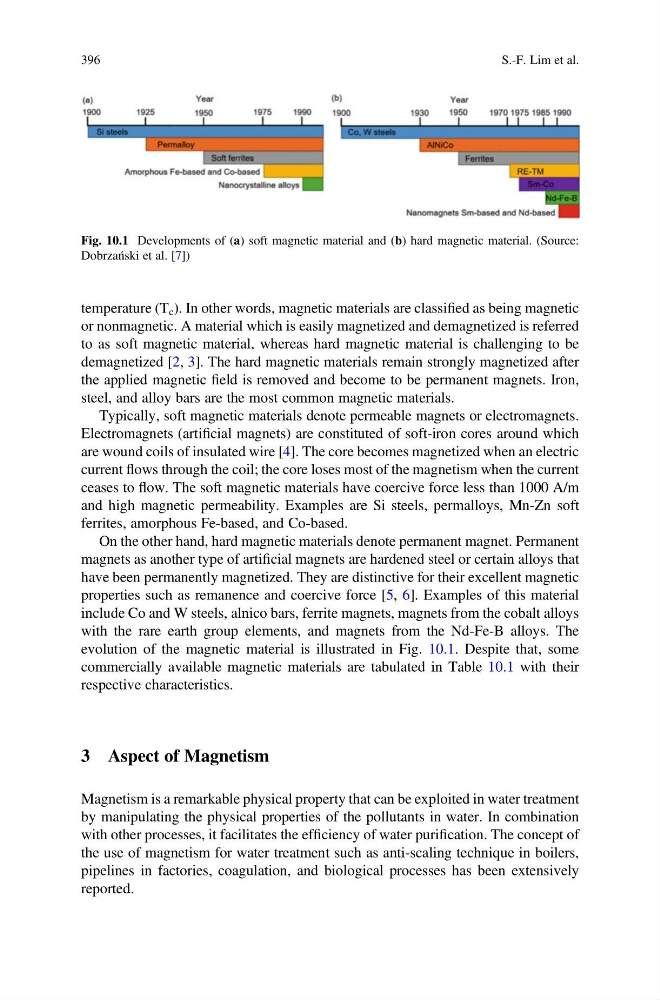
evolution of the magnetic material is illustrated in Fig. 10.1. Despite that, some
commercially available magnetic materials are tabulated in Table 10.1 with their
respective characteristics.
3 Aspect of Magnetism
Magnetism is a remarkable physical property that can be exploited in water treatment
by manipulating the physical properties of the pollutants in water. In combination
with other processes, it facilitates the efficiency of water purification. The concept of
the use of magnetism for water treatment such as anti-scaling technique in boilers,
pipelines in factories, coagulation, and biological processes has been extensively
reported.
Fig. 10.1 Developments of (a) soft magnetic material and (b) hard magnetic material. (Source:
Dobrzański et al. [7])
396
S.-F. Lim et al.
or nonmagnetic. A material which is easily magnetized and demagnetized is referred
to as soft magnetic material, whereas hard magnetic material is challenging to be
demagnetized [2, 3]. The hard magnetic materials remain strongly magnetized after
the applied magnetic field is removed and become to be permanent magnets. Iron,
steel, and alloy bars are the most common magnetic materials.
Typically, soft magnetic materials denote permeable magnets or electromagnets.
Electromagnets (artificial magnets) are constituted of soft-iron cores around which
are wound coils of insulated wire [4]. The core becomes magnetized when an electric
current flows through the coil; the core loses most of the magnetism when the current
ceases to flow. The soft magnetic materials have coercive force less than 1000 A/m
and high magnetic permeability. Examples are Si steels, permalloys, Mn-Zn soft
ferrites, amorphous Fe-based, and Co-based.
On the other hand, hard magnetic materials denote permanent magnet. Permanent
magnets as another type of artificial magnets are hardened steel or certain alloys that
have been permanently magnetized. They are distinctive for their excellent magnetic
properties such as remanence and coercive force [5, 6]. Examples of this material
include Co and W steels, alnico bars, ferrite magnets, magnets from the cobalt alloys
with the rare earth group elements, and magnets from the Nd-Fe-B alloys. The
evolution of the magnetic material is illustrated in Fig. 10.1. Despite that, some
commercially available magnetic materials are tabulated in Table 10.1 with their
respective characteristics.
3 Aspect of Magnetism
Magnetism is a remarkable physical property that can be exploited in water treatment
by manipulating the physical properties of the pollutants in water. In combination
with other processes, it facilitates the efficiency of water purification. The concept of
the use of magnetism for water treatment such as anti-scaling technique in boilers,
pipelines in factories, coagulation, and biological processes has been extensively
reported.
Fig. 10.1 Developments of (a) soft magnetic material and (b) hard magnetic material. (Source:
Dobrzański et al. [7])
396
S.-F. Lim et al.